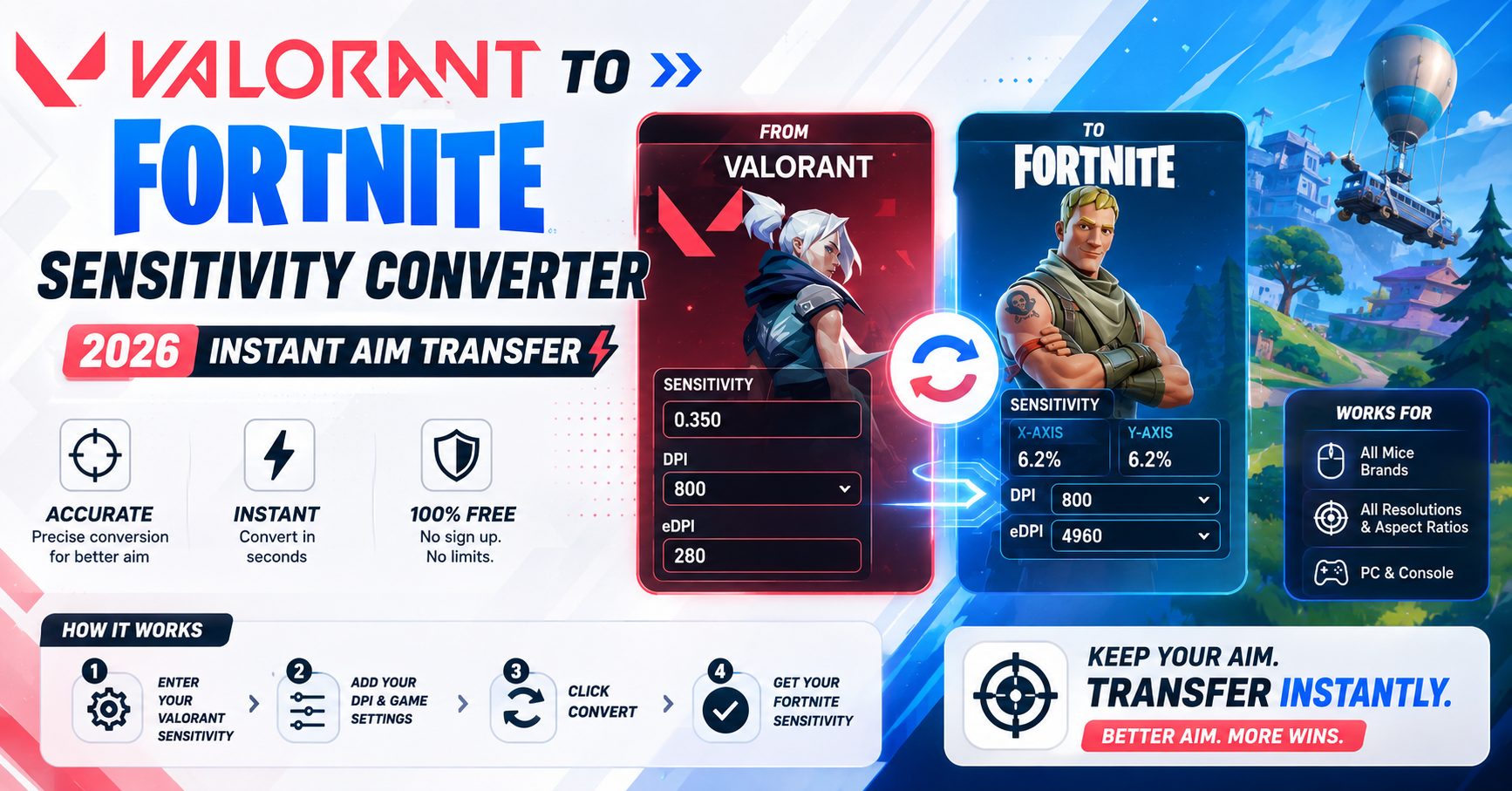
VALORANT to Fortnite Sensitivity Converter (2026): Instant Aim Transfer
Switching between VALORANT and Fortnite shouldn't mean relearning your aim from scratch. Your muscle memory is built around one physical thing: how far your hand has to move your mouse to turn your crosshair a full 360 degrees. Keep that distance consistent, and your aim carries over almost perfectly — even though the two games use completely different sensitivity scales under the hood.
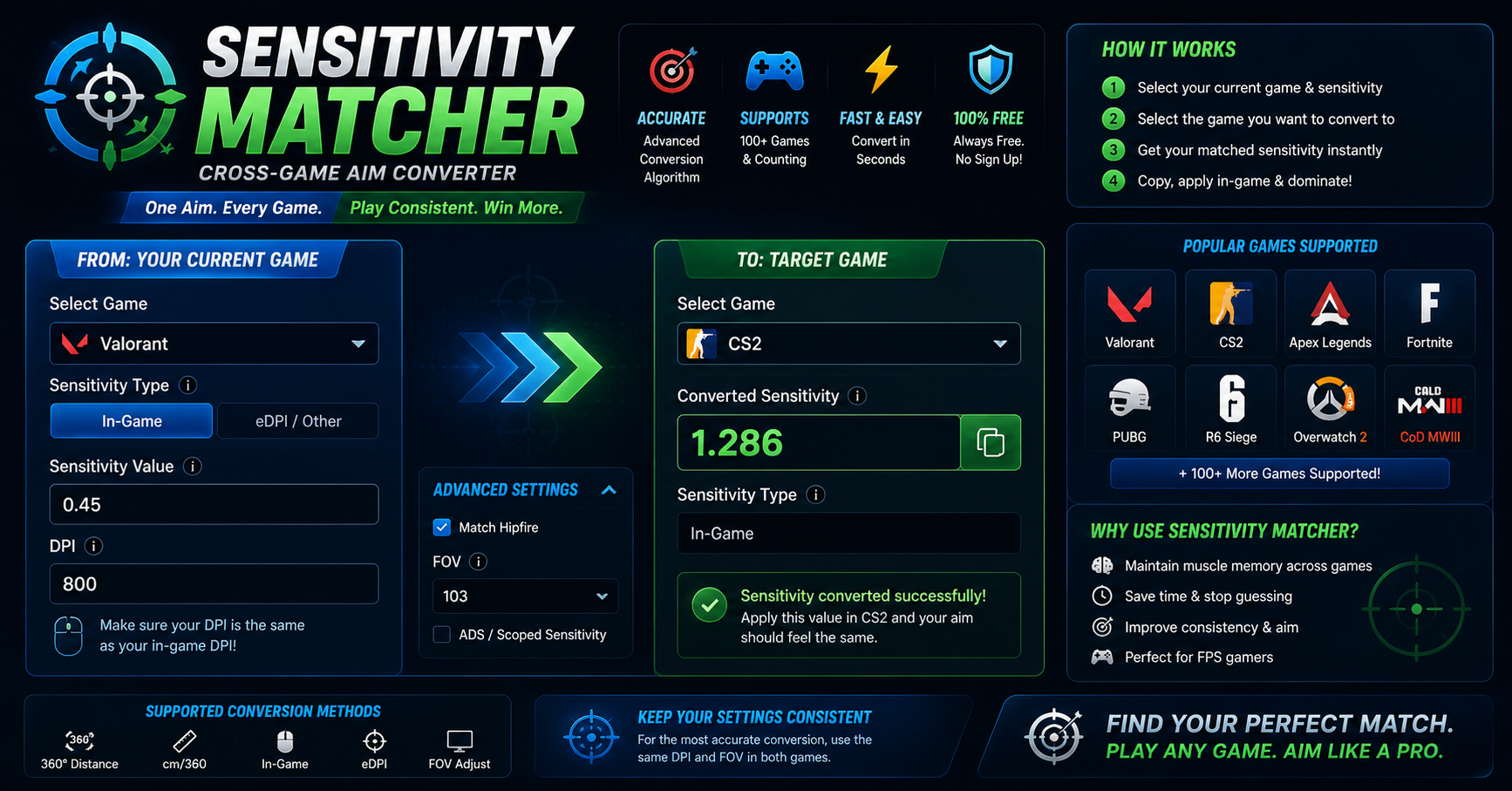
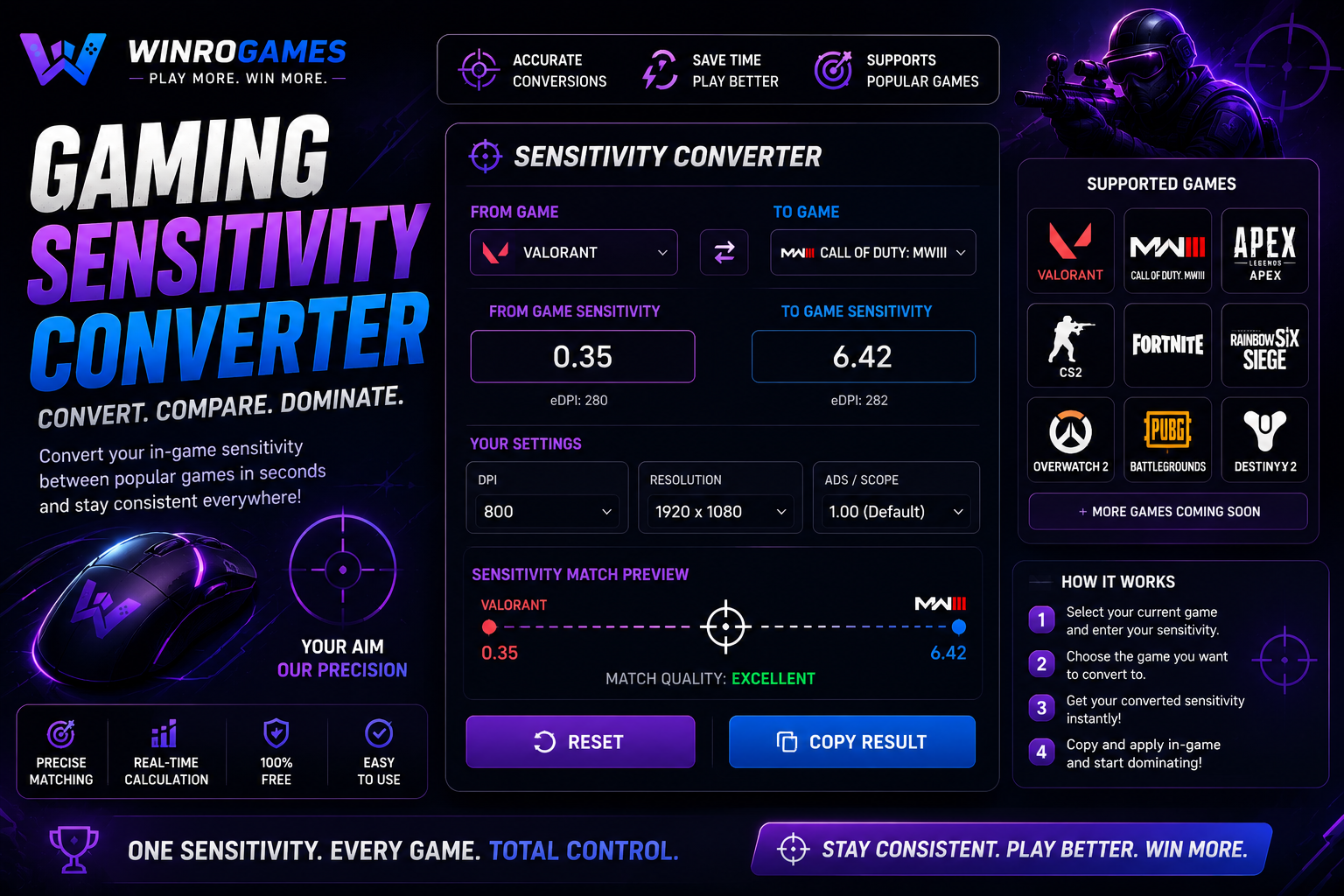
Enter your VALORANT sensitivity and DPI below to get your matching Fortnite sensitivity instantly, along with your cm/360 and eDPI for both games.
How This Converter Actually Works Check Below related tools
Every FPS uses a different sensitivity scale, which is exactly why your VALORANT number and your Fortnite number will never look the same even when your aim feels identical. The trick is ignoring both games' arbitrary scales entirely and focusing on one physical constant instead: how far you have to physically move your mouse to spin your crosshair a full 360 degrees. That distance is called your cm/360, and it's the actual thing your muscle memory has learned — not the number on the slider.
This tool calculates your VALORANT cm/360 using your sensitivity, DPI, and VALORANT's fixed yaw value (0.07 degrees of rotation per mouse count, which never changes regardless of your field of view). Then it works out the Fortnite sensitivity that preserves that exact same physical distance, so your hand doesn't have to relearn anything.
Why the Numbers Look So Different Between Games
VALORANT uses a simple, fixed system
VALORANT's sensitivity scale is refreshingly straightforward — a single multiplier applied to a constant yaw value that never shifts, regardless of your field of view settings. This predictability is part of why VALORANT is often used as the "baseline" game in sensitivity conversion communities.
Fortnite's system is tied to field of view
Fortnite runs on Unreal Engine, where turn rate is influenced by your field of view setting in addition to your sensitivity slider. This is the main reason generic sensitivity conversions between the two games can feel slightly off if you're using a custom FOV instead of the default 80.
DPI is the multiplier sitting underneath both
Your mouse DPI (dots per inch) determines how many "counts" your mouse sends per inch of physical movement. Change your DPI without adjusting your in-game sensitivity to compensate, and your actual turn rate shifts even though your slider value stayed the same — which is exactly why this converter asks for DPI on both sides.
Step-by-Step: Applying Your Converted Sensitivity
1. Confirm your current VALORANT sensitivity and DPI
Open VALORANT's settings menu and note both your in-game sensitivity value and the DPI your mouse software is currently set to. Both numbers matter for an accurate conversion.
2. Enter both values into the calculator above
If you're planning to use the same DPI in Fortnite (recommended, since switching DPI per game adds unnecessary complexity), leave the Fortnite DPI field matching your VALORANT DPI.
3. Open Fortnite's Mouse and Keyboard settings
Navigate to the sensitivity section, which includes separate fields depending on your control scheme — make sure you're editing the general look sensitivity, not a scoped or build-specific multiplier.
4. Enter your converted sensitivity
Type in the Fortnite sensitivity value the calculator gave you and save your settings.
5. Test with slow, deliberate flicks first
Before jumping into a competitive match, spend a few minutes in a practice area doing slow 180 and 360-degree turns to confirm the converted sensitivity actually feels like your VALORANT muscle memory.
A Few Honest Notes on Accuracy
No converter — this one included — can promise a mathematically perfect 1:1 feel between two different games. A few real factors can still cause small differences:
- Custom field of view in Fortnite shifts the actual turn rate slightly compared to the default 80 FOV this calculator assumes.
- Monitor size and viewing distance affect how a given turn rate visually feels, even at the same physical cm/360.
- Raw input and mouse acceleration settings in your operating system or mouse software can introduce small inconsistencies if they're not identical across both games.
None of this means the conversion is inaccurate — it means the physical starting point will be extremely close, and a short warm-up session is still worth doing before you fully trust it in a ranked match.
Tips for Keeping Aim Consistent Across Both Games
Use the same DPI everywhere if you can
Switching DPI per game adds an extra layer of complexity to every future sensitivity change. Picking one DPI and adjusting only in-game sensitivity keeps things simpler long-term.
Re-check your conversion after any sensitivity change
If you tweak your VALORANT sensitivity later, don't forget to re-run the converter — your old Fortnite value will no longer match.
Save your cm/360 number somewhere permanent
Your cm/360 is the real, portable version of your sensitivity. Writing it down means you can always recalculate a matching sensitivity for any future game, not just Fortnite.
Don't chase pro players' exact numbers
A converted sensitivity should match your own existing aim, not someone else's. Converting to match a pro's Fortnite sensitivity instead of your own VALORANT baseline defeats the entire purpose of preserving your muscle memory.
Frequently Asked Questions
Will my aim feel exactly the same in Fortnite after converting?
It will feel extremely close, since the calculator preserves your exact physical cm/360 distance. Small differences can still come from Fortnite's FOV setting or monitor differences, so a short warm-up is still worth it.
Do I need to use the same DPI in both games?
No, but it's simpler if you do. The calculator accounts for different DPI values between VALORANT and Fortnite if you'd rather keep them separate.
Why is my converted Fortnite sensitivity so much higher than my VALORANT number?
This is expected — Fortnite's sensitivity scale is fundamentally different from VALORANT's, so a much higher-looking number can represent the exact same physical turn distance.
Does changing my Fortnite field of view affect this conversion?
Yes. This calculator assumes the default 80 FOV. If you use a custom field of view in Fortnite, your actual turn rate will shift slightly from the converted value.