Why Your Sensitivity Doesn't Carry Over Between Games
Switching between CS2, Valorant, and Fortnite? Your muscle memory doesn't have to reset every time. Each game uses a different sensitivity scale under the hood, which means the same "5.0 sensitivity" feels completely different depending on which game you're in. This guide breaks down exactly why that happens, shows you how to find the numbers you need, and gives you a fast way to convert your settings so your aim feels consistent no matter which game you're playing.
CS2, Valorant, and Fortnite are all built on different game engines, and each one interprets your mouse input differently:
- CS2 runs on the Source engine, which uses a fixed "yaw" value (how many degrees your view turns per unit of mouse movement).
- Valorant runs on Unreal Engine with its own turn-rate constant, tuned differently from Source games.
- Fortnite also runs on Unreal Engine, but Epic uses its own sensitivity scaling separate from Valorant's.
Because each engine calculates "how far you turn per inch of mouse movement" differently, a sensitivity of "0.5" in one game is not the same physical mouse movement as "0.5" in another. If you just copy the number across games, your aim will feel off — usually faster or slower than what you're used to.
The Real Fix: Convert by Physical Mouse Movement (cm/360)
The most reliable way to match your feel across games is to convert based on cm/360 — the physical distance your mouse needs to travel across your mousepad to do a full 360-degree turn in-game. This number is the great equalizer, because it's based on real-world hand movement, not each game's internal scale.
The general formula looks like this:
cm/360 = (2.54 × 360) / (DPI × In-Game Sensitivity × Game's Yaw Constant)Each game has its own yaw constant baked in:
- CS2 (Source engine): uses a fixed yaw multiplier of 0.022
- Valorant: uses its own turn-rate multiplier, commonly cited around 0.07
- Fortnite: uses a separate Unreal Engine turn-rate value, which differs again from Valorant's
Because these constants aren't identical, converting sensitivity by hand means solving the formula twice — once to get your cm/360 in your current game, then again to solve for the new sensitivity number in CS2 using the same cm/360 target.
How to Find Your Current DPI and In-Game Sensitivity
Before converting anything, you need your two starting numbers. Here's where to look:
Finding your DPI:
- If you use a gaming mouse, open its companion software (Razer Synapse, Logitech G Hub, SteelSeries GG, etc.) and check the DPI value shown for your active profile.
- If you don't use companion software or aren't sure, most mice default to 800 or 1600 DPI — check your mouse's product page or box to confirm the stock setting.
Finding your in-game sensitivity:
- Valorant: Settings → General → Controls → look for "Sensitivity" under the mouse section.
- Fortnite: Settings → Input tab → look for "Look Sensitivity (X)" — this is the number you'll want, not the ADS multiplier.
- CS2: Settings → Mouse → "Sensitivity" field, or type
sensitivityin the developer console if you have it enabled.
Once you have both numbers from your current game, you're ready to convert.
Convert Your Sensitivity Instantly
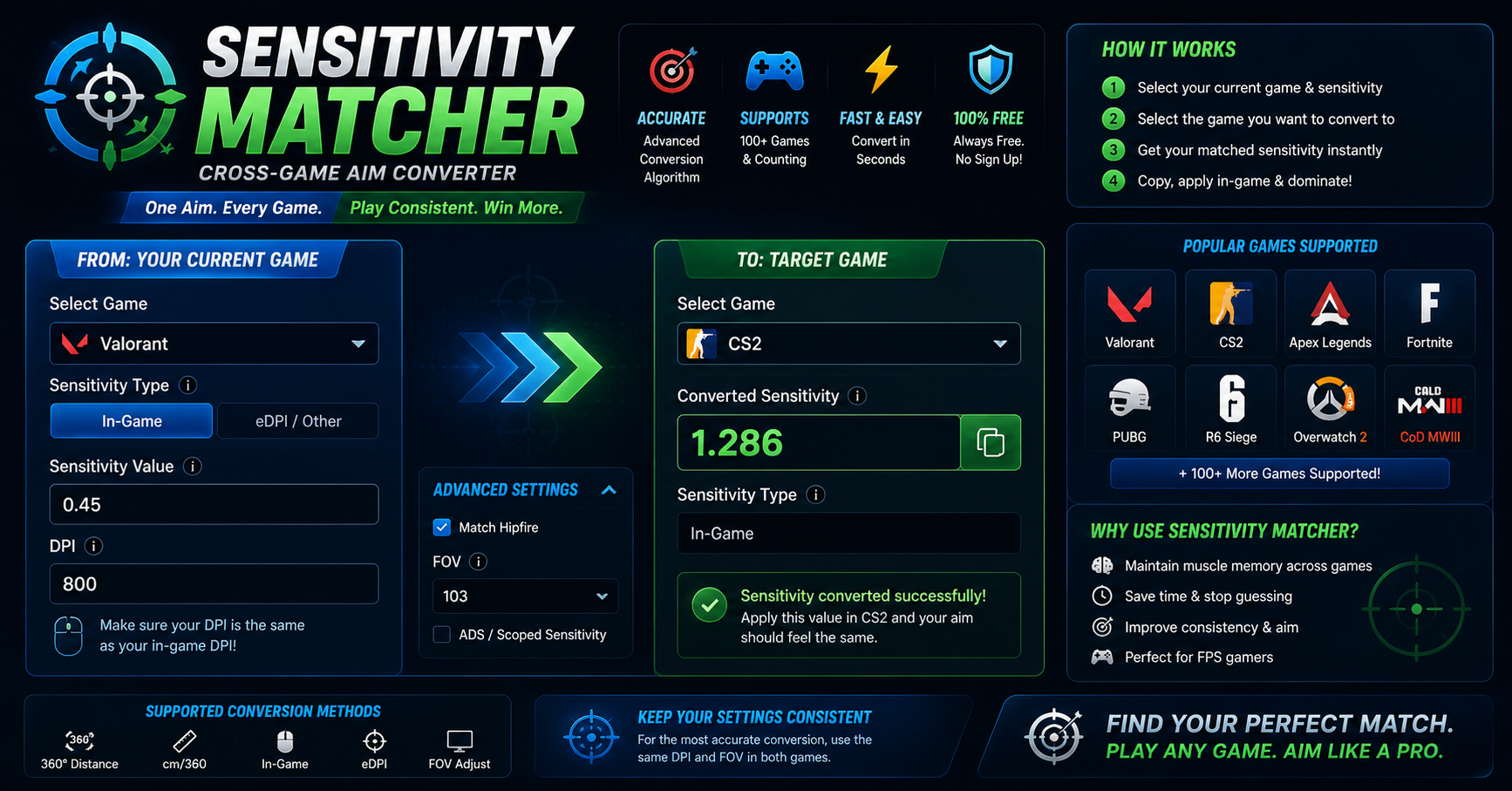
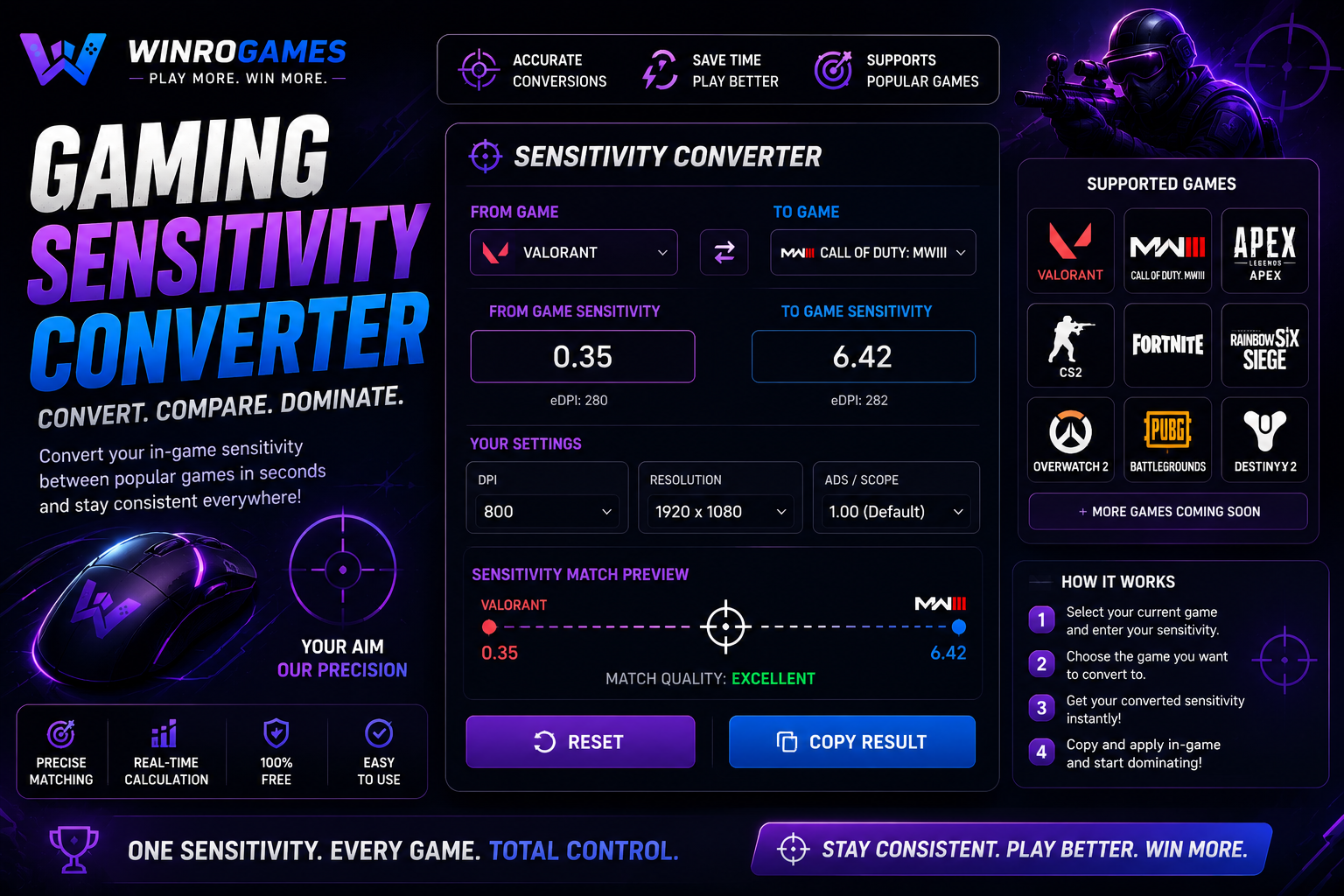
Doing this math manually every time you switch games gets old fast — especially if you play competitively and need your aim to feel identical across titles. That's exactly what our converter below is built for:
Just enter your current DPI and in-game sensitivity from Valorant or Fortnite, and it instantly calculates the matching CS2 sensitivity that keeps your cm/360 — and your muscle memory — exactly the same.
Common Sensitivity Conversion Mistakes to Avoid
Even with a converter, a few small mistakes can throw off your results:
- Copying the raw sensitivity number instead of converting it. This is the single biggest mistake — "4.5" in Valorant is not "4.5" in CS2.
- Forgetting your ADS (aim-down-sights) multiplier in Fortnite. Fortnite separates hipfire and scoped sensitivity — make sure you're converting your base "Look Sensitivity," not a scoped multiplier.
- Changing your DPI without re-converting. Your cm/360 depends on both DPI and in-game sensitivity together. If you bump your DPI later for a different reason, your old converted sensitivity is no longer accurate.
- Ignoring mousepad size. A converted sensitivity that requires 40cm of movement won't work well if your mousepad is only 30cm wide — you may need to nudge your DPI up slightly to fit your actual physical space.
- Assuming FOV doesn't matter. While cm/360 conversion accounts for turn rate, a very different field-of-view setting between games can still make target tracking feel different even at a technically "matched" sensitivity.
Recommended CS2 Sensitivity Ranges
Once you've converted your number, here's how to think about where you land:
| Range | cm/360 | Best For |
|---|---|---|
| Low sensitivity | 30+ cm | Precision spray control and one-tap headshots at range |
| Medium sensitivity | 15–30 cm | Balanced — works for both spray control and close-range flicks |
| High sensitivity | Under 15 cm | Fast flick shots and quick 180-degree turns |
There's no single "correct" number — the goal is consistency with what already feels natural to your hand, not copying someone else's exact settings.
Don't Forget Your Crosshair
Sensitivity is only half the equation — your crosshair placement and visibility matter just as much for consistent aim. Once your sensitivity feels right, dial in a CS2 crosshair that's easy to track and doesn't block your target:
Adjust size, color, gap, and thickness, then preview it live before copying the exact console command into your game.
FAQ
What sensitivity do CS2 pros use?
Most professional CS2 players land in a cm/360 range of roughly 25–40 cm, favoring lower sensitivities for precise spray control and one-tap accuracy, though this varies by individual playstyle and mousepad size.
How do I convert my Valorant sensitivity to CS2?
Use a cm/360-based converter (like the one above) rather than copying the raw sensitivity number — since Valorant and CS2 use different turn-rate constants, the same number produces a different physical mouse movement in each game.
Is lower sensitivity better in CS2?
Not universally — lower sensitivity tends to help with spray control and precision at range, but it depends on mousepad space and personal preference. Many players land on a medium range that balances both flicking and tracking.
Does DPI matter if I already convert my sensitivity?
Yes — DPI and in-game sensitivity work together to determine your cm/360. If you change your mouse DPI later, you'll need to reconvert to keep the same feel.
Can I use the same crosshair across CS2 and Valorant?
Not directly — each game has its own crosshair system and code format. Use a dedicated generator for each game to get an accurate, game-specific crosshair.
How long does it take to adjust to a converted sensitivity?
Most players adapt within a few days of consistent practice, since a properly converted cm/360 should already feel close to what you're used to. If it still feels off after a week, double-check your DPI and sensitivity inputs for typos.
Should I use the same sensitivity for casual and competitive play?
Yes — switching sensitivities between casual and ranked play can hurt your muscle memory more than it helps. Stick with one converted setting across all modes for the most consistent aim.
What's a good mousepad size for a low sensitivity setup?
If you're converting to a low sensitivity (30+ cm/360), a large mousepad (roughly 45–50cm wide) gives you enough physical space to complete full turns without lifting your mouse mid-swipe.