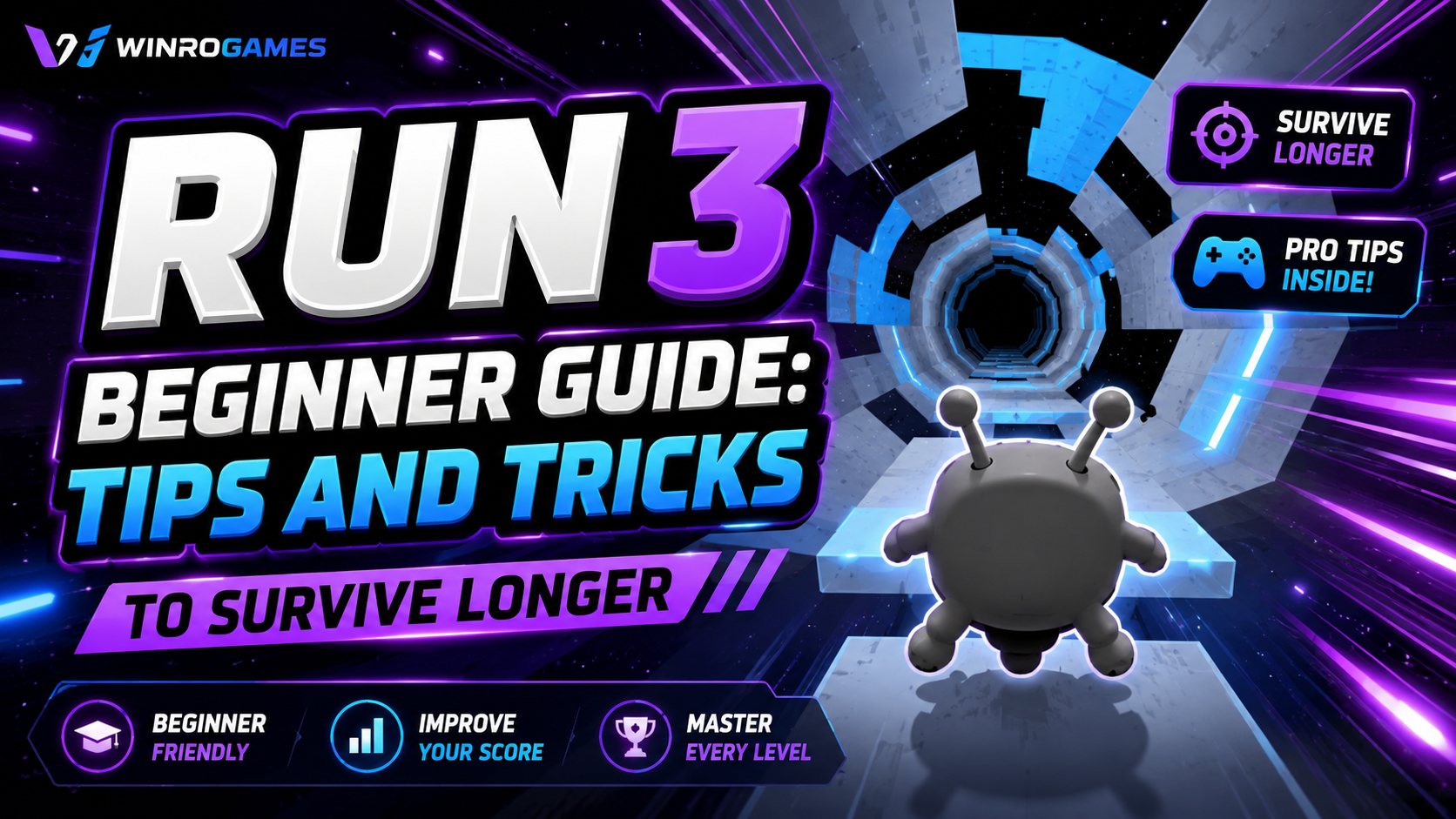
Run 3 is one of the most celebrated and enduring browser-based endless runner games ever created. With its unique rotating gravity mechanics, branching galactic tunnel networks, and fast-paced gameplay, Run 3 offers an experience that is immediately intuitive to pick up but remarkably demanding to master on high-speed levels. Whether you are aiming to complete every stage in Explore Mode or set high-distance records in Infinite Mode, surviving requires understanding how the game's physics, character capabilities, and tunnel mechanics actually work.
Understand the Gravity & Tunnel Physics
In Run 3, you run inside a series of cylindrical and box-shaped tunnels suspended in outer space. The defining mechanic is that touching any wall causes the entire tunnel to rotate 90 degrees, making that wall your new floor. Gravity shifts instantly.
Mastering this means realizing that you are never confined to a single flat plane. If a massive gap appears on the floor ahead, leaping sideways onto a wall keeps your momentum alive without risking a fatal drop into the void. The tunnel does not care which surface you land on, so long as your feet connect with a solid tile before you plunge into deep space.
When you transition to a wall, your vertical velocity resets. This means you can effectively cancel a falling arc by touching a side wall, instantly converting what would have been a fatal descent into horizontal forward running. Practicing this wall-catch maneuver is the single most important skill for conquering the difficult late-game tunnels.
Character Unlock Breakdown: Runner, Skater, and Lizard
While the default Runner handles early tunnels smoothly, unlocking specialized characters in Explore Mode dramatically changes your movement capabilities. Choosing the right character for each tunnel layout is the single most effective strategy for difficult stages:
1. The Runner (Default)
The standard character is balanced with moderate running speed and reliable jump height. The Runner is ideal for learning new tunnels because her jump arc is predictable and allows for fine air-control adjustments. If a level features narrow platforms with frequent 90-degree wall shifts, the Runner's controlled deceleration prevents you from overshooting landings. She remains the best pick for exploratory reconnaissance runs when encountering unknown tunnel hazards.
2. The Skater (Speed & Long-Distance Arcs)
Unlocked relatively early in Explore Mode, the Skater moves at high base speed and maintains massive forward momentum. The trade-off is higher inertia—stopping or turning sharply takes longer. However, the Skater can clear immense gaps that the Runner cannot cross. Use the Skater on straight tunnels with expansive tile voids, but switch away from him in winding box tunnels with dense obstacle pillars. When piloting the Skater, commit to jump trajectories early, as micro-adjustments in mid-air are far less responsive than with the Runner.
3. The Lizard (Explosive Jump Power)
The Lizard sleeps between levels and possesses an enormous vertical jump height, allowing you to vault over entire hazard sequences in a single leap. The downside is sluggish horizontal acceleration and heavy gravity on descent. The Lizard shines on vertical-heavy tunnels, broken tile clusters, and high-altitude alternate paths where standard jumps fall short. Use the Lizard on stages where platforms are elevated far above the main floor, allowing you to skip complex platforming sequences entirely.
4. Other Key Characters: The Student & The Pastafarian
As you progress through the galaxy map, you will encounter the Student, who flips gravity entirely to run upside-down, and the Pastafarian, who bridges gaps with light bridges. Each character fundamentally alters the level design, turning previously impossible chasms into simple crossings.
Level & Tunnel Navigation Strategies
Navigating deeper tunnels requires planning your landing zone before your feet leave the current platform:
1. Look Two Tiles Ahead
Do not watch your character's feet. Fix your eyes roughly one-third of the screen ahead to identify crumbling tiles and missing panels before you reach jumping distance. By keeping your gaze fixed forward, your peripheral vision manages your character's immediate position while your active focus maps out the next three jumps.
2. Pre-Rotate on Approaching Walls
Rather than jumping at the absolute edge of a pit, steer into the adjacent wall early. Wall transitions reset your falling speed and provide a fresh horizontal surface to continue running. Rotating before entering a broken tunnel section allows you to run along solid ceiling or wall tiles, bypassing the broken floor entirely.
3. Feathering Short vs. Long Jumps
Tapping the jump key executes a low hop that lands quickly, allowing you to react to immediate obstacles. Holding the jump key yields maximum hang time for crossing major chasms. Mastering the distinction between a quick tap and a sustained hold prevents you from overshooting narrow safe tiles.
4. Identify Crumbling Dark Gray Tiles
Dark gray tiles detach approximately half a second after contact. If you must step on them, never hesitate—treat them as single-step springboards and jump immediately upon touchdown. Lingering for even a fraction of a second guarantees a plunge into the void.
5. Handle Tunnel Junctions and Ramps
Certain tunnels split into upper and lower pathways. Upper pathways typically feature narrower platforms but fewer obstacles, making them ideal for high-speed characters like the Skater. Lower pathways offer wider platforms but denser hazard clusters, which are better suited for the precise control of the Runner.
Explore Mode vs. Infinite Mode Progression
Always conquer Explore (Adventure) Mode first before grinding Infinite Mode. Explore Mode features hand-crafted tunnels that systematically introduce each obstacle type, character unlock paths, and alternate route tunnels on the galaxy map.
In Explore Mode, you can retry individual stages without losing overall progress, allowing you to build muscle memory on difficult sections. Once you have unlocked key characters like the Skater, Student, and Lizard, switch to Infinite Mode where your character variety allows you to adapt to random tunnel generations and compete for high scores on global leaderboards.
Benefits of Playing Run 3
Beyond entertainment, Run 3 sharpens hand-eye coordination, spatial awareness, and predictive timing. Because gravity shifts require mental 3D spatial rotation, playing regularly improves your ability to visualize geometry under time pressure.
Frequently Asked Questions
How do you unlock new characters in Run 3?
Characters are unlocked by progressing through specific branches on the Explore Mode galaxy map or by spending Power Cells collected during runs in the in-game shop.
Can you play Run 3 without Flash?
Yes. The modern version of Run 3 runs entirely on HTML5 and WebGL, allowing instant, smooth play on any modern browser without third-party plugins.
What is the best character for beginners in Run 3?
The standard Runner is the most reliable for beginners due to her balanced speed, predictable jump height, and responsive air steering.
How do you skip difficult levels in Run 3?
In Explore Mode, you can navigate alternate tunnel branches on the galaxy map to bypass bottleneck stages while still progressing toward character unlocks.