The Real Problem With Playing Games With Friends Online
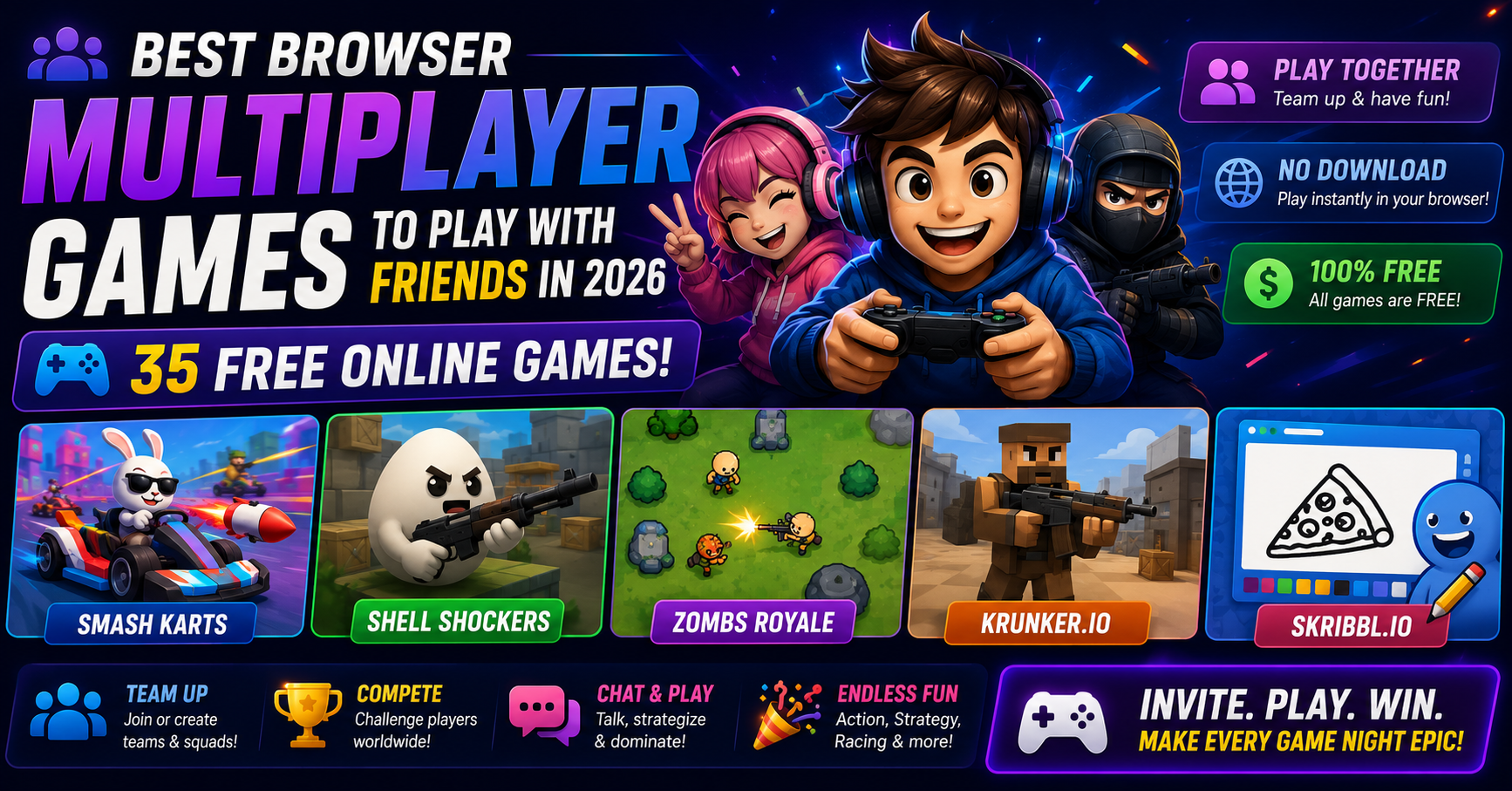
Getting everyone into the same game has always been harder than it should be. Platform exclusives, 60GB downloads, different subscription tiers, and version mismatches turn "let's play something together" into a 45-minute logistics exercise. Browser multiplayer games eliminate almost all of that friction. You send a link, everyone clicks it, and the game starts. No installs, no accounts, no waiting.
The games below are the best at achieving this. They're genuinely fun, they work across Windows, Mac, and mobile, and they can accommodate groups from 2 to 30 players depending on the game type.
Party & Social Games: Best for Groups
Skribbl.io
One player draws a word while the rest race to type it correctly. Rounds are fast, custom word lists are easy to create, and the chaotic quality of browser drawings makes it consistently entertaining regardless of artistic skill. Private room links make it ideal for friend groups — no public matchmaking required.
Gartic Phone
A combination of telephone game and Pictionary. One player writes a phrase, the next draws it, the next describes the drawing in words, and so on. The final reveal of how the original phrase mutated through the chain is the actual game. It's one of the best browser party games for groups of 4 to 16, and requires zero gaming experience to enjoy.
Kahoot!
Quiz game platform where one player hosts and everyone else answers multiple-choice questions on their own device. Custom quiz creation is free. While primarily used for education, friend groups routinely create gaming trivia, pop culture, and "guess who" style custom games. The competitive leaderboard format keeps everyone engaged.
Scattergories Online
The classic word game in browser form. Players must name items in a category (e.g., animals, movies, foods) that begin with a randomly rolled letter — faster answers score higher when multiple players match. The creative argument phase after each round — debating whether "Batman" counts as a "superhero" starting with B — is where the real fun happens.
Spyfall
A deduction game where all players know the secret location except one — the spy. Players ask each other questions to identify the spy, while the spy asks questions to figure out the location without being caught. Social deduction, bluffing, and the paranoia of not knowing who knows what make it compelling even through multiple sessions.
Competitive Multiplayer Games
Krunker.io
A fully featured browser FPS with class selection, custom maps, and private lobby creation. The movement system — surfing, bunny hopping, slide mechanics — has a dedicated competitive scene and enough mechanical depth to keep skilled players engaged for extended sessions. Private lobbies make friend vs friend matches straightforward.
Slither.io
The multiplayer Snake game that still holds up years after launch. Trapping opponents into self-collisions requires reading movement patterns, positioning, and timing — there's real skill behind the simple presentation. Custom servers and private rooms are available through third-party hosting.
Agar.io
Control cells that grow by consuming smaller ones. Mass ejection and cell splitting add depth — experienced players coordinate cell merges to engulf opponents, while opponents dodge by splitting in the opposite direction. Team mode makes it genuinely cooperative with friends sharing a mass pool.
Bonk.io
A physics-based multiplayer game where the last player standing on a platform wins. Simple controls, destructible environments, and a massive user-created map library. The chaos of player-vs-player collisions on creative maps makes it one of the most consistently entertaining 4-player browser games available.
Diep.io
Control a tank and shoot geometric shapes and other players to earn experience and upgrade your build. Multiple classes, a progression system within each session, and active team modes make it significantly deeper than its browser-game tag suggests. The skill gap between new and experienced players is large enough to make improvement feel rewarding.
Co-op Browser Games
Codenames Online
The official browser version of the popular board game. Two teams compete to identify their agents from a grid of words using one-word clues given by their spymasters. The communication constraint — giving clues that connect multiple words without touching the opposing team's words or the assassin — creates the exact right amount of tension. Supports 4 to 8 players well.
Wavelength
One player gives a clue on a spectrum between two opposite concepts (e.g., Hot — Cold, Cheap — Expensive) and their team tries to guess where on the spectrum the correct answer falls. It's a game about how similarly you and your friends think, and the debates about why "fire" lands at 70% on the Hot scale are more fun than the score.
Drawasaurus
Similar to Skribbl but with an emphasis on in-round interaction — players can react to drawings while the round is in progress. The drawing tools are slightly more expressive and the word difficulty system is well calibrated. Good alternative when your friend group has burned through Skribbl's default word list.
Real-Time Action Games for 2+ Players
Shellshock.io
Artillery strategy game where players take turns lobbing shells at each other across terrain, adjusting angle and power. The browser version has real-time team modes alongside the classic turn-based format. Atmospheric damage and terrain destruction add a visual satisfaction that keeps each shot interesting.
Tank Trouble
Old-school tank combat on maze-like maps. Bullets ricochet off walls, which means fights involve predicting bounce trajectories as much as direct aim. The three-player mode creates chaotic three-way standoffs that are difficult to win fairly — and extremely entertaining to watch unfold.
Tips for Running a Browser Multiplayer Session With Friends
- Use Discord or a voice chat while playing. Most of these games benefit enormously from live voice communication — reaction time, trash talking, and coordination all improve the experience significantly.
- Private rooms over public matchmaking. Almost every game listed has a private room or custom lobby option. Use it — public lobbies introduce strangers who may disconnect or disrupt the session.
- Rotate games every 30 minutes. Variety keeps energy high in longer sessions. Start with a high-energy competitive game, transition to something social like Gartic Phone, then finish with something cooperative.
- Test the game before the session. Load the game yourself first, verify it works on your browser, and share a direct room link rather than a homepage URL to reduce friction for other players joining.
Frequently Asked Questions
What is the best browser multiplayer game for large groups?
Gartic Phone and Kahoot support the largest groups most smoothly. Gartic Phone handles up to 30 players in a single game, while Kahoot has effectively no player cap for the quiz format.
Do browser multiplayer games require an account?
Most of the games listed allow guest play with no account required. Some games like Codenames and Kahoot work on a host-and-join system where only the host needs a free account, and joining players click a room code link without registering.
What browser multiplayer games work on mobile?
Skribbl.io, Gartic Phone, Codenames, Kahoot, and Wavelength all work well on mobile browsers. Krunker and Bonk.io are designed for keyboard and mouse and don't translate well to touchscreen controls.
How many players can join a browser multiplayer game?
This varies significantly by game. Party games like Gartic Phone support 4 to 30 players. Competitive games like Krunker run 10-20 player lobbies. Social deduction games like Spyfall work best with 5 to 10 players. The game listings above note their ideal player counts.