Let me describe a scene that's probably played out on your screen at least a dozen times. The ball is bouncing somewhere near mid-court. Your player is flailing their arms like a inflatable tube man outside a car dealership. The opponent takes a shot from what appears to be the wrong side of the court. The ball arcs through the air in a trajectory that defies physics, bounces off three invisible walls, hits the rim seven times, and somehow drops through the hoop. The score is now 8-2. You haven't scored a single basket. You're not even sure if you're controlling the right character anymore.
Welcome to Basket Random. The game that looks like a simple two-button basketball arcade game but plays like basketball designed by someone who's never seen basketball and learned about it exclusively through fever dreams. It's chaotic. It's unfair. It's absolutely hilarious. And despite the randomness baked into its name, there are real Basket Random tips and tricks that separate players who win consistently from players who blame the physics engine for every loss.
I've played hundreds of Basket Random matches — against AI, against friends on the same keyboard, against strangers online. I've raged at impossible shots. I've landed impossible shots. I've learned that "random" doesn't mean "strategy doesn't matter." It means strategy matters differently than in normal basketball games. The physics are unpredictable, but the patterns within that unpredictability are learnable. The court changes every match, but the principles for adapting to new courts are consistent. The power-ups seem chaotic, but their behaviors follow rules you can exploit.
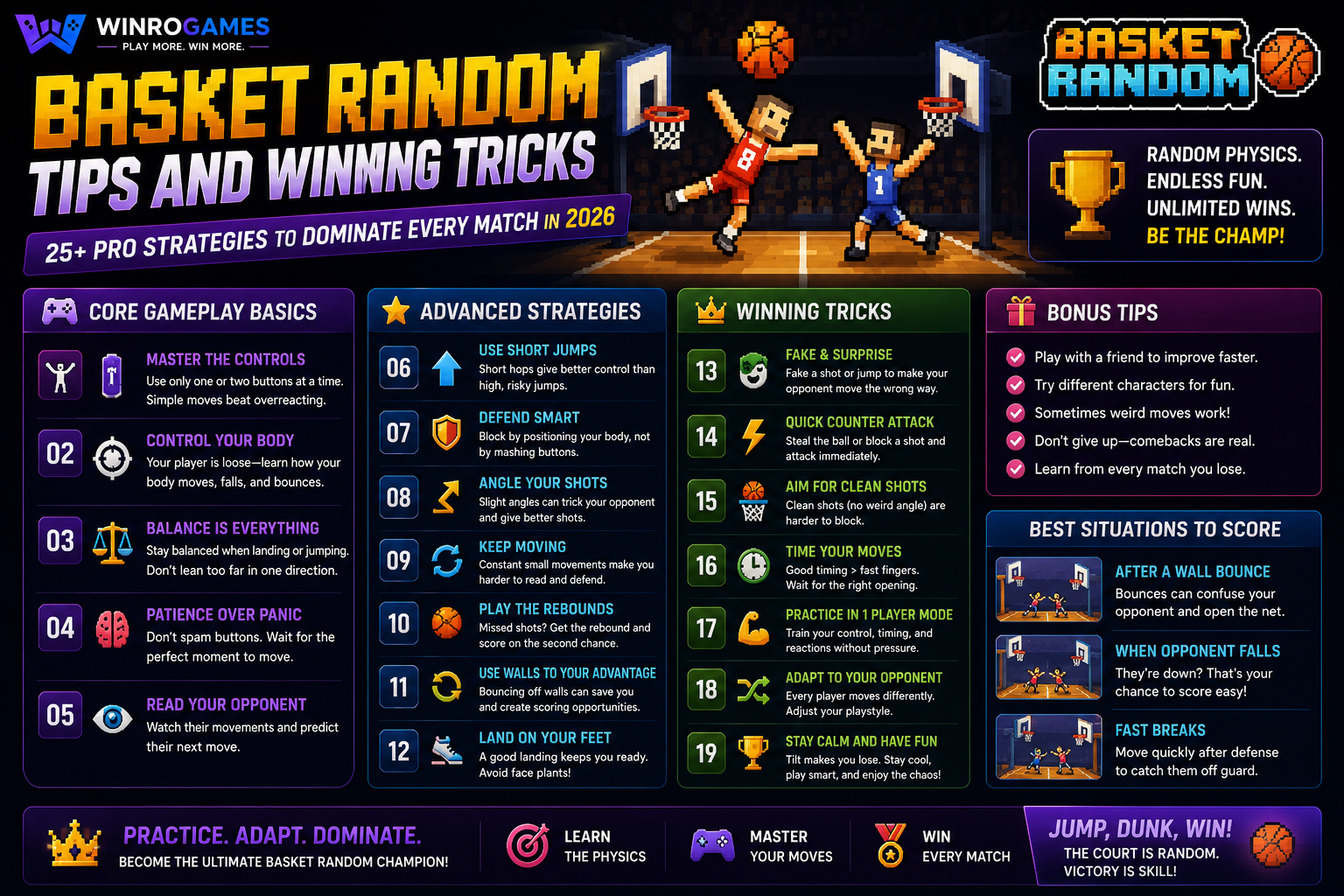
This guide covers everything: how Basket Random controls actually work, shooting techniques that improve your accuracy, defensive positioning that prevents opponents from scoring, power-up strategies, 2-player tactics, and the mental approach that stops you from tilting when the physics engine decides it's not your day. Let's turn your Basket Random game from "random" to "calculated chaos."
Why Basket Random Feels Impossible (And Why It's Not)
Before diving into specific Basket Random tips, let's address the elephant in the room: the game feels unfair by design. That's the point. The developers at RHM Interactive created Basket Random as a physics-based parody of basketball games. The ragdoll physics, the bizarre court designs, the power-ups that change everything — it's all intended to create chaotic, funny moments rather than a serious basketball simulation.
But here's what separates frustrated players from winning players: understanding that the chaos follows rules. The ragdoll physics engine has consistent behavior patterns. Certain shots work more reliably than others. Defensive positioning matters even when the animations look random. The "random" in Basket Random doesn't mean "every outcome is equally likely." It means "the variables are unpredictable, but skilled play shifts the probabilities in your favor."
Think of it like poker. Individual hands involve luck. Over hundreds of hands, skill determines who wins. Basket Random operates the same way. A single match can be stolen by a lucky bounce. Over twenty matches, the player with better Basket Random strategy will win significantly more often. This guide is about maximizing your skill advantage so that randomness becomes your backup plan, not your only plan.
How Basket Random Controls Actually Work (And Why You're Probably Using Them Wrong)
The most fundamental Basket Random tips start with understanding the controls. The game looks simple — one button to jump, another to shoot or steal — but the nuances of how these controls interact with the physics engine make all the difference.
The Jump Button: More Than Just Going Up
Your jump button does more than lift your character off the ground. Jump height varies based on timing and momentum. A standing jump reaches lower than a moving jump. Jumping while running forward gives you forward momentum in the air. Jumping from a standstill gives you more vertical height but less horizontal movement. The jump button held longer doesn't make you jump higher — it's a fixed-height jump based on when you press it relative to your character's movement state. Master the moving jump for offensive drives to the hoop. Use standing jumps for defensive blocks and rebounds.
The Shoot/Steal Button: Timing Is Everything
The second button serves dual purpose: shooting when you have the ball, stealing when the opponent has it. The timing window for both is wider than most players realize. You don't need frame-perfect presses — the game gives you a generous window. The key is pressing the button when your character is in a position to make meaningful contact with the ball. For shooting, press when your character is at the peak of their jump for the highest release point. For stealing, press when you're close enough to the opponent that your character's arm swing will intersect with the ball. Spamming the button rapidly is less effective than one well-timed press. Quality over quantity.
Movement: The Hidden Third Control
Technically, Basket Random has no dedicated movement buttons — your characters auto-move based on the court and game state. But you influence movement through jump direction and timing. Jumping left moves you left. Jumping right moves you right. Jumping at different points in the auto-movement cycle changes your position on the court. Advanced Basket Random strategy involves anticipating where the auto-movement will take your character and using jumps to adjust positioning before the ball arrives. This is the hardest skill to master because it's never explicitly taught. Watch where your character is drifting. Jump to correct course. Over time, this becomes instinctive.
Core Basket Random Tips: The Fundamentals That Win Matches
These are the foundational Basket Random tricks that apply to every match, every court, every situation. Master these first, and you'll immediately start winning more games regardless of which random elements the game throws at you.
Tip 1: The High-Arc Shot Is Your Best Friend
In real basketball, a high-arcing shot with backspin is fundamentally sound. In Basket Random, it's practically a cheat code. Shots released at the peak of your jump with a high arc are harder for defenders to block and have a better chance of dropping through the hoop even when the physics get weird. Low, line-drive shots are easier to block and more likely to bounce off the rim at unpredictable angles. To execute a high-arc shot: jump first, then press shoot at the peak of your jump. The slight delay between jump and shoot creates a higher release point and a more vertical ball trajectory.
Tip 2: Defense Wins Random Matches
Most new players focus entirely on scoring. Experienced players know that defense is more reliable than offense in Basket Random. The physics engine makes scoring unpredictable, but defensive positioning is entirely under your control. Stay between your opponent and the basket. Time your jumps to contest shots without fouling (yes, the game has loose foul mechanics). When the opponent has the ball, prioritize getting back on defense over chasing steals. A player who plays solid defense will beat a player who only focuses on scoring, because defense is consistent while offense is variable.
Tip 3: Master the Rebound Game
Rebounds are the most underrated aspect of Basket Random strategy. After a missed shot, the ball bounces in semi-predictable patterns — usually toward the opposite side of the rim from where the shot came. Position yourself on the weak side (opposite the shooter) before the shot reaches the rim. When the ball bounces, you're already in position while your opponent is reacting. Offensive rebounds give you second-chance points. Defensive rebounds prevent the opponent from getting those same second chances. Control the boards, control the game.
Tip 4: Use the Entire Court
Basket Random courts vary wildly — some are normal rectangles, others have platforms, moving elements, or bizarre geometries. The players who win consistently are the ones who adapt to each court's unique layout fastest. At the start of each match, take two seconds to scan the court. Where are the high ground advantages? Where are the dead zones where the ball gets stuck? Are there moving platforms you can use for positioning? Treat each new court as a puzzle. The player who solves the puzzle first wins.
Tip 5: The First Basket Mentality
Scoring first matters more in Basket Random than in most games. The first basket sets the tone. It puts psychological pressure on your opponent. It gives you a lead to protect rather than a deficit to chase. Play aggressive for the opening tip-off. Rush the ball. Take the first available shot. Even a low-percentage attempt is worth it for the early lead, because playing from ahead in Basket Random is significantly easier than playing from behind. When you're ahead, you control the pace. When you're behind, the physics engine's randomness feels twice as cruel.
Advanced Basket Random Tricks for Consistent Victories
Once you've internalized the fundamentals, these advanced Basket Random tricks will push your win rate even higher. These are the techniques that experienced players use against each other in close matches.
The Fake-Out Jump
Jump without shooting. Your opponent commits to a block attempt. You land, then immediately jump and shoot while they're still recovering from their missed block. This fake-out works because Basket Random players are conditioned to react to jumps with jumps of their own. By breaking the pattern — jumping defensively rather than offensively — you create an opening. The timing is tight. Jump, wait for opponent reaction, then jump-shoot. Practice it against AI before using it against human opponents.
The Corner Cheese Shot
On most court layouts, shots taken from the extreme corners have a higher success rate than shots from straight-on. The physics engine seems to favor corner trajectories — possibly because the ball has more surfaces to bounce off before missing entirely. Position yourself in the corner. Aim for the near side of the backboard. The ball often ricochets off the backboard, hits the rim, and drops in. It's not pretty. It's not realistic. It's Basket Random, and the corner cheese shot works far more often than it should.
The Tip-Off Rush Strategy
Every match starts with a tip-off — the ball drops from the center of the court. Most players jump straight up. The better play: jump forward toward where the ball will land. Your character's forward momentum carries you into the ball's landing zone faster than your opponent's vertical jump. Grab the ball. Immediately shoot or drive. This aggressive tip-off strategy wins possession on roughly 70% of opening plays. The small advantage of first possession compounds over the match.
Power-Up Prioritization
Power-ups appear randomly during matches. They can change the ball size, alter physics, freeze opponents, or add points. Not all power-ups are equally valuable. The "ball size increase" power-up makes scoring dramatically easier — prioritize grabbing this one. The "freeze opponent" power-up is game-changing — grab it and immediately attack the basket while they can't move. The "points multiplier" power-up is situational — grab it if you're in scoring position, ignore it if grabbing it would put you out of position. Learning power-up priorities is one of the most impactful Basket Random tricks for winning close matches.
The Desperation Foul Strategy
When you're losing late in the match, Basket Random (like real basketball) rewards strategic fouling. The game's foul system is loose — sometimes contact that looks clean is called a foul, sometimes obvious fouls go uncalled. But when you're trailing, aggressive defensive contact is worth the risk. Jump into the opponent when they have the ball. Spam the steal button even if it risks a foul call. The worst that happens is they get a free possession, which they were going to get anyway. The best that happens is you force a turnover and score in transition. When you're losing, play desperate. When you're winning, play safe. This risk-management principle applies across all Basket Random strategy.
Basket Random 2 Player: How to Dominate Couch Co-Op and Online Duels
The Basket Random 2 player experience is where the game truly shines — and where these tips become most valuable. Playing against a friend on the same keyboard or against online opponents requires different strategies than playing AI.
Keyboard Positioning for Local Play
In Basket Random 2 player local mode, Player 1 typically uses W (jump) and E (shoot/steal), while Player 2 uses I (jump) and O (shoot/steal). If you're on the same keyboard, physical positioning matters. Sit on the left side if you're Player 1 so your hands align naturally with the keys. Sit on the right for Player 2. Better yet, if possible, use separate input devices — one player on keyboard, the other on a connected controller. This prevents the cramped-hands problem that affects late-game performance in long sessions.
Reading Your Human Opponent
Human opponents have patterns. Most players favor one direction for drives. Most players shoot from preferred spots on the court. Most players have a predictable jump rhythm. In the first 30 seconds of a Basket Random 2 player match, focus entirely on observing your opponent. Which way do they drift? When do they jump? Where do they shoot from? Once you've identified their patterns, you can predict their actions and counter them. This is the skill that separates casual 2-player matches from competitive ones.
The Psychological Game
Basket Random with friends is as much mental as mechanical. Celebrate your lucky bounces. Shrug off your opponent's lucky bounces like they don't bother you (even when they absolutely do). Maintain a consistent rhythm. If you get frustrated, your opponent can see it in your play — you start jumping too early, shooting too quickly, abandoning defensive positioning. The player who stays calm wins more Basket Random 2 player matches than the player with better mechanical skills. Tilt is real. Managing it is a winning strategy.
Team Play in 2v2 Modes
Some Basket Random versions include 2v2 modes. In team play, communication and role assignment matter. Designate one player as the primary scorer and one as the primary defender. The scorer focuses on positioning for shots. The defender focuses on preventing opponent scores and feeding the scorer with steals. Overlapping roles lead to both players chasing the ball and leaving the basket undefended. Coordinate verbally. Call out who has the ball. Call out when you're going for a steal so your teammate can fall back. Team play in Basket Random rewards coordination far more than individual skill.
Court-Specific Basket Random Strategy
Different courts demand different approaches. Here's how to adapt your Basket Random strategy to the most common court types.
Standard Court
The normal basketball court with two hoops at regulation height. Standard basketball principles apply most here. Drive to the hoop. Use the backboard. Defend the paint. Standard courts are where fundamental skills shine because the physics are most predictable. If you're struggling on standard courts, focus on the basic Basket Random tips in the fundamentals section above.
Elevated Platforms Court
Hoops placed on raised platforms. The high ground is everything. Control the platform and you control the scoring opportunities. Jump to reach platforms. Use the shoot button from elevated positions for easier baskets. Defensively, prevent the opponent from reaching the platforms by positioning yourself between them and the elevation points. Platform courts reward vertical movement and positioning more than horizontal drives.
Moving Elements Court
Courts with sliding platforms, rotating elements, or moving hoops. These are the most chaotic and the most fun. The key strategy: time your movements to the moving elements' rhythm. Moving platforms have consistent cycles — count the beats between cycles and jump accordingly. Moving hoops are harder to score on but also harder to defend — take more shots from distance since close-range positioning is unreliable. Patience on moving courts beats aggression. Wait for the alignment. Then strike.
Walled and Enclosed Courts
Courts with walls, ceilings, or barriers that the ball bounces off. These courts reward creativity. Bank shots off walls become viable. Ricochet passes around barriers become possible. The physics engine treats wall bounces consistently — learn the angles and you can score from positions that look impossible. Enclosed courts also make defense harder because the ball stays in play longer. Prioritize positioning over chasing on these courts.
How to Win Basket Random Against Different Play Styles
Opponents fall into predictable categories. Here's how to beat each type.
Against Aggressive Scorers
These players rush the ball and shoot at every opportunity. Their weakness: they overcommit on offense and leave themselves vulnerable to counterattacks. Let them shoot. Focus on defensive rebounds. When you get the ball, they're often out of position — take advantage with quick transition shots. Aggressive scorers also tend to foul frequently. Draw contact. Earn free possessions. Their aggression is their undoing if you stay patient.
Against Defensive Specialists
These players sit back, protect the hoop, and wait for you to make mistakes. Their weakness: they're passive on offense. Take long-range shots against them — they're less likely to contest shots from distance. Use the corner cheese strategy. If you score first against a defensive player, they're forced to abandon their defensive posture and chase the game. Score early, force them out of their comfort zone, then exploit their unfamiliarity with offensive play.
Against Power-Up Hunters
These players abandon positioning to chase every power-up that appears. Their weakness: they leave the basket undefended. While they're chasing a power-up in the corner, take an uncontested shot. Power-ups are tempting, but positioning wins matches. Let them have the less impactful power-ups. Contest them only for game-changing ones (ball size, freeze, points multiplier). Their obsession with power-ups is a positioning weakness you can exploit.
Against Random Chaos Players
These players seem to have no strategy at all — they jump constantly, shoot from anywhere, and rely entirely on luck. Their weakness: they're unpredictable, but also inefficient. Play fundamental basketball against them. Solid defense. High-percentage shots. Rebound control. Over a full match, your consistency will beat their chaos. Don't get drawn into their random play style. Don't match their frantic pace. Be the calm center of the storm. The chaos player beats themselves more often than they beat disciplined opponents.
Basket Random Unblocked: Playing at School or Work
A huge portion of Basket Random's player base accesses the game through Basket Random unblocked versions at school or work. If that's you, here's how to optimize your experience.
Finding Reliable Unblocked Versions
Basket Random is widely available on unblocked game sites because it's an HTML5 game that runs cleanly in browsers without plugins. Sites like Unblocked Games 76, Unblocked Games 66, and Tyrone's Unblocked Games typically host working versions. Bookmark 2-3 different sites — school filters sometimes block one domain while leaving others accessible. The game runs on almost any hardware, making it perfect for school Chromebooks or office computers with limited specs.
Keyboard Customization for Restricted Setups
If you're playing Basket Random unblocked on a restricted computer, you might not be able to change default key bindings. The default controls work fine, but if the default keys are uncomfortable, look for versions that allow key remapping in the settings menu. Some unblocked sites host modified versions with quality-of-life improvements. If you're stuck with default controls, practice with them — muscle memory adapts faster than you think.
Quick-Close Reflexes
Let's be practical: if you're playing Basket Random unblocked somewhere you shouldn't be gaming, have an exit strategy. Know where the close-tab keyboard shortcut is (Ctrl+W on most browsers). Keep a legitimate-looking tab open behind the game. Master the Alt+Tab quick-switch. The best Basket Random tip for school players isn't about gameplay — it's about not getting caught. Winning a match isn't worth detention.
Common Mistakes That Lose Basket Random Matches
I've watched countless matches and made every mistake myself. These are the errors that consistently cost players wins. Eliminate them from your game.
- Jumping constantly. Non-stop jumping makes you predictable, exhausts your positioning, and leaves you vulnerable when you actually need to jump for a shot or block. Jump with purpose. Not out of habit.
- Shooting immediately on every possession. Not every possession needs to end in a shot within two seconds. Sometimes the best play is to hold the ball, let your character drift to a better position, and shoot when you have an advantage. Patience is a weapon.
- Ignoring the clock. Basket Random matches have time limits. When you're ahead with 30 seconds left, your strategy should shift to clock management — hold the ball, force the opponent to chase, run out the clock. When you're behind, speed up. Play with urgency. Many players play the same way regardless of score and time. Don't be one of them.
- Chasing the ball on defense. When the opponent has the ball, your instinct is to chase them. This leaves the basket undefended. Instead, position yourself between the ball and your hoop. Force them to shoot over you or drive through you. Ball-chasing defenders give up easy baskets.
- Tilting after bad bounces. The physics engine will screw you sometimes. A shot that was 95% in will somehow bounce out. An opponent's desperation heave from half-court will somehow drop. These moments are Basket Random's charm. Accept them. Move on. Tilting after bad luck leads to sloppy play, which leads to more bad luck, which leads to more tilting. Break the cycle by accepting randomness as part of the game's identity.
- Not adapting to the court. Playing the same way on every court is a losing strategy. Platform courts require different positioning than standard courts. Moving hoop courts require different shot timing than static hoop courts. Take five seconds at the start of each match to assess the court and adjust your approach.
Basket Random Best Team: Character and Court Synergies
While Basket Random doesn't have formal team selection in most versions, certain character appearances and court combinations create advantages. Here's what to look for when choosing your side.
Character Visibility
Some character colors blend into certain court backgrounds. Red characters on red-toned courts are harder to track. Dark characters on dark courts cause the same problem. When possible, choose characters with high contrast against the court background. Bright colors against dark courts. Dark colors against bright courts. This isn't about aesthetics — it's about being able to track your character's position with peripheral vision while focusing on the ball.
Character Size Considerations
Larger characters have slightly bigger hitboxes for blocking and rebounding but are also easier for opponents to target with steals. Smaller characters are harder to defend against but struggle more on rebounds. There's no definitively "best" size — it depends on your playstyle. Aggressive, rebounding-focused players benefit from larger characters. Finesse, shooting-focused players benefit from smaller characters. Experiment with both to find your fit.
Quick Reference: Basket Random Tips Cheat Sheet
Save this section. Reference it before matches. These are the Basket Random tips that win games.
| Category | Key Tip |
|---|---|
| Shooting | High-arc shots at jump peak. Corner shots have higher success rate. |
| Defense | Position between opponent and hoop. Don't chase the ball. |
| Rebounds | Position weak side before shot lands. Control boards, control game. |
| Tip-Off | Jump forward, not straight up. Win first possession 70% of time. |
| Power-Ups | Prioritize ball size and freeze. Ignore low-impact power-ups if out of position. |
| Clock Management | Ahead = slow down. Behind = speed up. Play the score, not just the ball. |
| Court Adaptation | Scan court for 5 seconds at match start. Adjust strategy to layout. |
| 2 Player Local | Observe opponent patterns first 30 seconds. Exploit their habits. |
| Mental Game | Accept bad bounces. Don't tilt. Calm players beat frustrated players. |
| Unblocked Play | Bookmark multiple sites. Master Alt+Tab. Don't get caught gaming. |
How to Practice Basket Random Effectively
Reading Basket Random tips is one thing. Implementing them is another. Here's a practice plan that builds skills systematically.
Week 1: Fundamentals Focus
Play 10 matches against AI each day. Don't worry about winning. Focus exclusively on one skill per day. Day 1: high-arc shooting. Day 2: defensive positioning. Day 3: rebounding. Day 4: tip-off strategy. Day 5: corner shooting. Day 6: power-up prioritization. Day 7: play normally and notice how much better your fundamentals feel.
Week 2: Opponent Adaptation
Play against human opponents (online or friends). Before each match, identify their playstyle within the first 30 seconds. After each match, note what worked and what didn't against their style. Build your mental database of counter-strategies. By the end of the week, you should be able to identify an opponent's style and adjust your strategy within the first minute of play.
Week 3: Court Mastery
Seek out specific court types. Play 5 matches on each court type, focusing on what works uniquely on that court. Develop court-specific strategies. By the end of the week, no court should surprise you. You should have a game plan for every layout the randomizer can throw at you.
Week 4: Competitive Integration
Put it all together. Play competitive matches (ranked if available, or against the best opponents you can find). Apply everything: fundamentals, opponent adaptation, court strategies, mental composure. Track your win rate. Compare it to your pre-practice win rate. The improvement should be dramatic.
Embrace the Chaos, Master the Patterns
Basket Random will never be a game of pure skill. That's not what it's trying to be. The randomness is the point. The chaos is the charm. The impossible bounces and the physics-defying shots are what make victory feel earned and defeat feel survivable. You can laugh at the chaos because you know it's part of the design.
But within that chaos, there are patterns. There are Basket Random tips and tricks that shift the odds in your favor. There are strategies that win more often than they lose. There are techniques that turn you from a player who hopes to win into a player who expects to win. The game says "random" right in the title. But the best players know that random doesn't mean uncontrollable. It means the game is a conversation between skill and luck — and you want skill to be doing most of the talking.
So take these Basket Random tips. Apply them. Practice them. Win with them. And when the physics engine inevitably betrays you with a bounce that defies all known laws of motion, just laugh. That's Basket Random. That's why you're playing it. The chaos is what makes the victories meaningful. The randomness is what keeps you coming back. And now, with these strategies in your pocket, you'll be coming back as a winner more often than not.
Now go find a match. High-arc your shots. Protect your rim. Control the boards. And remember — when in doubt, shoot from the corner.
What's the most ridiculous Basket Random moment you've experienced? Drop your stories in the comments — I love hearing about impossible shots and physics disasters. And if these tips help you finally beat your friend who's been dominating your 2-player matches, come back and let me know. Those revenge victory stories are the best part of writing these guides.