
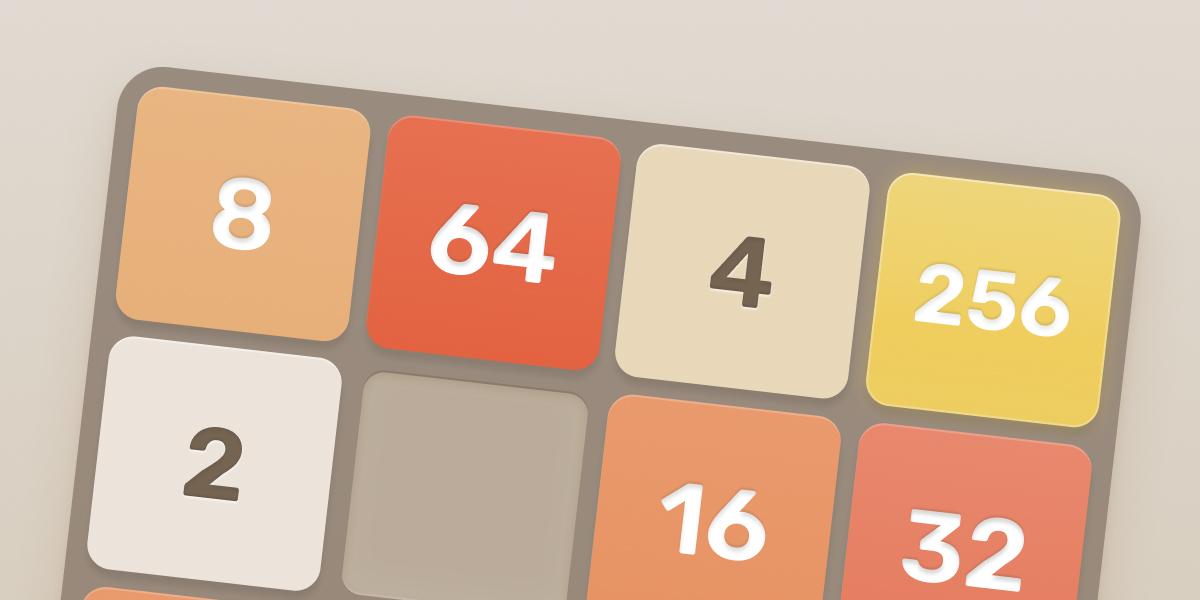
Understanding the Mechanics of 2048
At first glance, 2048 feels like a fast-paced game of chance. You slide tiles across a 4x4 grid, matching identical numbers to combine them into powers of two (2 + 2 = 4, 4 + 4 = 8, and so on). However, playing reactively by swiping in whatever direction looks convenient will quickly fill your board with mismatched tiles, trapping you in a gridlock long before you reach the 2048 tile.
To win consistently, you must understand how tile generation works. Every time you make a move, a new tile spawns randomly in an empty grid space. Crucially, 90% of newly spawned tiles are a 2, while 10% are a 4. Understanding this distribution and controlling where empty spaces remain is the fundamental key to controlling the board.
The Corner-Locking Strategy: The Foundation of Every Win
The single most effective strategy in 2048 is the Corner-Locking Method. Instead of moving tiles across all four cardinal directions, you choose one corner of the board and anchor your largest tile there permanently.
1. Choose Your Corner and Stick to It
Pick one corner at the start of the game — usually the bottom-left or bottom-right — and commit to it. Your goal is to build your highest-value tile in that exact spot and never allow it to move out of position. For example, if you choose the bottom-left corner, your largest tile should rest on the bottom-left space for the duration of the entire game.
2. Restrict Your Swipe Directions to Three Keys
If your anchor is the bottom-left corner, your primary movements should only be DOWN and LEFT, with RIGHT used carefully to merge tiles along rows. You should almost never swipe UP. Swiping up pulls your highest-value tile away from the bottom row, allowing a newly spawned 2 or 4 to lodge underneath it. Once a small tile gets trapped under a large corner tile, clearing it becomes extremely difficult.
3. Build Descending Rows (The Snake Method)
To merge high-value tiles efficiently, structure your numbers along the bottom row in descending value. From left to right along your anchor row, your target layout should look like this:
- Bottom Row: [ 1024 ] → [ 512 ] → [ 256 ] → [ 128 ]
- Second Row: [ 16 ] ← [ 32 ] ← [ 64 ] ← [ 64 ]
This "snake" pattern allows smaller tiles on upper rows to merge progressively rightward and downward, cascading into a single massive merge sequence that builds your corner tile step by step.
Advanced Grid Management and Recovery Moves
Keeping the Anchor Row Full
Before making a horizontal swipe (such as swiping RIGHT), make sure your bottom row is completely full with four tiles. If your bottom row has fewer than four tiles and you swipe RIGHT, your anchor tile in the bottom-left will shift to the right. If a new tile spawns in the newly opened bottom-left space on that turn, your anchor position is compromised. Always keep four tiles packed into your base row before making lateral moves.
Recovering From an Accidental Displacement
If you are forced to swipe UP because no other legal moves exist, do not panic. Your top priority on the very next turn is to force your largest tile back down into the corner:
- Look for an immediate DOWN move to return the anchor tile to the bottom row.
- If a small tile spawned under your corner tile, focus entirely on clearing that column by combining adjacent tiles until the space under your anchor can be merged out.
- Avoid making extraneous lateral moves while your main tile is floating in the middle of the board.
Common Mistakes That Ruin High-Scoring Runs
- Swiping in all four directions: Randomly tapping arrow keys creates a checkerboard of alternating high and low numbers that cannot be merged.
- Chasing small merges across the board: Ignore small 2s and 4s scattered at the top of the grid if merging them forces you to move your main anchor. Focus on feeding tiles into your descending chain.
- Allowing the board to fill above 12 tiles: When 12 or more spaces are occupied, your tactical options shrink dramatically. Maintain at least 4 to 6 empty spaces at all times to give yourself maneuverability.
Frequently Asked Questions
Is every game of 2048 winnable?
Not 100% of games are winnable due to random tile spawns, but using a strict corner-locking strategy allows an experienced player to win over 80% of games. Bad luck with 4-spawns in tight grids can occasionally end a run, but strategy accounts for most outcomes.
Can you keep playing after reaching the 2048 tile?
Yes! Reaching 2048 is simply a milestone. The game continues as long as valid moves remain, allowing you to reach 4096, 8192, and beyond. The exact same corner-locking principles apply no matter how high your score grows.
Which corner is best to use in 2048?
All four corners are functionally identical mathematically. Most players prefer the bottom-left or bottom-right because pressing DOWN and LEFT (or RIGHT) matches natural hand ergonomics on arrow keys or mobile touchscreens.
Using the Undo Feature Correctly
Many 2048 implementations include an undo button. How you use it separates deliberate practice from repeated mistakes.
The most valuable time to undo is immediately after a move that breaks your corner lock — specifically, any move that forces your highest tile away from its anchor corner. Do not hesitate to undo that move and find an alternative route, even if it means surrendering a merge you wanted elsewhere. Protecting the corner anchor is worth more than almost any immediate tile combination.
Avoid using undo to chase a specific merge you were excited about. If the only way to get the merge you want is to use undo repeatedly to engineer the board toward it, you are pattern-chasing rather than playing strategically. The best 2048 players use undo to correct structural mistakes — displaced anchors, accidental board fills — not to optimise individual merges.
In competitive or timed modes without undo, the inability to correct mistakes makes the anchor discipline even more important. Practice without undo occasionally to build cleaner, more decisive decision-making under pressure.