
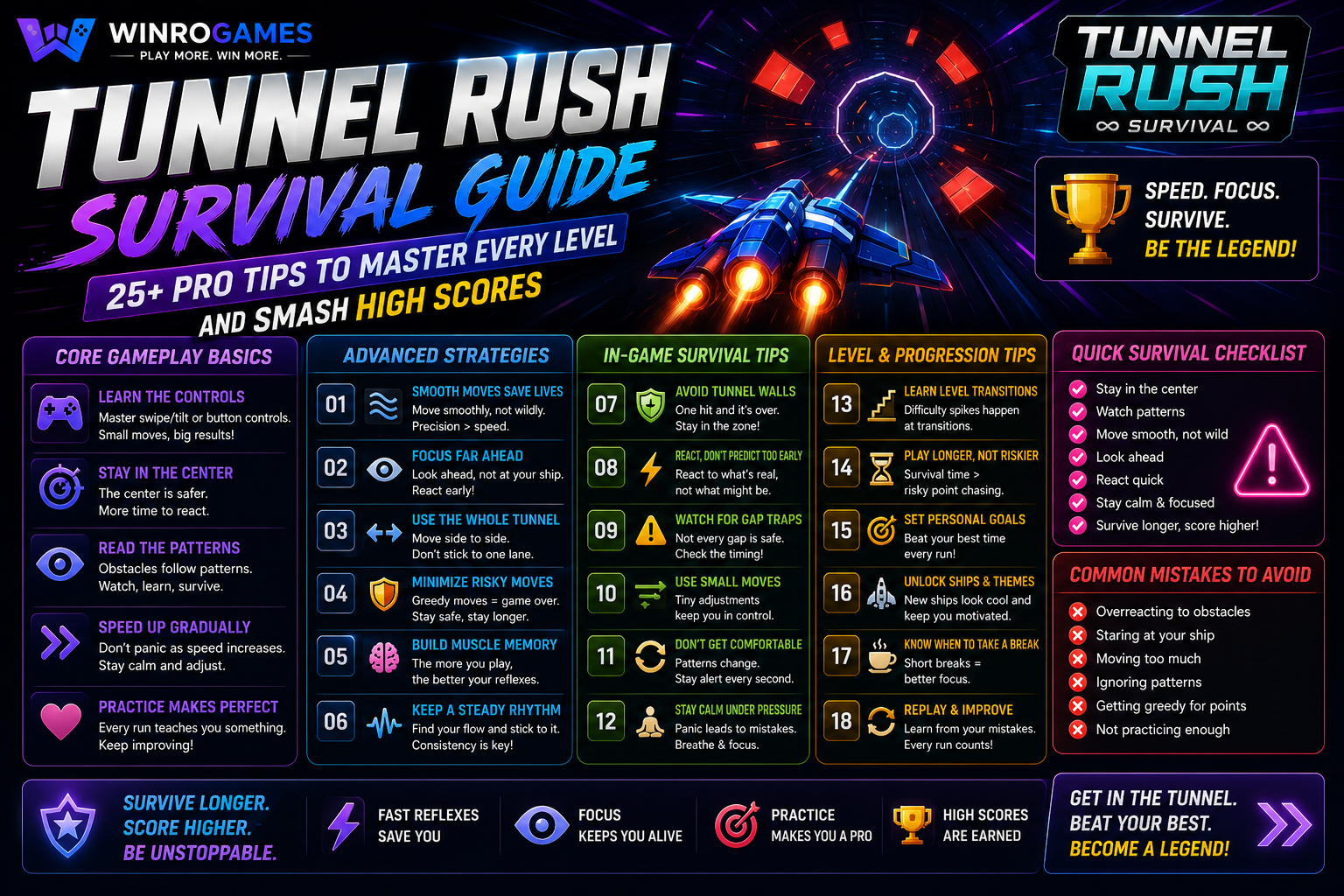
Let me take you inside a moment every Tunnel Rush player knows intimately. You're 45 seconds into a run. The tunnel has shifted from calm blue to aggressive red. The walls are closing in. The obstacles are coming faster than your brain can process them. Your pupils are dilated. Your breathing is shallow. Your finger is hovering over the left arrow key, twitching with every fiber of muscle memory you've built over dozens of failed attempts. You dodge left. Dodge right. Thread through a gap so narrow you're not sure how you survived it. And then — a color shift you didn't see coming. A wall that wasn't there a millisecond ago. Game over. Your high score: 2,847. Your previous best: 2,839. You were eight points away from a new record, and now you're staring at the restart screen wondering if you should give your heart a break or immediately dive back in.
That's Tunnel Rush. It's not just a game. It's a reflex exam disguised as a colorful tunnel. It's a test of how long you can maintain perfect focus before your nervous system taps out. It's the digital equivalent of trying to thread a needle while riding a roller coaster, and millions of players are addicted to its brutal, beautiful simplicity. You move left and right. You dodge obstacles. The speed increases. The colors shift. You die. You restart. You die again. And somehow, you keep coming back.
I've spent countless hours in the tunnel. I've died in ways that felt physically impossible. I've developed strategies, studied patterns, and pushed my scores higher than I ever thought possible. This Tunnel Rush survival guide is everything I've learned — the techniques that work, the mistakes that kill runs, the mental approaches that keep you calm when the speed hits maximum, and the secrets that separate players stuck at 1,500 from players who regularly break 5,000. Whether you're playing Tunnel Rush unblocked during a school break or grinding for a world record on your gaming PC, these Tunnel Rush tips will transform your gameplay. Let's get you deeper into the tunnel than you've ever been before.
What Makes Tunnel Rush So Addictive (And So Brutal)
Before we dive into specific Tunnel Rush strategy, let's understand what we're dealing with. Tunnel Rush is an endless runner set inside a constantly rotating 3D tunnel. You control a small vessel — usually a dot or tiny ship — that moves left and right to avoid obstacles. The tunnel twists, the colors shift, the speed increases, and the obstacles evolve from simple blocks to complex geometric patterns that seem designed specifically to overwhelm your visual processing.
The genius of Tunnel Rush lies in its psychological design. The game uses sensory overload as a mechanic. The color shifts aren't just aesthetic — they're deliberately disorienting. The speed increases aren't gradual warnings — they're sudden spikes that test your ability to adapt instantly. The tunnel rotation adds a spatial reasoning challenge on top of the reflex challenge. Your brain is processing color, speed, rotation, and obstacle patterns simultaneously. Most games ask you to focus on one or two things. Tunnel Rush asks you to focus on everything at once, and the moment your attention fractures, you're dead.
But here's what experienced Tunnel Rush players understand that beginners don't: the sensory overload is predictable. The color shifts follow patterns. The speed increases happen at consistent intervals. The obstacle arrangements repeat in recognizable sequences. What feels like random chaos to a new player is actually a learnable system. This guide will teach you that system. Once you understand the patterns behind the chaos, Tunnel Rush transforms from a frustrating death simulator into a flow-state machine where you can lose yourself for hours.
Tunnel Rush Basics: How to Play Before You Learn to Survive
If you're brand new to Tunnel Rush, this section covers the fundamentals. If you've already played but want to refine your basics, skim through — there might be nuances you've missed.
Controls and Movement
Tunnel Rush uses two controls: left and right. On desktop, that's typically the left and right arrow keys or A and D keys. On mobile, you tilt your device or tap the left and right sides of the screen. The movement is smooth — you're not snapping between positions, you're gliding. This smooth movement is both a blessing and a curse. It allows for precise positioning in tight gaps. It also means you can't instantly change direction. There's a tiny momentum delay that becomes critically important at high speeds. Tap, don't hold. Short, controlled inputs give you more precise positioning than holding the key down. Think of it like steering a car with small adjustments rather than jerking the wheel.
The Tunnel Layout
The tunnel is circular, and you're moving forward through it. Obstacles appear on the walls, floor, and ceiling of the tunnel. Your vessel stays centered vertically — you only control horizontal movement around the tunnel's circumference. This means obstacles can come from any angle. An obstacle on the "ceiling" of the tunnel appears at the top of your screen. An obstacle on the "wall" appears on the sides. The tunnel rotates as you progress, which means the positions of obstacles relative to your screen constantly shift. This rotation is what makes Tunnel Rush disorienting for new players — an obstacle that was on your left two seconds ago is now above you because the tunnel rotated. Adapting to rotation is the first major skill hurdle.
Obstacle Types and Recognition
Tunnel Rush obstacles come in several varieties. Single blocks occupy one section of the tunnel and require a simple dodge. Double blocks leave a gap in the middle that you need to thread through. Rotating barriers sweep across the tunnel and require timing your movement to pass through openings. Color-shifting walls blend into the background and test your ability to spot obstacles against similar colors. Speed-zone gates signal an upcoming speed increase. Learning to identify each obstacle type at a glance — before you're close enough for it to be dangerous — is essential for survival. Your eyes should be scanning the far distance of the tunnel, not the area directly in front of your vessel.
Essential Tunnel Rush Tips: The Core Survival Techniques
These are the foundational Tunnel Rush tips that every player needs to internalize. Master these, and you'll immediately start surviving longer and scoring higher.
Tip 1: Look Far Ahead, Not at Your Ship
This is the single most important Tunnel Rush tip I can give you. New players stare at their vessel. Experienced players stare at the distant tunnel. Your peripheral vision can track your vessel's position. Your focused vision needs to be identifying obstacles while they're still small dots in the distance. By the time an obstacle is close enough to fill your screen, you should have already planned your dodge. The "look ahead" technique feels unnatural for your first few games. Your eyes will want to drift back to your ship. Fight that urge. After 20-30 minutes of deliberate practice, looking ahead becomes automatic, and your survival time will increase dramatically.
Tip 2: Small Movements Save Runs
The most common cause of death in Tunnel Rush isn't failing to dodge — it's over-dodging. You see an obstacle on the left. You jam the right arrow key. Your vessel slams into the right wall because you moved too far. You were trying to avoid one obstacle and created another problem. The solution: use the smallest movement necessary to clear each obstacle. Your vessel's hitbox is smaller than you think. You don't need to move to the opposite side of the tunnel to avoid a block on the left side. A tiny adjustment — barely a tap — is often enough to slip past. Practice minimal movement. Pretend the arrow keys are sensitive and a full press is too much. Light taps. Small adjustments. Less movement means less chance of overcorrecting into danger.
Tip 3: Find Your Center Line
After every dodge, return to the center of the tunnel. The center position gives you equal distance to dodge left or right. It's your neutral stance. Players who stay near the edges after dodging have cut their escape options in half — if the next obstacle appears on their edge, they have nowhere to go. Center yourself after every obstacle. This rhythm — dodge, center, dodge, center — becomes the heartbeat of your Tunnel Rush gameplay. It's the same principle race car drivers use: after every turn, return to the racing line. Your racing line is the center of the tunnel.
Tip 4: Learn the Color Shift Patterns
Tunnel Rush uses color changes to disorient you. The tunnel shifts from blue to red to green to purple and back again. These shifts aren't random. They happen at specific intervals — typically every 20-30 seconds of gameplay. More importantly, certain colors make obstacles harder to see. Red obstacles on a red background blend together. Blue obstacles on a blue background create the same problem. When the tunnel shifts to a new color, consciously adjust your visual scanning. Look for the contrast between obstacles and background, not the color itself. Players who die during color shifts are usually victims of reduced contrast, not increased difficulty. Expect the shift. Prepare for it. Adjust your scanning when it happens.
Tip 5: Master the Speed Zones
Speed increases in Tunnel Rush happen at specific gates — you'll see the tunnel walls shift or a visual marker indicating the speed is about to increase. The jump from normal speed to medium speed is manageable. The jump from medium to fast is where most players die. The key to surviving speed increases: when you see the speed gate approaching, stop making aggressive movements. Get to the center of the tunnel. Take a breath. Enter the speed zone calm and centered. The first five seconds after a speed increase are the most dangerous — you're adjusting to the new rhythm. Play defensively during those five seconds. Small dodges only. Survive the transition, then gradually resume normal play.
Advanced Tunnel Rush Strategy: Techniques for High Scores
Once you're consistently surviving past the first speed increase, these advanced Tunnel Rush strategy techniques will push your scores into the upper tiers. These are the techniques that separate casual players from leaderboard contenders.
The Rhythm Method: Playing to the Beat
Tunnel Rush has an underlying rhythm. Obstacles appear on a beat. Speed increases happen on a beat. Color shifts happen on a beat. When you find the rhythm — the pulse of the tunnel — your movements start to flow rather than jerk. You're not reacting to individual obstacles anymore. You're moving with the tunnel's tempo. This is the flow state Tunnel Rush players chase. To find the rhythm, try playing with the game audio on. The background music and sound effects are synced to obstacle patterns. Let the audio guide your movement timing. After enough practice, you'll feel the rhythm even without sound. Your fingers will move before your conscious brain registers the obstacle. That's the zone. That's where high scores live.
Peripheral Vision Training
Your central vision can only focus on one point. Your peripheral vision covers everything else. In Tunnel Rush, your central vision should be fixed on the far distance of the tunnel — identifying upcoming obstacles and planning routes. Your peripheral vision should track your vessel's current position, the tunnel walls on either side, and any obstacles in your immediate vicinity. This split-vision technique takes practice. Start by consciously noting what your peripheral vision can see. Can you detect movement on the edges of the screen while staring at the center? Can you track your vessel's position without looking directly at it? Spend 5-10 minutes per session deliberately practicing peripheral awareness. It's a trainable skill, and it's the secret weapon of elite Tunnel Rush players.
Obstacle Pattern Memorization
While Tunnel Rush uses procedural generation, the obstacle patterns are drawn from a limited set. Single block left. Single block right. Double block center gap. Alternating left-right sequence. Spiral pattern. Diamond formation. The more you play, the more your brain builds a library of these patterns. When you recognize a pattern in the distance, you don't have to process each individual obstacle — you just execute the pattern response. "Ah, alternating sequence incoming — tap-tap-tap-tap." Recognition is faster than reaction. Build your pattern library by playing consistently and paying attention to recurring obstacle arrangements. After 50-100 games, you'll start seeing patterns repeat. After 500 games, pattern recognition becomes automatic.
The Calm Zone: Breathing Through Chaos
At maximum speed, Tunnel Rush becomes an anxiety simulator. Your heart rate climbs. Your palms sweat. Your breathing gets shallow and rapid. This physiological stress response makes you play worse. Fast, shallow breathing reduces oxygen to your brain, slowing your reaction time. Tense muscles make your movements jerky instead of smooth. The solution is counterintuitive: deliberately slow your breathing. Inhale for four counts. Exhale for four counts. Relax your shoulders. Loosen your grip on the keyboard or phone. This calm-breathing technique feels impossible at first — you're trying to relax while the game is trying to kill you. But after practice, it becomes your anchor. The calmer you stay, the faster your reactions. The faster your reactions, the longer you survive. The longer you survive, the more confident you feel. It's a positive feedback loop that starts with one deliberate breath.
Death Analysis: Study Every Failure
When you die in Tunnel Rush, don't immediately restart. Take five seconds to analyze what happened. Did you over-dodge into a wall? Did a color shift catch you off guard? Did you lose focus for a split second? Did a speed increase overwhelm you? Categorize your deaths. After 20-30 games, patterns emerge. Maybe 60% of your deaths are from over-dodging. Maybe you consistently die within 10 seconds of a color shift. Maybe speed zone transitions kill you more than anything else. Identifying your specific weaknesses lets you target them with deliberate practice. Generic "play more" doesn't help. Specific "you die to red-on-red obstacles after color shifts" does. Fix your specific weaknesses, and your overall game improves.
Tunnel Rush Unblocked: Playing Anywhere, Anytime
A massive portion of Tunnel Rush players access the game through Tunnel Rush unblocked versions at school, work, or other restricted environments. If that's you, here's everything you need to know.
Finding Reliable Unblocked Versions
Tunnel Rush is widely available on unblocked gaming sites because it's an HTML5 game that runs cleanly in browsers without plugins or downloads. Popular unblocked gaming portals like Unblocked Games 76, Unblocked Games 66, Unblocked Games 77, and Tyrone's Unblocked Games typically host working versions. Bookmark 2-3 different sites — network filters sometimes block one domain while leaving others accessible. The game runs smoothly on almost any hardware, including school Chromebooks, office computers, and low-end laptops. If one site gets blocked, you have backups ready.
Optimizing Performance on Low-End Hardware
Tunnel Rush is lightweight, but on very old hardware, you might experience micro-stutters or input lag. Close all other browser tabs before playing — Tunnel Rush needs as much RAM and processing power as your device can spare. Use a lightweight browser like Firefox or Brave instead of Chrome if you're on a particularly weak machine. Lower the game's graphics settings if the version you're playing offers quality options. A consistent 30 FPS with no stutters is better than an unstable 60 FPS with frame drops that kill your run. In Tunnel Rush, consistency beats visual quality every time.
Keyboard vs. Mobile: Which Is Better?
The great Tunnel Rush debate: keyboard or touchscreen? Competitive players generally prefer keyboard — the physical keys provide tactile feedback and faster response times. Arrow keys or A/D keys offer precise, repeatable inputs. Mobile tilt controls can feel more immersive but introduce slight input delays. Mobile tap controls (tapping left/right sides of the screen) are more responsive than tilt but less precise than keyboard. If you're chasing high scores, play on desktop with a keyboard. If you're playing casually during commutes or breaks, mobile works fine. The best platform is the one you have access to. Don't let "I don't have a gaming PC" stop you from enjoying Tunnel Rush unblocked on whatever device you own.
Tunnel Rush 2: What's Different and How to Adapt
Tunnel Rush 2 is the sequel that expands on the original in significant ways. If you've mastered the first game and are looking for a new challenge, or if you're wondering whether to start with the original or the sequel, here's what you need to know.
Key Differences from the Original
Tunnel Rush 2 introduces several new mechanics. Multiple paths — the tunnel sometimes splits, forcing you to choose a route. Moving obstacles — barriers that slide across the tunnel rather than staying fixed. Power-ups — collectible items that grant temporary abilities like slow motion or invincibility. Enhanced visuals — more complex color schemes, particle effects, and tunnel designs. The core gameplay loop remains the same (dodge obstacles, survive, score points), but the added complexity raises the skill ceiling. Players who found the original Tunnel Rush too simple often prefer the sequel's depth.
Adapting Your Strategy for Tunnel Rush 2
The fundamental Tunnel Rush strategy transfers to the sequel, but with adjustments. Tunnel splits require quick decision-making — glance at both paths and choose the one with fewer visible obstacles. Moving obstacles require timing rather than just positioning — wait for the barrier to pass, then move through the gap. Power-ups change the risk-reward calculus — a slow-motion power-up is worth a slight detour, but don't risk death for a minor power-up. The enhanced visuals make color contrast even more important — the busier backgrounds can hide obstacles if you're not actively scanning for them. Play Tunnel Rush 2 like you play the original, but with an extra layer of caution for the new mechanics.
Games Like Tunnel Rush: Expanding Your Reflex Gaming Horizons
Love Tunnel Rush but want to mix up your reflex training? These games like Tunnel Rush offer similar high-speed dodging experiences with their own unique twists.
- Slope. The closest cousin to Tunnel Rush. Guide a rolling ball down a neon slope, dodging obstacles and gaps. Same fast-paced reflex challenge, different perspective (third-person behind the ball instead of first-person through a tunnel). If you're good at Tunnel Rush, your skills will transfer to Slope immediately.
- Run 3. An endless runner set in space tunnels with gravity manipulation. Run on walls and ceilings to avoid gaps. The spatial reasoning challenge is similar to Tunnel Rush's tunnel rotation. Multiple characters with unique abilities add variety.
- Geometry Dash. Rhythm-based platformer that demands the same pattern recognition and precise timing as Tunnel Rush. The soundtrack guides your movements. The difficulty curve is steeper, but Tunnel Rush players adapt quickly.
- Super Hexagon. A minimalist reflex game where you rotate a triangle to avoid closing walls. Even faster and more intense than Tunnel Rush. Games last seconds, not minutes. The ultimate reflex training supplement.
- Wave Road. Similar tunnel-dodging concept with an electronic music theme. Obstacles pulse to the beat. If you enjoy Tunnel Rush's rhythmic elements, Wave Road amplifies them.
Rotating between these games keeps your reflex training fresh and prevents burnout on any single title. Each game stresses slightly different reflex skills — rotation, timing, pattern recognition, rhythm — and cross-training makes you better at all of them.
Tunnel Rush World Record: What the Best Players Achieve
If you're wondering how high the Tunnel Rush ceiling goes, let's talk about the Tunnel Rush world record. The highest verified scores in Tunnel Rush exceed 50,000 points — that's several minutes of perfect play at maximum speed with no mistakes. These players aren't reacting to obstacles. They're operating in a pure flow state where the tunnel's patterns are so deeply internalized that conscious thought is no longer part of the process. Their fingers move. The vessel dodges. The score climbs. It looks supernatural. It's actually the result of thousands of hours of deliberate practice.
What can we learn from world record holders? First: they play on consistent hardware. Keyboard, high-refresh-rate monitor, stable internet connection. Second: they've memorized every obstacle pattern through sheer repetition. Third: they maintain perfect calm during runs — no frustration after deaths, no excitement during good runs, just steady focus. Fourth: they treat Tunnel Rush like a skill to be trained, not just a game to be played. Drills. Practice sessions. Performance analysis. The same approach that works for traditional sports works for Tunnel Rush.
Your goal doesn't need to be a world record. But understanding what peak performance looks like gives you a target to aim toward. Every player who now holds a record once struggled to break 1,000. They climbed the same mountain you're climbing. They just kept climbing longer.
Common Mistakes That Kill Tunnel Rush Runs
I've analyzed thousands of my own deaths and watched countless Tunnel Rush gameplay videos. These are the mistakes that consistently kill promising runs. Eliminate them from your game.
- Staring at your ship. We covered this in the tips, but it bears repeating because it's the number one killer of new players. Your ship should be in your peripheral vision. Your focus should be on the distant tunnel. Every time your eyes drift back to your ship, you're processing obstacles later than you should be.
- Panic-jerking the controls. A fast obstacle appears. You slam the arrow key. Your ship flies to the opposite wall. You hit a different obstacle. You die. The obstacle that triggered your panic wasn't the killer — your overreaction was. Smooth, small, controlled movements. Always.
- Losing focus during "easy" sections. The beginning of Tunnel Rush is slow and sparse. It's easy to let your attention drift. Then the first speed increase hits while you're mentally unprepared. Treat every section of the tunnel with the same focus. The moment you think "this is easy" is the moment before you die.
- Playing tilted. You died at 4,982. Your high score is 5,000. You're furious. You immediately restart. You die at 300 because you're still thinking about the previous death. Playing angry makes you play worse. Take a break between frustrating deaths. Stand up. Walk around. Come back calm.
- Ignoring audio cues. Tunnel Rush has sound design for a reason. The music tempo increases before speed changes. Obstacle appearances have subtle audio cues. The tunnel rotation has an audible rhythm. If you're playing on mute, you're missing information that could save your run.
- Not resting between sessions. Tunnel Rush is mentally exhausting. After 30-45 minutes of intense play, your focus degrades. Reaction times slow. Mistakes increase. Take breaks between sessions. Your best runs often happen in the first 15 minutes of a fresh session when your mind is sharp.
Tunnel Rush Survival Cheat Sheet
Save this quick-reference table. Review it before your high-score attempts. These are the Tunnel Rush tips that win runs.
| Category | Key Survival Tip |
|---|---|
| Vision | Look at the distant tunnel, not your ship. Peripheral vision tracks position. |
| Movement | Smallest possible dodges. Light taps. Return to center after every obstacle. |
| Speed Zones | Center yourself before speed gates. Survive the first 5 seconds defensively. |
| Color Shifts | Expect shifts every 20-30 seconds. Adjust scanning for new contrast levels. |
| Rhythm | Play with audio. Let the music guide your movement timing. Find the flow. |
| Breathing | Slow, deliberate breaths. Relax shoulders. Calm body = fast reactions. |
| Death Analysis | Pause 5 seconds after dying. Identify what killed you. Fix that specific weakness. |
| Mental State | Don't play tilted. Take breaks between sessions. Fresh mind = better runs. |
| Hardware | Close other tabs. Use keyboard if possible. Consistent performance matters. |
| Practice | Deliberate practice on specific weaknesses. Build pattern recognition library. |
Your 30-Day Tunnel Rush Training Plan
Reading Tunnel Rush tips is one thing. Implementing them systematically is another. Here's a 30-day training plan that builds your skills layer by layer. Commit to 15-20 minutes per day, and your scores will transform.
Week 1: Foundation
Days 1-3: Focus exclusively on the "look ahead" technique. Don't worry about your score. Every 30 seconds, consciously check where your eyes are focused. If they've drifted back to your ship, redirect them to the distant tunnel. By day 3, looking ahead should feel natural.
Days 4-5: Add the "center line" technique. After every dodge, return to center. Deliberately practice this rhythm: dodge, center, dodge, center. Your movement should feel like a pendulum, always returning to neutral.
Days 6-7: Combine looking ahead and centering. Play normal games but with heightened awareness of these two fundamentals. Your score should already be improving from week 1 alone.
Week 2: Pattern Recognition
Days 8-10: Play "study sessions" where you're not trying to set high scores. Just observe. Watch the obstacle patterns. Notice which arrangements repeat. Mentally name them ("alternating sequence," "diamond gap," "double block").
Days 11-12: Focus on speed zone transitions. When you see the speed gate, practice your centering routine. Enter every speed zone calm and prepared. Survive the transition. Score doesn't matter — surviving speed zones does.
Days 13-14: Combine pattern recognition with speed management. Normal games. Notice how your improved recognition reduces panic reactions.
Week 3: Advanced Techniques
Days 15-17: Deliberate peripheral vision training. Spend the first 5 minutes of each session consciously noting what your peripheral vision detects. Then play normally, trusting your peripheral awareness.
Days 18-19: Rhythm training. Play with audio on. Move with the beat. Let the music guide your dodges. If audio isn't available, develop an internal rhythm — count beats in your head.
Days 20-21: Full integration. All techniques combined. Play for high scores, but prioritize clean technique over score chasing.
Week 4: Mental Mastery
Days 22-24: Breathing practice. During runs, maintain slow, steady breathing. If you notice your breathing becoming shallow or rapid, deliberately slow it down. Your goal: stay physically calm even at maximum speed.
Days 25-26: Death analysis sessions. After every death, pause and categorize it. Keep a mental (or written) log. Identify your most common death type. Target it specifically.
Days 27-28: Long-run endurance. Play extended sessions (30-45 minutes) focusing on maintaining consistent technique throughout. Notice when your focus wavers. Learn your personal endurance limit.
Days 29-30: Record attempts. Play your best game. Note your high score before this training plan. Compare it to your high score now. The improvement should be dramatic. Celebrate it. Then set your next goal.
The Tunnel Never Ends. Neither Does Your Potential.
Tunnel Rush is deceptive. It looks simple. Two controls. One objective. Survive as long as you can. But under that simplicity is a game that rewards dedication, patience, and systematic improvement more than almost any other browser game. The tunnel doesn't care about your feelings. It doesn't apologize for killing you at 4,999 when your high score is 5,000. It just keeps spinning, keeps accelerating, keeps throwing obstacles at you until you die or you quit.
But that's what makes improvement so satisfying. Every extra second of survival is earned. Every point above your previous best is proof that your reflexes are sharper, your focus is stronger, your calm is deeper than it was yesterday. The tunnel is a measuring stick for your nervous system. And the measurement keeps improving as long as you keep showing up.
The Tunnel Rush tips and strategies in this guide aren't shortcuts. There are no shortcuts in reflex gaming. They're accelerators. They compress the learning curve. They tell you what hundreds of hours of trial and error would eventually teach you. Apply them. Practice them. Trust them. And when you finally break through that score barrier that's been haunting you — when 5,000 falls, then 10,000, then whatever number feels impossible right now — remember that you didn't get lucky. You got good. The tunnel didn't get easier. You got faster.
Now close this guide. Open the game. Take a breath. Fix your eyes on the distant tunnel. Center yourself. And start dodging. The tunnel is waiting. Your high score is waiting. Go get it.
What's your current Tunnel Rush high score, and what obstacle type kills you most often? Drop your stats in the comments — let's troubleshoot together. And if one of these tips helps you finally break your record, come back and let me know. Those victory updates are why I write these guides.