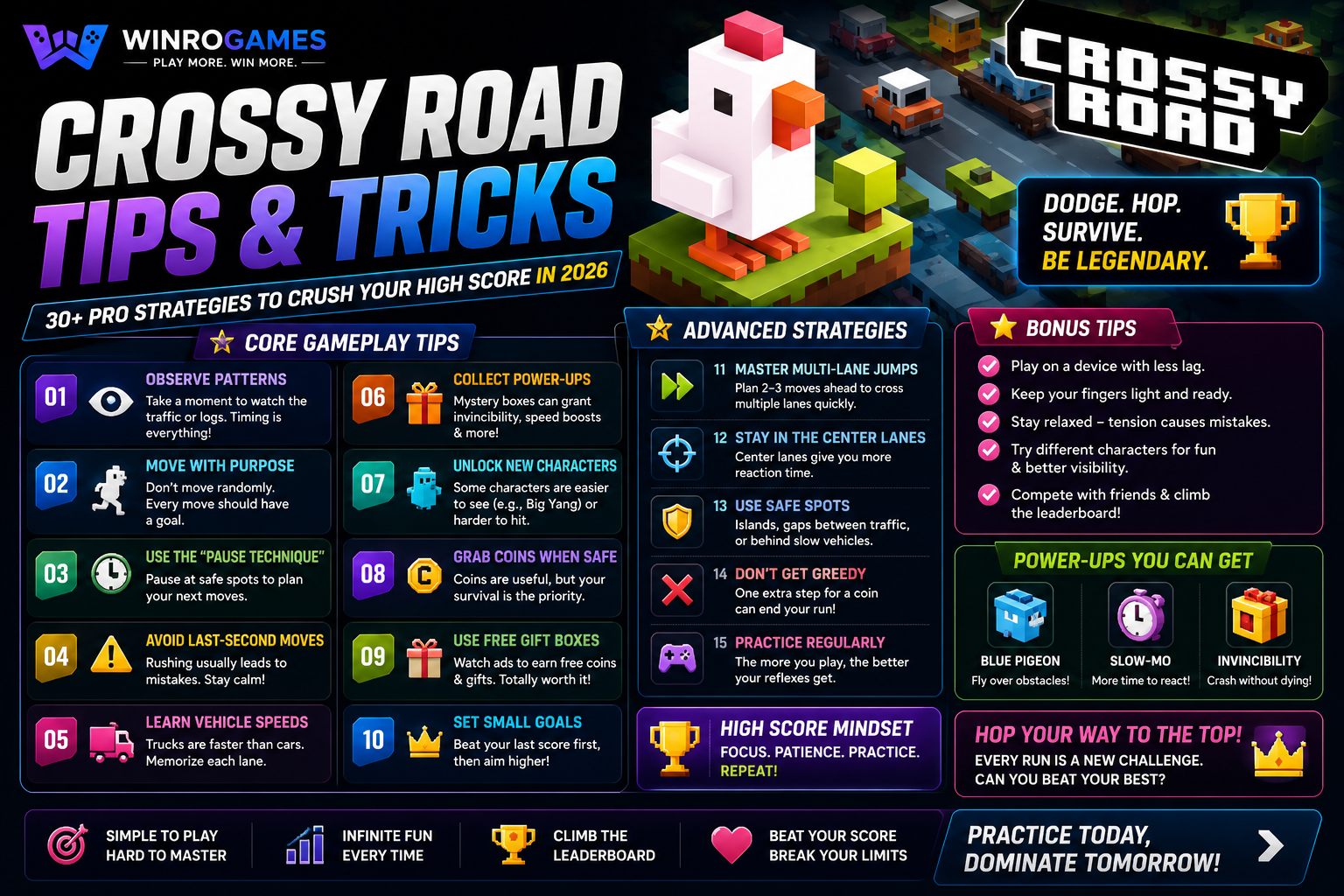
Let me describe a feeling you probably know intimately. You're at 187. Your previous best is 192. The lanes are moving faster now. Your heart rate has climbed to something approaching a light jog. Your thumb is sweating on the screen. You tap forward. Safe. Tap again. Safe. One more tap and you'll break 200 for the first time. You tap — and an eagle swoops down from absolutely nowhere, snatches your chicken, and flies off while you stare at the screen in stunned betrayal. Game over. New high score: 199. You were one tap away.
That's Crossy Road. Deceptively simple. Secretly brutal. And absolutely designed to make you whisper "one more try" under your breath until suddenly two hours have disappeared and you're still chasing a number that feels just barely out of reach. The game looks like a cute, blocky tribute to Frogger. And it is that. But underneath the charming pixel art and the adorable unlockable characters is an endless hopper with surprisingly deep mechanics, hidden patterns, and strategies that separate players stuck at 200 from players who regularly break 1,000.
I've been playing Crossy Road since launch. I've unlocked every character. I've had my soul crushed by that eagle more times than I can count. And along the way, I've learned the Crossy Road tips and tricks that actually make a difference — not the obvious "just practice" advice, but the specific techniques that change how you approach every single hop. This guide covers timing patterns, character selection strategies, environmental awareness techniques, and the secret mechanics the tutorial never tells you about. Let's get you past 200. Then past 500. Then wherever you want to go.
Why Your Crossy Road High Score Is Stuck (And How to Fix It)
Before we dive into specific Crossy Road tips and tricks, let's diagnose why most players plateau. Understanding what's holding you back is half the battle. Players who struggle to improve their Crossy Road high score typically fall into one or more of these traps.
The Panic Hopper. You're playing reactively instead of proactively. You wait until you see an obstacle, then frantically tap to avoid it. This works at low speeds. At higher speeds — around 150+ — reaction alone isn't fast enough. You need to be reading the environment ahead of your character, not responding to what's directly in front of you.
The Greedy Coiner. You see coins. You want coins. You swerve dangerously to grab them. Then you die. Coins are the progression currency, but they're also the most common cause of unnecessary deaths. The best players collect coins opportunistically — when they're directly in your path — not sacrificially.
The Rhythmless Tapper. Crossy Road has an underlying rhythm that experienced players feel instinctively. Tap too fast and you'll hop into danger. Tap too slow and you'll get pushed off screen or eaten by the eagle. Finding and maintaining the game's natural tempo is essential for high scores.
The Tunnel Vision Player. You're staring at your character. This is the most common mistake. When you stare at your chicken (or whatever character you're using), you process obstacles only when they're close. The best players look ahead — scanning the upcoming lanes, identifying safe paths, and planning three to four hops in advance.
The Wrong Character Chooser. Not all Crossy Road characters are created equal. Some have visual advantages that make obstacles easier to see. Others have audio cues that help with timing. Some are actively harder to play because their animations or color schemes blend into the environment. Character choice matters more than most players realize.
Which of these sounds like you? Identifying your primary weakness is the first step to fixing it. Now let's fix them all.
Essential Crossy Road Tips and Tricks: The Fundamentals
These are the foundational strategies that every player should master. If you're struggling to consistently break 100, start here. These Crossy Road tips and tricks address the core mechanics that the game never explicitly teaches.
Master the "Look Ahead" Technique
This is the single most important Crossy Road strategy I can teach you. Stop looking at your character. Instead, focus your eyes about one-third of the way up the screen — roughly where new terrain is appearing. Your peripheral vision will track your character's current position while your focused vision scans for upcoming obstacles, safe landing spots, and coin positions. This technique feels unnatural for the first few games. Stick with it. After 20-30 games, it becomes automatic, and your average score will jump significantly. Players who master the look-ahead technique consistently outscore players who don't, even with less playtime.
Find the Game's Natural Rhythm
Crossy Road runs on a beat. Tap-tap... tap-tap... tap. The rhythm varies slightly based on terrain type and speed, but the underlying pulse is consistent. Try this exercise: mute the sound and tap to a steady beat in your head. Forward, forward, pause. Forward, forward, pause. The pause is crucial — it's when you assess the next lane. Players who tap continuously without pauses die to trains, cars, and river hazards that they saw coming but couldn't stop for. The rhythm isn't tap-tap-tap-tap. It's tap-tap-assess-tap-tap-assess. Learn that pattern, and the game slows down for you.
Understand the Eagle Timer
The eagle is Crossy Road's soft enforcer — it appears when you stay in one place too long. But the timer isn't random. You have approximately 3-4 seconds of stillness before the eagle appears. This is actually generous. Use those seconds to scan ahead, plan your next three moves, and wait for moving obstacles (cars, trains, floating logs) to align favorably. New players panic when the eagle shadow appears. Experienced players use the full timer deliberately. The eagle isn't your enemy. It's a pacing tool. Respect the timer, but don't fear it.
Hop Backward Strategically
One of the most overlooked Crossy Road tips and tricks: you can go backward. Most endless runners punish or prevent backward movement. Crossy Road allows it, and backward hops are essential for survival at high scores. Train coming that you hopped in front of? Hop backward to the previous lane. Eagle forcing you forward into a river with no logs? Hop backward to buy two more seconds of scanning time. Moving backward doesn't reduce your score — the game tracks forward progress only. A strategic backward hop that saves your life is worth far more than a forward hop that gets you killed.
Edge Hopping for Tight Spaces
Your character doesn't need to land in the center of a safe zone. Landing on the very edge of a log, a lily pad, or a train track gap is perfectly valid. This technique — edge hopping — lets you squeeze through gaps that look too small. The hitbox in Crossy Road is slightly more forgiving than the visual model suggests. Practice landing on the front edge of safe zones to maximize your forward progress per hop. This technique becomes essential above 500 when gap sizes shrink and reaction windows narrow.
Environmental Mastery: How to Read Every Terrain Type
Crossy Road features multiple terrain types, each with unique hazards and patterns. Mastering how to get a high score in Crossy Road requires understanding every environment individually. Here's the breakdown.
Roads and Highways
Cars, trucks, and occasional emergency vehicles move at varying speeds across multiple lanes. The key to road survival: watch the lane behind the one you're about to enter. Cars appear from the edges of the screen. By watching the lane behind your target lane, you can see what's coming before it reaches you. Also, vehicle speed is consistent within each lane. If the first car in a lane is moving fast, all cars in that lane move fast. Use the first car you see as a speed reference for the entire lane. Trucks take longer to pass but leave bigger gaps. Motorcycles are fast but narrow — you can sometimes squeeze between them and the lane edge.
Train Tracks
Trains are the most punishing obstacle in Crossy Road. They move fast. They occupy the entire lane. They give almost no reaction time if you're not looking ahead. The trick with train tracks: trains always come from one direction per track, and the warning lights flash for approximately 1.5 seconds before the train arrives. If you see flashing lights, stop. Do not try to beat the train. The timing window is tighter than it looks, and mistiming it means instant death with no recovery possible. Wait for the train. Use the eagle timer if necessary. Patience on train tracks is the difference between a 150 score and a 500 score.
Rivers and Water
Rivers require you to hop across moving logs and lily pads. The water is instant death. The challenge: logs and lily pads move at different speeds and sometimes in different directions. The key river strategy: match your hopping rhythm to the movement speed of the logs. Fast-moving logs require faster sequential hops. Slow-moving logs give you more time to assess. Lily pads are stationary but often placed in patterns that require diagonal movement. Wait for the log or lily pad to align with your current position before hopping. Rushing onto a log that's barely in range is how most river deaths happen. Logs also vary in length — longer logs give you more standing room and more time to plan your next hop.
Grass and Safe Zones
Grass areas are safe — no moving hazards. But they're also where coins concentrate and where the game tries to lull you into complacency. The danger of grass is that you stop scanning ahead. You see coins, you relax, you stop looking at the next terrain type. Then you hop forward and immediately die to a car you didn't see coming. Treat grass as a scanning opportunity, not a break. Use grass sections to look ahead at the next road or river. Plan your first three moves. Then proceed.
Snow and Ice
In winter-themed environments, snow and ice affect movement. Ice surfaces are slippery — your character slides slightly after each hop, which can carry you into hazards if you're not accounting for the extra momentum. On ice, tap more gently. Hop shorter distances. Give yourself extra margin for error near edges. Snow doesn't affect physics but can obscure coin visibility — white coins on white snow are harder to spot. Adjust your scanning pattern in snow environments to account for reduced contrast.
Crossy Road Characters: Which Ones Give You an Advantage
This is the section most Crossy Road guides gloss over, but character choice genuinely affects your score potential. Different Crossy Road characters have different visual properties, sizes, and in some cases, environmental interactions. Choosing the right character is one of the most impactful Crossy Road tips and tricks for high score chasing.
The Best Characters for High Scores
The Chicken (Default). The original character is actually one of the best for high scores. Small hitbox. High contrast against most backgrounds. Simple, readable animations. Don't assume the default character is bad — many top players use the chicken exclusively because they've built thousands of games of muscle memory with it.
Dark Lord. A popular choice among high-score chasers. The dark color provides strong contrast against most environments, making it easy to track your position with peripheral vision. The character model is compact with a clean hitbox.
Frogger (Classic Arcade). A tribute to the game that inspired Crossy Road. This character has a nostalgic green color that stands out well against roads and grass but can blend into river environments. The compact size is good for tight gaps.
Any Character With Strong Color Contrast. The best Crossy Road character for you is one that your eyes can track easily. Bright colors (yellow, white, neon) work well on dark backgrounds. Dark colors work well on bright backgrounds. Test different characters and notice which one your eyes follow most naturally. Your personal contrast sensitivity matters more than any objective "best character" ranking.
Characters That Make the Game Harder
Some Crossy Road characters are actively disadvantageous for high score runs. Large characters have bigger hitboxes that make tight squeezes harder. Characters with busy animations can distract your eyes from scanning ahead. Characters whose colors blend into common terrain types (green characters on grass, brown characters on dirt) are harder to track with peripheral vision. Characters with unusual movement animations can throw off your rhythm because the visual feedback of each hop feels different. If you're serious about improving your Crossy Road high score, stick to compact, high-contrast characters. Save the fun, wacky characters for casual play.
How to Unlock the Best Characters Fast
The fastest way to unlock Crossy Road characters is through the prize machine using coins. You earn coins during gameplay — but there's a smarter way to farm them. Instead of risking your run for every coin you see, focus on surviving and collecting only the coins directly in your path. Longer runs naturally generate more coins because you're covering more distance. Also, watch the free gift videos when offered — they often reward coins or rare characters. The daily challenges and missions (added in recent updates) provide bonus coin opportunities. Don't spend real money on the coin packs unless you want to support the developers — patient free play will unlock everything eventually.
Advanced Crossy Road Strategy: Techniques for Breaking 500 and Beyond
Once you're consistently hitting 200-300, these advanced Crossy Road strategy techniques will push you into the upper tiers of players. These are the techniques that separate casual hoppers from leaderboard chasers.
The "Safe Lane" Mentality
Every time you advance one lane, mentally categorize the lane you're standing on: safe, risky, or lethal. Safe lanes have no immediate threats and multiple escape options. Risky lanes have one safe spot with hazards on either side. Lethal lanes have no safe spots — you need to move immediately. This categorization should happen automatically after enough practice. If you're on a risky lane, your next hop should be to a safe lane. If you're on a lethal lane, hop immediately in whichever direction offers survival. Conscious lane categorization prevents the "deer in headlights" freeze that kills players when multiple hazards appear simultaneously.
Pattern Recognition Training
Crossy Road uses procedural generation, but the patterns within each terrain type are limited. Cars follow specific speed tiers. Logs appear in predictable sequences. Train warnings flash for consistent durations. The more you play, the more your brain builds a library of these patterns. You can accelerate this process by playing "study sessions" — 10-15 minute sessions where you're not trying to beat your high score, just observing patterns. Watch car spacing. Note log timing. Memorize the rhythm of train warnings. Treat it like studying a game you want to master rather than just playing it. Pattern recognition is what allows top players to seem psychic — they're not reacting faster, they're recognizing situations they've seen hundreds of times before.
The Two-Second Scanning Rule
Develop the habit of scanning the entire screen every two seconds of gameplay. Quick glance: top of screen (what terrain is coming next?), middle of screen (where are the immediate hazards?), your character position (are you centered or near an edge?). This scan takes less than a second once practiced. It prevents tunnel vision and keeps you aware of the full playfield. Players who don't scan get surprised by terrain changes — they hop from a road directly onto train tracks without noticing the flashing lights. A quick scan two seconds earlier would have revealed the upcoming terrain change and given time to adjust.
Death Analysis: Learn From Every Game Over
When you die, don't immediately tap "Play Again." Take three seconds to analyze what happened. Were you looking ahead or at your character? Did you miss a pattern you should have recognized? Were you greedy for a coin? Did you panic-hop into danger? Most deaths fall into predictable categories. Start mentally logging your deaths. After a week, you'll notice patterns — maybe 60% of your deaths are from trains, or you always die around 180-200, or you consistently misjudge log timing on rivers. Knowing your specific weaknesses lets you target them with deliberate practice. Generic "play more" advice doesn't help. Specific "you die to trains because you're not watching for flashing lights" advice does.
Audio Cue Mastery
Crossy Road's sound design isn't just charming — it's informative. Different surfaces make different hop sounds. Cars have distinct audio based on size and speed. The train warning has a specific audio cue before the visual flash. The eagle has an audio warning before the shadow appears. Playing with sound on (or with quality earbuds) gives you a split-second advantage on every hazard. The audio cue reaches your brain slightly faster than the visual cue. In a game where split seconds matter, that advantage compounds over hundreds of hops. If you've been playing on mute, try a session with sound. You'll notice hazards sooner. That's not placebo — that's your auditory processing giving your visual processing a head start.
Common Mistakes That Kill Crossy Road High Score Runs
I've analyzed hundreds of my own deaths and watched countless gameplay videos. These are the most common killers — and they're all avoidable with awareness.
- Chasing coins into traffic. Coins are bait. The game places them in dangerous positions deliberately. A coin on a road with fast-moving cars isn't a reward — it's a test of your discipline. Pass the test. Leave the coin.
- Hesitating at speed. Above 300, the game speed increases noticeably. Hesitation — that split-second pause where you're not sure which direction to hop — becomes fatal. At high speeds, commit to a direction immediately. A decisive hop into moderate danger is better than freezing and getting hit by something you didn't see.
- Forgetting the eagle exists. The eagle timer runs even when you're carefully planning your next move. Players who meticulously scan for the perfect path sometimes get snatched mid-scan. The eagle shadow is your five-second warning. When you see it, move. Doesn't matter where. Move forward. You can adjust your path after surviving the immediate threat.
- Playing tired or tilted. Crossy Road requires focus. Playing when you're exhausted, frustrated, or on a losing streak leads to sloppy hops and stupid deaths. If you die three times in a row under 50, put the game down. Come back fresh. Your high score attempts should happen when you're alert and calm.
- Comparing yourself to YouTube players. Those videos of someone hitting 2,000+? That player has probably logged thousands of hours. Comparing your week-old Crossy Road journey to their years of experience is demoralizing and unproductive. Compare yourself to your previous high score. That's the only comparison that matters.
- Ignoring device performance. On older phones, Crossy Road can experience micro-stutters or input lag. Close background apps before high-score attempts. Enable performance mode if your device has it. Clean your screen — a sticky screen surface can cause missed taps. These seem like minor factors, but at high speeds, a single missed tap ends your run.
Crossy Road Secrets: Hidden Mechanics Most Players Miss
These Crossy Road secrets aren't documented in the tutorial or help screens. They're discovered through community experimentation and thousands of hours of collective playtime.
The Coin Magnet Effect
Your character has a small coin collection radius that extends slightly beyond your visual model. You don't need to land directly on a coin to collect it — passing near it (within about half a character width) is usually sufficient. Exploit this by aiming your hops near coins rather than directly on them, especially when direct landings would put you in danger. The collection radius is generous enough to let you grab coins from relative safety while maintaining your optimal path.
Terrain Transition Safe Zones
When transitioning between terrain types — road to grass, grass to river, river to train tracks — there's often a tiny safe zone right at the transition point. Cars don't spawn on the very edge of roads. Logs don't appear immediately at river banks. These transition safe zones give you a moment to assess the new terrain before committing. Land on the first row of a new terrain type and pause briefly. Scan the new environment. Then proceed. Rushing through transitions is how players get blindsided by terrain-specific hazards.
The Framerate Advantage
Crossy Road performs best at consistent frame rates. On devices with variable refresh rates, locking your display to 60Hz (rather than adaptive 120Hz) can actually improve consistency. The game's internal timing is optimized for 60fps. Higher frame rates don't make the game smoother — they can introduce micro-variations in timing that throw off experienced players' rhythm. If your device supports refresh rate control, try locking to 60Hz for Crossy Road sessions.
Character-Specific Easter Eggs
Some Crossy Road characters have unique interactions with the environment. The Android character (from the robot set) leaves sparks when hopping on metal surfaces. The ghost characters have slightly translucent models that can make hazard visibility challenging. Certain holiday-themed characters change the coin appearance during their respective seasons. These aren't game-changing mechanics, but they're fun details that reward character experimentation. More importantly, knowing which characters have visual quirks helps you avoid accidentally choosing one that makes the game harder.
How to Get a High Score in Crossy Road: The Mental Game
At a certain point — usually around 300-400 — Crossy Road becomes as much a mental challenge as a mechanical one. Your hands know what to do. Your brain is the obstacle. Here's how to master the mental game.
Manage the "High Score Anxiety"
You're at 280. Your high score is 312. Suddenly every hop feels weighted. Your hands get tense. You start overthinking. Then you die at 295 to a car you would have dodged easily at score 50. This is high score anxiety, and it's the number one killer of potential record-breaking runs. The solution: hide the score counter if possible (some versions allow UI customization), or consciously avoid looking at it. Focus on the next hop. Just the next hop. Not the number. Not the milestone. The next safe landing. String together enough "next hops" and the high score takes care of itself.
The Reset Routine
Between runs, have a quick reset routine. Take a breath. Relax your grip on the phone. Roll your shoulders. Blink deliberately a few times. This physical reset prevents carryover tension from the previous death. Players who immediately tap "retry" after dying carry their frustration into the next run. A 10-second reset between attempts improves consistency more than grinding attempt after attempt without pause.
Set Incremental Goals
"I want to hit 1,000" is a terrible goal when your high score is 150. It's too far away. It feels impossible. It demotivates you. Instead, set incremental targets: beat 150, then 175, then 200, then 250. Each milestone feels achievable from the previous one. Each milestone gives you a dopamine hit that motivates continued play. The players who eventually hit 1,000 didn't jump there from 200. They climbed a staircase of incremental improvements over weeks or months. Build your staircase. Celebrate every step.
Quick Reference: Crossy Road Tips and Tricks Cheat Sheet
Save this section. Screenshot it. Use it as a pre-game reminder before high-score attempts.
| Category | Key Tip |
|---|---|
| Vision | Look ahead, not at your character. Scan one-third up the screen. |
| Rhythm | Tap-tap-pause. Don't tap continuously. Use pauses to assess. |
| Eagle | 3-4 seconds of stillness allowed. Use the full timer to plan. |
| Backward Hops | Retreating is valid. Survival matters more than forward progress. |
| Coins | Collect opportunistically. Never risk death for a coin. |
| Trains | Flashing lights = stop. Don't try to beat the train. |
| Rivers | Match hop rhythm to log speed. Wait for alignment. |
| Transitions | Pause briefly at terrain changes. Scan new environment. |
| Characters | Use compact, high-contrast characters for high-score runs. |
| Audio | Play with sound. Audio cues precede visual cues. |
| Mental | Reset between runs. Don't look at the score. Focus on the next hop. |
| Device | Close background apps. Clean your screen. Lock 60Hz if possible. |
Your High Score Is Waiting
Here's what I know about Crossy Road after years of playing: the game is fair. Every death is avoidable. Every obstacle follows rules you can learn. Every high score barrier can be broken with the right combination of technique, awareness, and patience. The eagle that snatches you at 199 isn't cheating. The train that ends your run at 487 isn't random. The log that drifts out of reach at 612 isn't unfair. They're all following patterns. Your job is to learn those patterns well enough that they stop surprising you.
The Crossy Road tips and tricks in this guide aren't shortcuts. They're accelerators. They compress the learning curve by telling you what experienced players discovered through thousands of deaths. Apply them deliberately. Practice them one at a time. Start with the look-ahead technique — that alone will add 50-100 points to your average score within a week. Then layer on rhythm training. Then character optimization. Then the advanced strategies. Build your skills systematically, and the high scores will follow.
Somewhere out there, your next record is waiting. 250. 500. 1,000. Whatever number feels just barely impossible right now — that's your target. And the version of you that hits that number is just a few hundred hops and a few dozen deaths away. So close this guide. Open the game. Take a breath. Focus on the next hop. Just the next hop.
That chicken isn't going to cross the road by itself.
What's your current Crossy Road high score, and what's the obstacle that kills you most often? Drop your stats in the comments — let's troubleshoot your runs together. And if one of these tips helps you break your record, come back and let me know. Those victory updates make my day.