Cast your mind back to 2017. Adobe announced it was killing Flash. The internet collectively panicked. For two decades, Flash had been the backbone of browser gaming — those countless hours spent on Newgrounds, Kongregate, Miniclip, and Armor Games were suddenly staring down obsolescence. Tech obituaries declared browser gaming dead. The future, they said, belonged to app stores, Steam libraries, and walled-garden platforms that required downloads, installations, and gigabytes of storage space.
They were wrong. Spectacularly wrong.
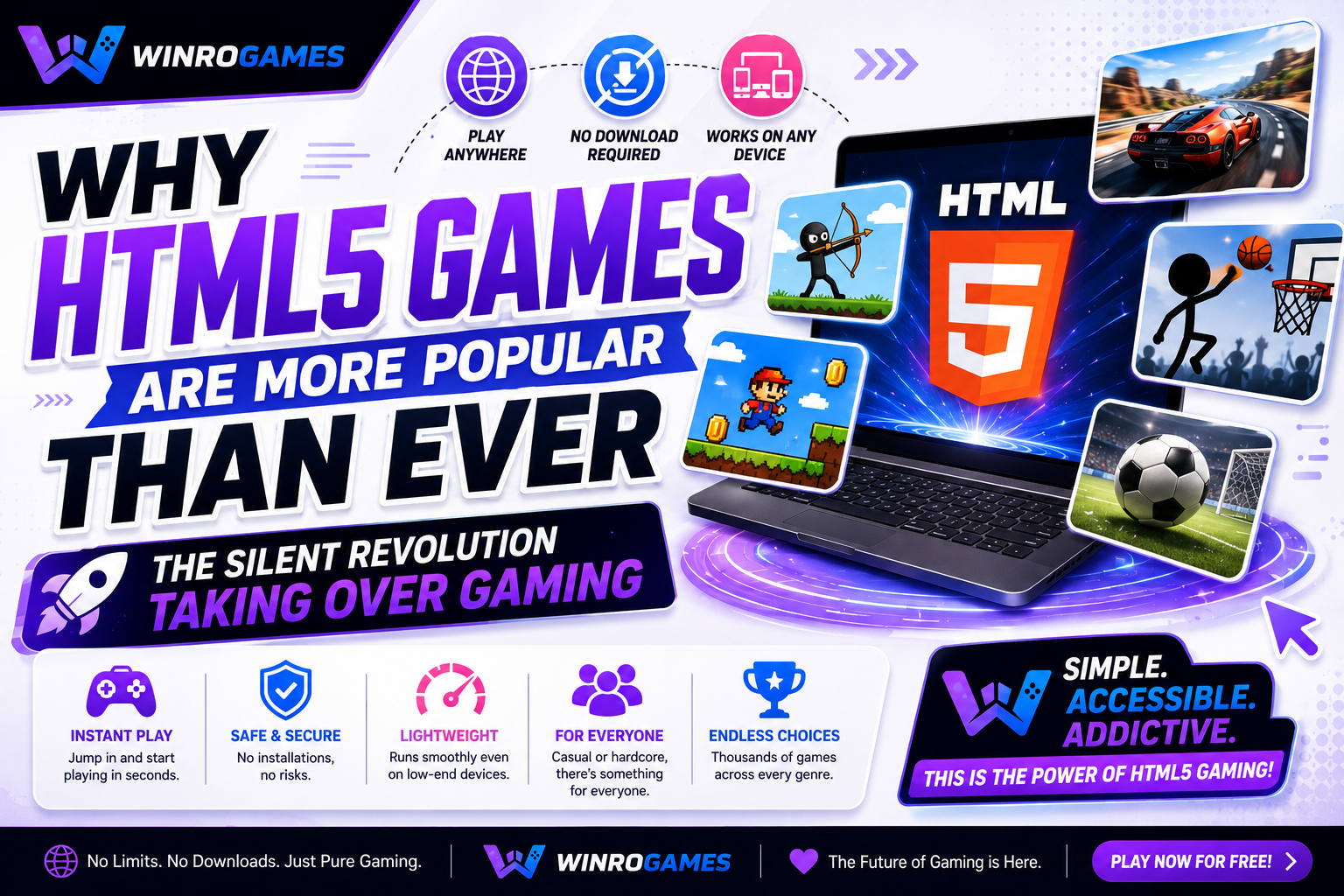
Fast forward to 2026, and browser gaming isn't just alive — it's thriving in ways that would have seemed impossible during the Flash era. HTML5 games have quietly become one of the most played categories in the world, powering everything from quick lunch-break distractions to surprisingly complex multiplayer experiences. The technology that was supposed to be a downgrade from Flash turned out to be an upgrade in almost every way that mattered. And the numbers back it up: browser game portals are seeing record traffic, unblocked game sites have become cultural institutions in schools worldwide, and even major publishers are releasing HTML5 versions of their flagship titles.
This isn't nostalgia. This isn't a niche. This is a full-blown renaissance hiding in plain sight — in your browser tabs, during your coffee breaks, on devices that couldn't dream of running "real" games. Let's unpack why HTML5 games are bigger now than browser games have ever been, and why the trend is only accelerating.
The Death of Flash Was the Best Thing That Ever Happened to Browser Games
It's hard to appreciate how transformative HTML5 is without understanding how limiting Flash was. Flash was a proprietary plugin owned by Adobe. You had to install it separately. It was a security nightmare — Flash vulnerabilities were one of the most common vectors for malware throughout the 2000s and 2010s. It drained laptop batteries like nothing else. It didn't work on iPhones or iPads because Steve Jobs famously banned it from iOS in 2010, correctly identifying it as a bloated, insecure relic. And when Adobe pulled the plug, thousands of classic games faced digital extinction.
HTML5 solved every single one of these problems by being fundamentally different. It's not a plugin. It's not owned by any company. It's just... the web. HTML5 is the fifth version of the HTML standard — the literal language websites are built with. Every modern browser supports it natively. There's nothing to install. Nothing to update. No security vulnerabilities specific to a plugin because there is no plugin. When you play an HTML5 game, you're just loading a webpage that happens to be interactive in a very fun way.
The transition was painful. Developers had to learn new tools. Thousands of Flash games were lost because their creators didn't port them. But the foundation that emerged from that disruption was stronger, faster, and more universal than Flash ever was. Flash games were a house built on rented land. HTML5 games are built on the land itself.
Reason 1: Zero Friction — The Power of Instant Play
The single greatest advantage HTML5 games have over traditional gaming is the complete absence of friction between wanting to play and actually playing. Think about the steps required to play a game on Steam: open the client, wait for updates to download, possibly restart, navigate your library, launch the game, wait through splash screens and shader compilation, load your save. Even on fast hardware, that's two to five minutes before you're actually playing. On mobile app stores: search, download (potentially hundreds of megabytes), install, grant permissions, create an account, sit through a tutorial. The friction is constant.
Now think about an HTML5 game. You click a link. The game loads in seconds. You're playing. That's it. The entire friction chain is: click, wait three seconds, play. For short-form gaming sessions — the kind that fit into a 10-minute break, a bus ride, or the gap between meetings — this friction difference is everything. Players don't commit to HTML5 games the way they commit to a 100-hour RPG. They don't need to. The games are designed for instant engagement, instant enjoyment, and instant exit when real life calls.
This frictionless access also democratizes gaming across hardware. An HTML5 game doesn't care if you're on a $3,000 gaming rig or a $200 Chromebook. It doesn't care if your phone is a flagship or a budget model from three years ago. If your device can run a modern web browser — and literally everything can — it can run HTML5 games. The addressable audience isn't measured in millions of Steam users or console owners. It's measured in billions of people with internet access.
Reason 2: The Unblocked Games Phenomenon
Let's talk about a cultural force that mainstream gaming media barely covers: unblocked games. If you've stepped foot in a school, university, or office in the last five years, you've almost certainly seen someone playing an HTML5 game when they should have been doing something else. Entire websites exist solely to host HTML5 games on domains that slip past network filters. These aren't shady operations — many are surprisingly well-organized platforms with curated libraries, rating systems, and active communities.
Why do HTML5 games dominate the unblocked space? Because they're essentially invisible to network filters. A Flash game required the Flash plugin, which network administrators could easily block at the firewall level. An HTML5 game is indistinguishable from any other website traffic. It's JavaScript and HTML and CSS — the same technologies that power Gmail, Google Docs, and every other web application that schools and offices need to function. Blocking HTML5 games would require blocking the fundamental technologies that run the modern internet.
This has created an enormous, largely invisible user base. Millions of students and office workers play HTML5 games during breaks, study halls, and slow afternoons. The demand is so consistent that unblocked game sites rank among the most visited gaming destinations on the internet — they just don't show up in traditional gaming industry metrics because they're not selling anything. They're providing a service: entertainment that works anywhere, on any device, regardless of what IT department stands in the way.
Reason 3: Mobile Browser Gaming Is Finally Good
For years, mobile gaming meant the App Store or Google Play. Browser games on mobile were an afterthought — slow, poorly optimized, and clearly designed for mouse and keyboard. That has changed dramatically. Modern HTML5 frameworks like Phaser, PixiJS, and Three.js are built with mobile-first design principles. Touch controls are native, not awkwardly mapped. Responsive design means games scale properly to any screen size. Performance optimizations that were once PC-only now work on mobile GPUs.
The result? Mobile HTML5 games that feel like native apps without the download. Players in regions with expensive data plans or limited phone storage — which describes most of the world outside North America and Western Europe — have embraced browser gaming as their primary platform. Why download a 500MB game when you can play something comparable in your browser for free, with no storage footprint? The economics of mobile data and device storage make HTML5 gaming not just convenient but economically rational for billions of potential players.
Major messaging platforms have noticed. WeChat, Telegram, and LINE all support HTML5 games that play directly in chat windows. These "mini-games" have become social phenomena in Asia, where playing a quick round of an HTML5 game with friends without leaving your messaging app is now completely normal. The rest of the world is catching up. Facebook Instant Games, Snapchat Games, and TikTok's gaming integrations are all built on HTML5. When you play a game inside a social app, you're almost certainly playing HTML5.
Reason 4: The Technology Is Shockingly Capable Now
Let's kill a persistent myth: HTML5 games are not just simple 2D time-wasters. The technology has evolved to the point where browser games can deliver experiences that rival mid-range console titles from the previous generation.
WebGL and WebGL 2.0 bring hardware-accelerated 3D graphics to browsers. WebAssembly (WASM) allows near-native performance for complex calculations — game engines like Unity and Unreal Engine can now export directly to HTML5 with surprisingly playable results. WebGPU is rolling out across browsers, bringing modern graphics API capabilities that were previously exclusive to native applications. Multiplayer networking through WebSockets and WebRTC enables real-time competitive games with latency comparable to dedicated clients.
What does this mean in practical terms? Krunker.io runs a full first-person shooter at 60 FPS in a browser tab with slide-hopping mechanics deeper than some paid shooters. Shell Shockers delivers egg-based multiplayer deathmatch with class systems and progression. 1v1.LOL replicates Fortnite's building and shooting mechanics without a download. These aren't tech demos. They're legitimate competitive games with active communities, tournaments, and skill ceilings high enough to sustain years of dedicated play.
Even single-player experiences have reached impressive scope. HTML5 roguelikes, RPGs, and strategy games now feature procedural generation, save systems, and content depth that would have required a dedicated client just five years ago. The ceiling of what's possible in a browser keeps rising, and developers keep pushing against it.
Reason 5: The Collapse of Flash Left a Vacuum That Had to Be Filled
When Flash died, it took an estimated 20,000+ games with it. Some were preserved through projects like Flashpoint and Ruffle (a Flash emulator written in — ironically — WebAssembly). But the cultural role those games played — quick, accessible, free entertainment that worked on any computer — didn't disappear when the technology did. The demand remained. Players still wanted browser games. They just needed them in a new format.
HTML5 didn't just replace Flash technically. It expanded the audience. Flash games were largely a desktop phenomenon because Flash didn't work on iOS and performed poorly on early Android devices. HTML5 games work everywhere. The audience for browser gaming is now larger and more diverse than it ever was during the Flash era, simply because the games run on phones, tablets, and devices that didn't exist or couldn't participate in the old ecosystem.
There's also a generational factor. Today's teenagers and college students grew up after Flash. They never experienced the Flash game era. To them, browser gaming isn't a nostalgic callback — it's just how games work on school computers. HTML5 games are their native browser gaming experience, not a downgrade from something they remember. This generational shift means the audience for HTML5 games will continue growing as digital natives who expect instant, download-free experiences become the dominant consumer group.
Reason 6: Developers Love the Platform
The HTML5 game development ecosystem has matured into something genuinely attractive for creators. Modern frameworks handle the heavy lifting. Game engines export to HTML5 with a single click. Distribution is infinitely easier than app stores — no 30% platform cut, no approval process, no waiting weeks for updates to go live. Developers can push changes instantly and iterate based on real-time player feedback.
Monetization has evolved beyond intrusive pop-up ads. HTML5 games now support rewarded video ads (watch an ad for an extra life), in-game purchases through standard payment APIs, and subscription models through platforms like Poki and CrazyGames that share revenue with developers. These monetization methods are less predatory than many mobile free-to-play systems because the barrier to quitting is zero — if a game pushes monetization too hard, players can simply close the tab and open a different one.
The open nature of the web also means developers aren't beholden to platform holders. Apple can't remove your HTML5 game because you violated an arbitrary App Store guideline. Google can't demonetize your browser game the way they can with YouTube content. The web is the most open distribution platform in existence, and for developers tired of navigating walled gardens, that freedom is increasingly attractive.
Reason 7: Schools and Education Embraced HTML5 Gaming
This is a fascinating development that most people outside education miss. Schools have become unexpected champions of HTML5 gaming — not just tolerating it, but actively integrating it into curricula. The reasoning is straightforward: educational HTML5 games teach concepts through interactivity, run on the Chromebooks that dominate the education market, and cost nothing compared to licensed educational software.
Platforms like Coolmath Games (which isn't actually all math games, despite the name) have built massive audiences by positioning themselves at the intersection of education and entertainment. Teachers use HTML5 logic games to teach problem-solving. Puzzle games become exercises in spatial reasoning. Even action games get justified as "hand-eye coordination practice." The line between educational game and pure entertainment game is blurry, and schools have largely decided that's fine — engagement is the goal, and HTML5 games deliver engagement in spades.
This educational embrace has a secondary effect: it normalizes browser gaming for an entire generation. When students play HTML5 games at school, they associate the format with legitimate, acceptable entertainment. They go home and continue playing the same games on personal devices. The school-to-home pipeline has been a quiet but powerful growth driver for HTML5 gaming as a whole.
Reason 8: The Rise of .IO Games and Social Browser Gaming
The .io game explosion — Agar.io, Slither.io, Diep.io, Krunker.io — was built entirely on HTML5. These games share a common DNA: simple mechanics, massive multiplayer lobbies, and the addictive "just one more round" loop that keeps players engaged for hours. They're also unapologetically browser-native. Most .io games don't even have mobile app versions, or if they do, the browser experience is considered the primary platform.
What made .io games a phenomenon is also what makes HTML5 gaming sticky: they're inherently social. You're not playing against AI. You're playing against dozens or hundreds of real people simultaneously. The leaderboard updates in real time. Your name is visible to everyone. The social proof and competitive drive that keep people playing traditional multiplayer games work identically in the browser — but without the $60 entry fee and 50GB install.
The .io naming convention itself became a brand signifier. Players learned that ".io game" meant "free, multiplayer, browser-based, and probably addictive." New games adopted the suffix even when hosted on .com domains. The cultural cachet of .io games attracted players who might never have considered browser gaming otherwise, and many of them stayed for the broader HTML5 ecosystem.
HTML5 Games vs. Native Apps: The Honest Comparison
I'm not going to pretend HTML5 games match native apps in every category. They don't. Let's be straight about where browser games still fall short and where they've pulled ahead.
| Category | HTML5 Games | Native Apps |
|---|---|---|
| Instant Access | ✅ Click and play, seconds to load | ❌ Download, install, update, wait |
| Cross-Platform | ✅ Works on any device with a browser | ❌ Platform-specific builds required |
| Storage Space | ✅ Zero permanent storage required | ❌ Can consume gigabytes |
| Graphics Ceiling | ❌ Below high-end native, improving fast | ✅ Photorealistic AAA graphics possible |
| Offline Play | ❌ Requires internet (mostly) | ✅ Full offline capability |
| Monetization Freedom | ✅ No platform tax, direct revenue | ❌ 30% app store cut typical |
| Discovery | ❌ Fragmented, SEO-dependent | ✅ Centralized app stores |
| Updates | ✅ Instant, no user action needed | ❌ Requires user to update |
The trade-offs are clear. HTML5 sacrifices graphical ceiling and offline capability for frictionless access and universal compatibility. For the types of games that dominate browser platforms — quick sessions, casual competition, puzzle and strategy titles — the trade-off favors HTML5 overwhelmingly. For a 100-hour cinematic RPG with ray-traced lighting? That's still native territory. But the overlap zone where HTML5 is "good enough" keeps expanding every year.
What the Future Holds for HTML5 Gaming
The trajectory is unmistakable. Every browser update brings performance improvements. WebGPU will close the graphics gap further. WebAssembly continues to enable increasingly complex game logic. Cloud gaming services like Xbox Cloud Gaming and GeForce Now already run in browsers — and while those stream native games rather than running natively in HTML5, they normalize the idea that a browser is a legitimate gaming platform.
Several trends point toward continued growth:
- 5G and improved mobile networks eliminate the last latency concerns for browser-based multiplayer. When every device has a fast, stable connection, the download-free nature of HTML5 becomes even more compelling.
- Progressive Web Apps (PWAs) blur the line between browser games and installed apps. An HTML5 game can be "installed" to a device's home screen, launch in its own window, and work offline — all without going through an app store. This hybrid approach captures the best of both worlds.
- AI-assisted development lowers the barrier to creating HTML5 games. Tools that generate game code from natural language descriptions will flood the ecosystem with new content, some of it genuinely innovative.
- Regulatory pressure on app stores (especially in the EU and potentially the US) could make the web's open distribution model more attractive to developers currently forced into walled gardens.
- Cryptocurrency and blockchain games (for better or worse) have found a natural home in HTML5, where players can access them without platform restrictions on crypto integration.
The Quiet Dominance of Browser Gaming
Here's what I find most fascinating about the HTML5 gaming boom: it's happening largely outside the attention of mainstream gaming media. The industry press covers console sales, Steam charts, and mobile app store revenue. Meanwhile, millions of people are playing HTML5 games every single day — during school lunch breaks, on office computers, on budget phones in markets the traditional gaming industry ignores.
There's no HTML5 game at The Game Awards. No E3 press conference announces the next big browser title. The ecosystem doesn't generate the same headline-grabbing revenue numbers as AAA publishing. But in terms of raw player count and daily active users, HTML5 gaming is almost certainly larger than most people realize. The audience is diffuse — spread across thousands of game portals, unblocked sites, educational platforms, and social media integrations — which makes it easy to underestimate. But add it all up, and you're looking at one of the largest gaming audiences on the planet.
Browser gaming won't replace consoles or PC gaming. It was never trying to. What it's doing is filling the gaps — the short sessions, the restricted environments, the devices that can't run anything else, the players who can't or won't pay premium prices. Those gaps turn out to be enormous. And HTML5 fills them better than any technology before it.
The Revolution Already Happened
The funny thing about revolutions is that sometimes they're so quiet you don't notice them until they're over. The transition from Flash to HTML5 felt like an ending in 2017. It was actually a beginning. The technology that replaced Flash didn't just replicate what came before — it expanded the entire concept of what browser gaming could be. More devices. More players. More types of games. More ways to discover and share them. More business models that work for developers without exploiting players.
Flash games were a product of their time — wonderful, creative, and ultimately unsustainable on a platform that was never designed for gaming. HTML5 games are built on the open web itself. They'll last as long as browsers exist, which is to say, effectively forever. The games you play in your browser today will still be playable in 2036, 2046, and beyond, because they're built on standards that the entire internet depends on.
So the next time someone dismisses browser games as "not real games," feel free to send them this article. Or better yet, just send them a link to Krunker.io and watch them lose an afternoon. The web is the world's largest gaming platform. It has been for years. The only thing that's changed is that the games finally got good enough to prove it.
What's the HTML5 game that's stolen the most hours of your life? Drop it in the comments — I'm always hunting for the next browser tab that'll destroy my productivity.