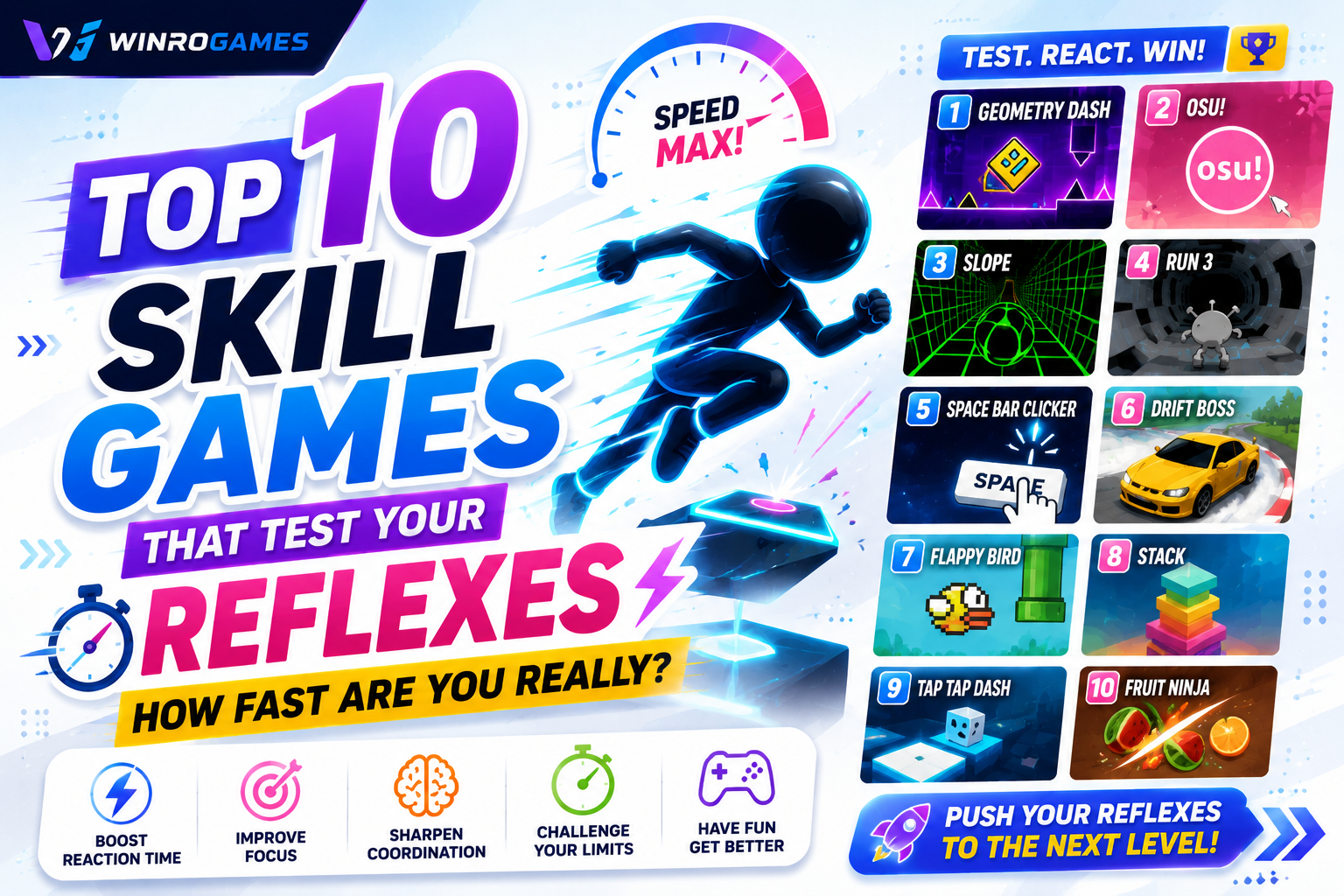
Let's settle something right now. You've probably claimed you have "fast reflexes" because you caught a falling phone that one time or swerved around a pothole at the last second. Cute. But have you ever tried to dodge 200 neon bullets while a techno track melts your eardrums and your heart rate climbs into cardiac territory? That's a different beast entirely. Reflexes aren't just about raw speed — they're about speed plus precision plus composure under pressure. And the games on this list? They'll expose every millisecond of hesitation you didn't know you had.
I've been chasing reflex-intensive games for years. Some of these titles have humbled me so thoroughly that I had to walk away from my keyboard and stare at a wall for ten minutes. Others have given me that transcendent flow state where my fingers move before my brain consciously registers what's happening on screen. That zone — where reaction becomes instinct — is what separates casual button-mashers from genuinely skilled players. These ten games will test exactly where you fall on that spectrum.
Before we dive in, a quick disclaimer: these games are demanding. If you're tired, tilted, or distracted, they'll punish you without mercy. But stick with them, and you'll notice something strange happening. Your reaction time in other games improves. Your mouse aim gets crisper. You start catching things before they fall. Reflexes are trainable, and these games are the gym.
What Makes a Game a True Reflex Test?
Not every fast-paced game is a reflex test. First-person shooters require aim and game sense, but they also involve strategy, positioning, and map knowledge. True reflex games strip away everything except raw input speed and pattern recognition. There's no hiding behind cover. No blaming teammates. No grinding for better gear. Just you, the screen, and a constant stream of split-second decisions that punish hesitation instantly.
The best reflex games share a few core traits: minimal input delay (every millisecond counts), clear visual feedback so you know exactly when you messed up, progressively increasing difficulty that forces continuous adaptation, and a restart loop so frictionless that dying and retrying feels like the same motion. When those elements align, the game becomes a pure measurement tool for your nervous system's processing speed. Let's find out where your ceiling is.
10. Osu! — The Rhythm Game That Exposes Your Limits
Platform: PC (free) | Reflex Skill Tested: Aim speed, rhythm sync, split-second clicking
If you've never seen high-level Osu! gameplay, pull up a video right now. I'll wait. What you just witnessed looks physically impossible — circles appearing and disappearing in fractions of a second, the cursor snapping between them with surgical precision, all perfectly synced to anime opening themes and breakcore tracks. That's not a sped-up video. That's what thousands of hours of practice looks like.
Osu! is a free rhythm game where you click circles, drag sliders, and spin spinners in time with music. The standard mode tests aim speed and accuracy. Circles appear randomly across the screen, and you must click them precisely as a ring closes around them. At low difficulty, it's relaxing. At high difficulty, it's an assault on your nervous system. The top-ranked maps require reaction times under 150 milliseconds — faster than the average human blink. Players use specialized tablets and keyboards with mechanical switches rated for millions of clicks. It's a whole competitive subculture.
The beauty of Osu! is that it's ruthlessly honest about your skill level. Your accuracy percentage, unstable rate (timing consistency), and miss count are displayed after every song. You can literally watch your reflexes improve over weeks as those numbers climb. Fair warning: this game has consumed lives. Approach with caution and maybe set a daily time limit.
9. Geometry Dash — One Tap, Infinite Pain
Platform: PC, Mobile | Reflex Skill Tested: Rhythm timing, pattern memorization, single-input reaction speed
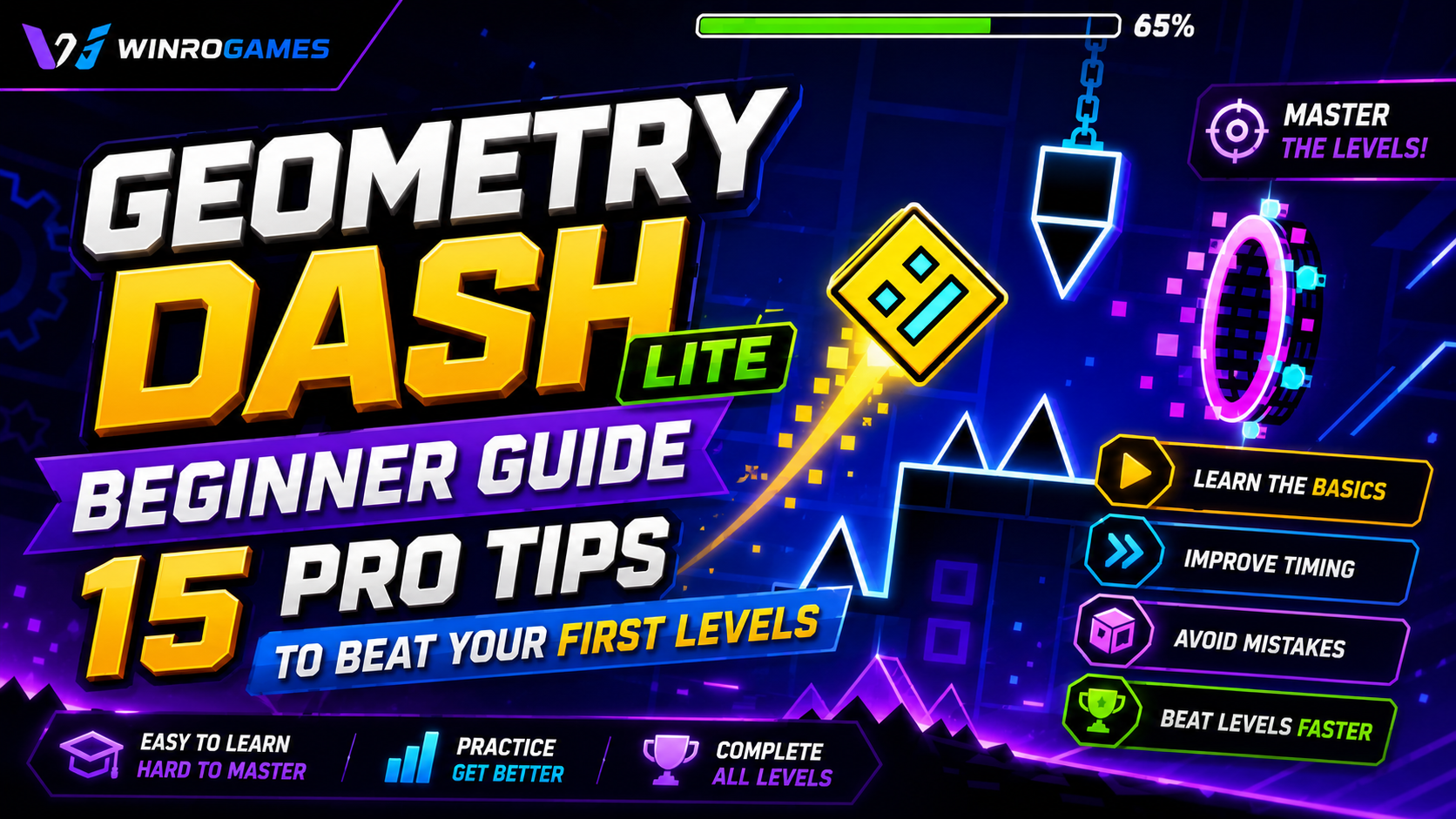
I wrote a whole beginner guide about this game, and it still deserves a spot on this list. Geometry Dash reduces reflex gaming to its purest form: one input. Tap to jump. That's it. The complexity comes from what you're jumping over — spikes, saw blades, gravity portals, moving platforms, and obstacles timed to the millisecond with the background music. There's only one correct moment to tap for each obstacle. Miss it by a fraction of a beat, and you're sent back to the beginning of the level.
What makes Geometry Dash a true reflex test isn't the basic levels like Stereo Madness. Those are pattern recognition warm-ups. The reflex killer is the Demon difficulty tier — user-created levels like "Bloodbath" and "Acheron" that require thousands of frame-perfect inputs over several minutes. One mistake at 98% completion, and you start over. The psychological pressure of that final stretch is part of the challenge. Your hands shake. Your heart pounds. And you learn what your reflexes actually look like under maximum stress.
The mobile version's touch controls are surprisingly responsive, though serious players swear by high-refresh-rate monitors and mechanical keyboards. Either way, the game measures your reaction consistency like few others.
8. Super Hexagon — Six Minutes to Mastery, Six Hours to Sanity Loss
Platform: PC, Mobile | Reflex Skill Tested: Rotational awareness, pattern recognition at high speed, visual processing under sensory overload
Terry Cavanagh's minimalist masterpiece looks simple. You control a tiny triangle orbiting a central hexagon. Walls close in from the edges. Rotate left or right to avoid them. Survive 60 seconds to clear a level. That's the entire game. And it is one of the most intense reflex challenges ever created.
The genius of Super Hexagon is in how it overwhelms your visual processing. The walls pulse in sync with a chiptune soundtrack. The background shifts colors. The patterns rotate and reverse direction without warning. Your brain has to filter signal from noise in real time, and the only way to survive is to stop thinking consciously and let your peripheral vision take over. When you enter the flow state — when the patterns click and your thumbs move before your conscious mind processes the wall — it feels like time slows down. That sensation is your reflexes operating at peak efficiency.
The game's creator famously said it takes six minutes to learn and six hours to beat the hardest difficulty. He's not exaggerating. The final level, "Hyper Hexagonest," has a completion rate so low that the achievement for beating it is a badge of honor in indie gaming circles. If you can survive 60 seconds on that mode, your reflexes are officially elite.
7. osu! — Wait, Didn't We Already Cover This? (The Other Mode)
Platform: PC (free) | Reflex Skill Tested: Hand independence, rhythmic precision, multi-limb coordination
I'm cheating slightly by including Osu! twice, but hear me out: the osu!mania mode is a completely different reflex challenge from the standard clicking mode. It's a vertical scrolling rhythm game in the style of Dance Dance Revolution or Beatmania — notes fall from the top of the screen in multiple columns, and you press the corresponding keys as they reach the bottom. At high difficulty, you're processing seven or more columns of notes simultaneously, with patterns that require your left and right hands to operate independently.
This is called hand independence, and it's a distinct reflex skill from pure reaction speed. Your brain has to split attention across multiple input channels while maintaining perfect rhythm. Jazz drummers and concert pianists train this skill for years. Osu!mania gives you a gamified version that's equally brutal. The highest-difficulty maps feature note densities exceeding 20 notes per second across seven keys. That's not a typo. Twenty distinct inputs per second, each requiring precise timing within a 30-millisecond window for perfect accuracy.
Start with four-key mode and work upward. The progression from fumbling beginner to sight-reading complex patterns is one of the most satisfying skill curves in gaming. Your fingers will literally move faster after a few months of practice.
6. Celeste — Precision Platforming That Demands Perfection
Platform: PC, Consoles | Reflex Skill Tested: Split-second input timing, aerial control, chain movement execution
At first glance, Celeste looks like a charming pixel-art platformer about climbing a mountain. And it is that — the story about mental health and self-acceptance is genuinely beautiful. But underneath the heartfelt narrative is a platforming engine so tight and demanding that it spawned an entire speedrunning subculture. The game introduces mechanics gradually: a dash that recharges when you touch the ground, wall jumps, moving platforms, and environmental hazards. By the late-game chapters, you're chaining dashes, wall jumps, and momentum carries through screens that require 20+ precise inputs in under ten seconds.
What makes Celeste a reflex test rather than just a hard platformer is the respawn system. When you die — and you will die thousands of times — you restart at the beginning of the current screen instantly. No loading screen. No animation. Just immediate retry. This loop is so fast that dying and restarting become part of the rhythm. You'll die, adjust, die again, adjust again, and eventually thread through a screen that felt impossible ten minutes earlier. The game teaches your fingers the patterns through sheer repetition, and the speed at which you internalize new mechanics is a direct measure of your adaptive reflexes.
The B-side and C-side remix levels are where the reflex demands truly escalate. These optional challenges reimagine the main game's screens with tighter timing windows and longer input chains. Completing all C-sides is a legitimate gaming achievement that puts your reaction time in the top percentile of players.
5. Enter the Gungeon — Bullet Hell Meets Roguelike Chaos
Platform: PC, Consoles | Reflex Skill Tested: Pattern recognition, dodge timing, multi-threat tracking
Bullet hell games have been testing reflexes since the arcade era, but Enter the Gungeon modernizes the formula with roguelike progression and an absurd sense of humor. You navigate procedurally generated rooms filled with enemies that fill the screen with projectiles. Your primary defensive tool is the dodge roll — a brief invincibility window that lets you phase through bullets. Master the dodge roll timing, and you can survive rooms that look physically impossible. Panic and roll too early, and you'll land directly on another bullet.
The reflex challenge in Gungeon is multi-layered. You're tracking your character's position, the trajectories of dozens of enemy bullets, the cooldown on your dodge roll, your active weapon's reload timing, and the positions of environmental hazards — all simultaneously. Boss fights escalate this to absurd levels, with screen-filling attack patterns that require pixel-perfect movement through gaps that appear and disappear in fractions of a second. The game doesn't just test raw reaction speed; it tests your ability to process chaos and find the safe path through it.
What separates good Gungeon players from great ones is the transition from reactive dodging to predictive positioning. Beginners dodge bullets they see. Experts position themselves where bullets won't be. That cognitive shift — from reaction to anticipation — is the highest expression of reflex skill.
4. Beat Saber — Full-Body Reflex Training in VR
Platform: VR (Meta Quest, PSVR, PC VR) | Reflex Skill Tested: Full-body reaction time, hand-eye coordination, spatial awareness in 3D
If you want to physically feel your reflexes improving, Beat Saber is unmatched. You stand in a neon void with two lightsabers — one red, one blue — and colored blocks fly toward you in time with music. Slice each block in the correct direction with the correct saber. Dodge walls. Avoid bombs. At low difficulty, it's a fun rhythm workout. At Expert+ difficulty, it's a full-body reflex test that pushes your reaction speed, arm coordination, and cardiovascular endurance simultaneously.
The physicality changes everything. In most reflex games, your hands are stationary on a keyboard or controller. In Beat Saber, your entire upper body is the controller. You're swinging, ducking, sidestepping, and crossing your arms at speeds that feel superhuman. Expert+ maps can exceed 300 blocks per minute — that's five distinct arm movements every second, each requiring directional precision within a narrow angle for maximum points. Your brain is processing 3D spatial information while your muscles execute complex motor patterns. It's the closest gaming gets to martial arts training.
The VR requirement limits accessibility, but if you have access to a headset, this is the reflex game that will make you sweat. Competitive players routinely achieve reaction times under 100 milliseconds on ranked maps. Your body learns the patterns faster than your conscious mind can track them.
3. Neon White — Speedrunning as a Core Mechanic
Platform: PC, Consoles | Reflex Skill Tested: Route optimization, rapid input sequencing, movement execution under time pressure
Neon White is what happens when you take a first-person shooter, remove the shooting, and replace it with a card-based movement system where your goal is to reach the exit as fast as humanly possible. Each level is a floating platform playground. You collect Soul Cards — weapons that also grant movement abilities when discarded. A pistol card lets you double jump. A rifle card lets you dash forward. An SMG card launches you upward. The puzzle isn't just completing the level — it's threading together a sequence of card uses and discards that shaves milliseconds off your time.
What makes this a reflex test is the sheer speed of execution required for top times. The global leaderboard shows replays of the fastest players, and watching them is disorienting — they're not just playing the level, they're exploiting every pixel of the geometry, chaining ability uses so fast that the animations barely have time to play. Your brain has to plan the optimal route, then your fingers have to execute it without hesitation. One fumbled input costs you the leaderboard position.
The game cleverly segments levels into short sprints (most take under 30 seconds), which creates that "one more try" loop that reflex games thrive on. You'll finish a run, see you're 0.03 seconds behind the gold medal time, and immediately restart. Four hours later, you're still chasing milliseconds. That's reflex training disguised as addictive game design.
2. Cuphead — Hand-Drawn Hell
Platform: PC, Consoles | Reflex Skill Tested: Pattern memorization, multi-phase boss adaptation, tight parry timing
Don't let the 1930s cartoon aesthetic fool you. Cuphead is a brutal run-and-gun boss rush that demands frame-perfect dodging, shooting, and parrying across multi-phase encounters that can stretch beyond three minutes of continuous concentration. The game's visual style is a deliberate deception — it looks charming and whimsical while it's absolutely destroying your confidence.
Each boss has multiple phases with completely different attack patterns. You might spend two minutes learning the first phase, only to discover the second phase introduces new mechanics that kill you instantly. The reflex test is cumulative: you have to master every phase well enough to execute them back-to-back without dying. The final phase is always the most demanding, which means you're performing at your peak reflex capacity at the exact moment the fight is hardest. That's psychological warfare disguised as game design.
The parry mechanic deserves special mention. Certain pink objects can be slapped in mid-air to build your super meter. The parry window is tight — around 100 milliseconds — and you often need to parry while dodging multiple other threats. In the late-game bosses and Expert difficulty, parry timing becomes the difference between victory and watching that loading screen for the 200th time. If you can beat Cuphead on Expert, your reflexes are officially certified. Frame it. Put it on your resume.
1. Sekiro: Shadows Die Twice — The Ultimate Reflex Final Exam
Platform: PC, Consoles | Reflex Skill Tested: Deflection timing, attack pattern recognition, split-second combat decisions
I can already hear the comments. "Sekiro isn't a reflex game, it's a rhythm game with swords." And you're right. But that's exactly why it takes the top spot. Sekiro distills reflex gaming into its most elegant form: the deflection system. Enemies attack. You press the block button at the exact moment their strike lands to deflect — a perfect parry that damages their posture and opens them for a counterattack. The deflection window is approximately 200 milliseconds on standard difficulty, which is generous compared to some entries on this list. The catch? You have to do it dozens of times per fight, against enemies with deliberately deceptive attack animations, without missing.
The genius of Sekiro is how it punishes the wrong kind of reflexes. Most action games reward fast button pressing. Sekiro punishes panic inputs brutally. If you spam the block button, the deflection window shrinks. If you dodge when you should deflect, you eat the full damage. The game demands calm, deliberate reactions at high speed. It's the difference between a sprinter flailing their arms and an Olympic fencer making precise, economical movements. Your reflexes have to be fast and controlled and adaptive to different enemy rhythms.
Boss fights like Genichiro, Owl Father, and the final encounter with Isshin the Sword Saint are legendary reflex gauntlets. Genichiro's floating passage combo requires seven perfectly timed deflections in under two seconds. Isshin's spear phase mixes delayed thrusts and lightning-fast sweeps that test your ability to read subtle animation tells and react correctly. When the combat clicks — when you're deflecting entire combos without conscious thought, reading enemy intent from the tiniest shoulder twitch — it's the most satisfying reflex experience in all of gaming. No other game has made me feel like my nervous system was being directly upgraded.
If you beat Sekiro, every other game on this list will feel slightly slower. That's not an exaggeration. The game literally changes your reaction baseline.
How to Actually Improve Your Reflexes (Beyond Just Playing)
Playing these games is the training, but there are ways to accelerate your progress and maximize the reflex gains. Here's what actually works, backed by sports science and competitive gaming research.
Sleep Is Your Secret Weapon
Reaction time drops significantly when you're sleep-deprived. A 2022 study in Sleep Medicine found that participants who slept fewer than six hours showed reaction times 30% slower than well-rested controls. Your brain consolidates motor learning during REM sleep. Those Sekiro deflection patterns you practiced all evening? Your brain is literally strengthening those neural pathways while you sleep. Skip sleep, skip the gains. Competitive Osu! players treat sleep like a performance-enhancing drug — because it is.
Hydration and Nutrition Matter
Even mild dehydration (1–2% body water loss) impairs cognitive performance and reaction speed. Keep water nearby during gaming sessions. Caffeine can temporarily boost reaction time — 40–100mg about 30 minutes before playing — but avoid energy drink crashes that tank your focus mid-session. Complex carbohydrates provide sustained glucose for brain function during long practice sessions. Your brain consumes roughly 20% of your daily calories. Feed it properly.
Warm Up Before Hard Sessions
Professional esports players don't jump straight into ranked matches. They spend 15–30 minutes warming up with easier content to activate neural pathways and establish rhythm. Apply the same principle: start with easier levels, lower difficulties, or slower songs before attempting your current challenge ceiling. Your reaction time peaks about 20 minutes into a session and stays elevated for 60–90 minutes before fatigue sets in. Time your hardest attempts for that window.
Record and Review Your Failures
When you die in a reflex game, you usually know that you messed up but not why. Recording your gameplay and watching deaths in slow motion reveals reaction errors invisible in real time. Maybe you're pressing the button 50ms too early. Maybe your eyes are fixating on the wrong part of the screen. Maybe you're tensing your shoulders, which adds 15ms of physical delay to your finger movement. These micro-optimizations add up to significant reaction time improvements.
Cross-Train Across Multiple Reflex Types
Don't just grind one game. Mix rhythm games (timing), bullet hells (spatial tracking), and action games (decision-making under pressure). Different games stress different components of the reflex system. A well-rounded reflex training diet produces faster overall improvement than hyper-specialization. The skills transfer between games more than you'd expect. Osu! players pick up bullet hell games faster. Sekiro veterans adapt to new action games in half the time.
How to Measure Your Reflex Progress Objectively
"I feel faster" isn't data. Here's how to actually track whether your reflexes are improving.
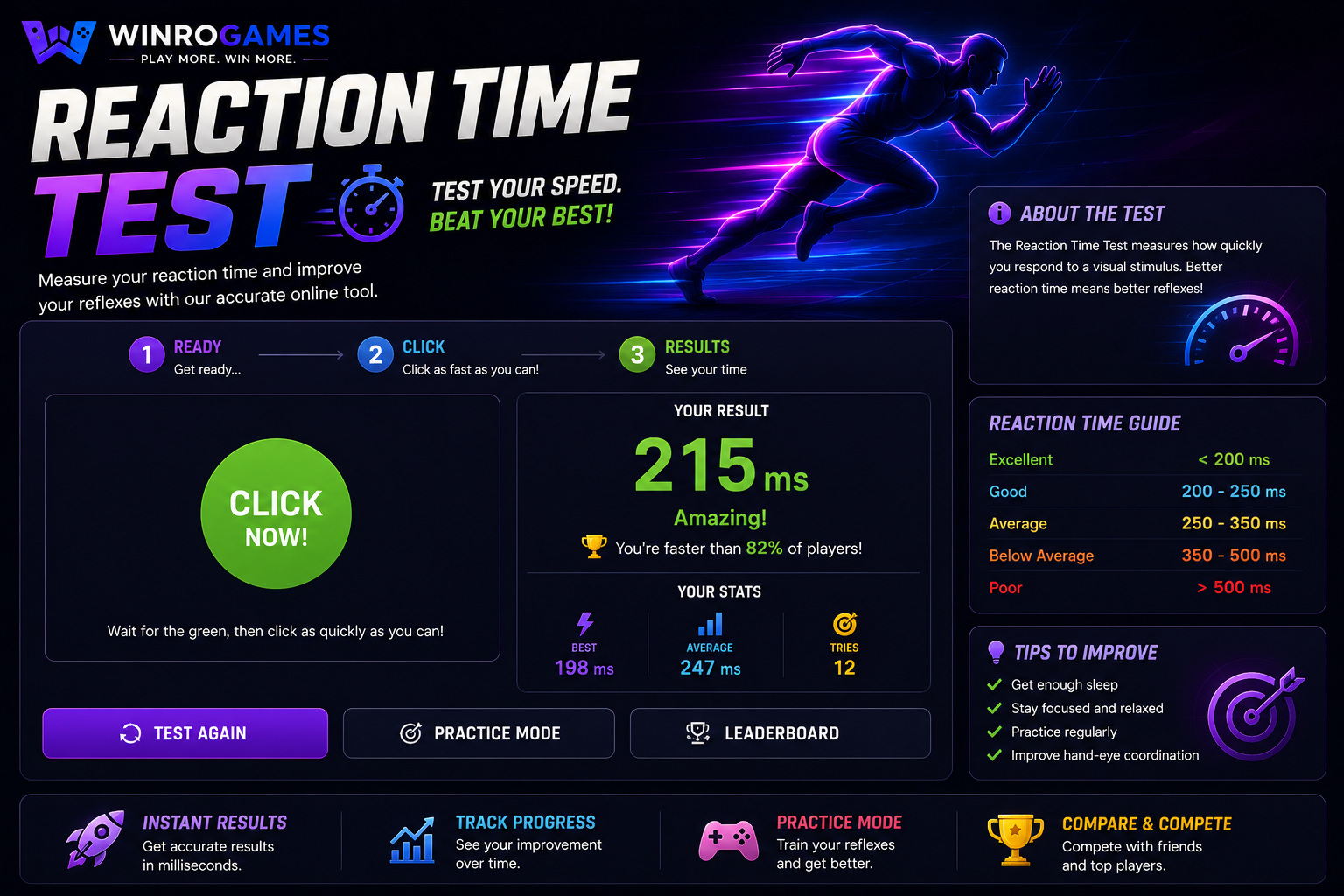
- Human Benchmark Reaction Time Test. A free online tool that measures your simple reaction time to a visual stimulus. The average human reaction time is 200–250 milliseconds. Competitive gamers often test between 150–180ms. Test yourself monthly and track the trend.
- Aim Lab (Steam, free). A dedicated aim trainer with detailed analytics on reaction time, flick speed, tracking accuracy, and decision-making speed. Used by professional Valorant and CS2 players for warmup. The Gridshot and Spidershot tasks directly measure reaction-to-click speed in milliseconds.
- In-game metrics. Osu! tracks unstable rate (timing consistency). Geometry Dash shows attempt counts. Celeste displays death counts per screen. These numbers trending downward over time is objective proof your reflexes are sharpening.
- Physical reaction tests. The ruler drop test — have a friend drop a ruler between your fingers, measure where you catch it. Repeat monthly. Lower catch distance equals faster reaction time. Crude but effective, and no screen required.
The Games Are the Gym. Keep Showing Up.
Here's the uncomfortable truth about reflexes: they decline with age unless actively maintained. Peak reaction time typically occurs between ages 18–24, then gradually slows. But — and this is crucial — the decline is much smaller in people who regularly engage in reflex-intensive activities. A 40-year-old who plays rhythm games daily will out-react a 20-year-old who doesn't. Consistency matters more than age.
Pick one game from this list. Play it regularly. Track your progress. Watch your reaction time drop. The first time you deflect a Sekiro combo on pure instinct, or thread a bullet hell pattern you couldn't even perceive two weeks earlier, or sight-read an Osu! map that used to look like incomprehensible noise — that's when you'll understand. Reflexes aren't a gift. They're a skill. And these ten games are the best tools on the planet for sharpening yours.
Now close this article, launch one of these games, and find out how fast you really are. The leaderboards are waiting. Don't keep them waiting too long — someone out there is getting faster while you're reading. Go.
Which of these games has humbled you the most? Or is there a reflex-testing gem I missed that deserves to be on this list? Drop it in the comments. I'm always looking for the next game that'll make my hands feel too slow.