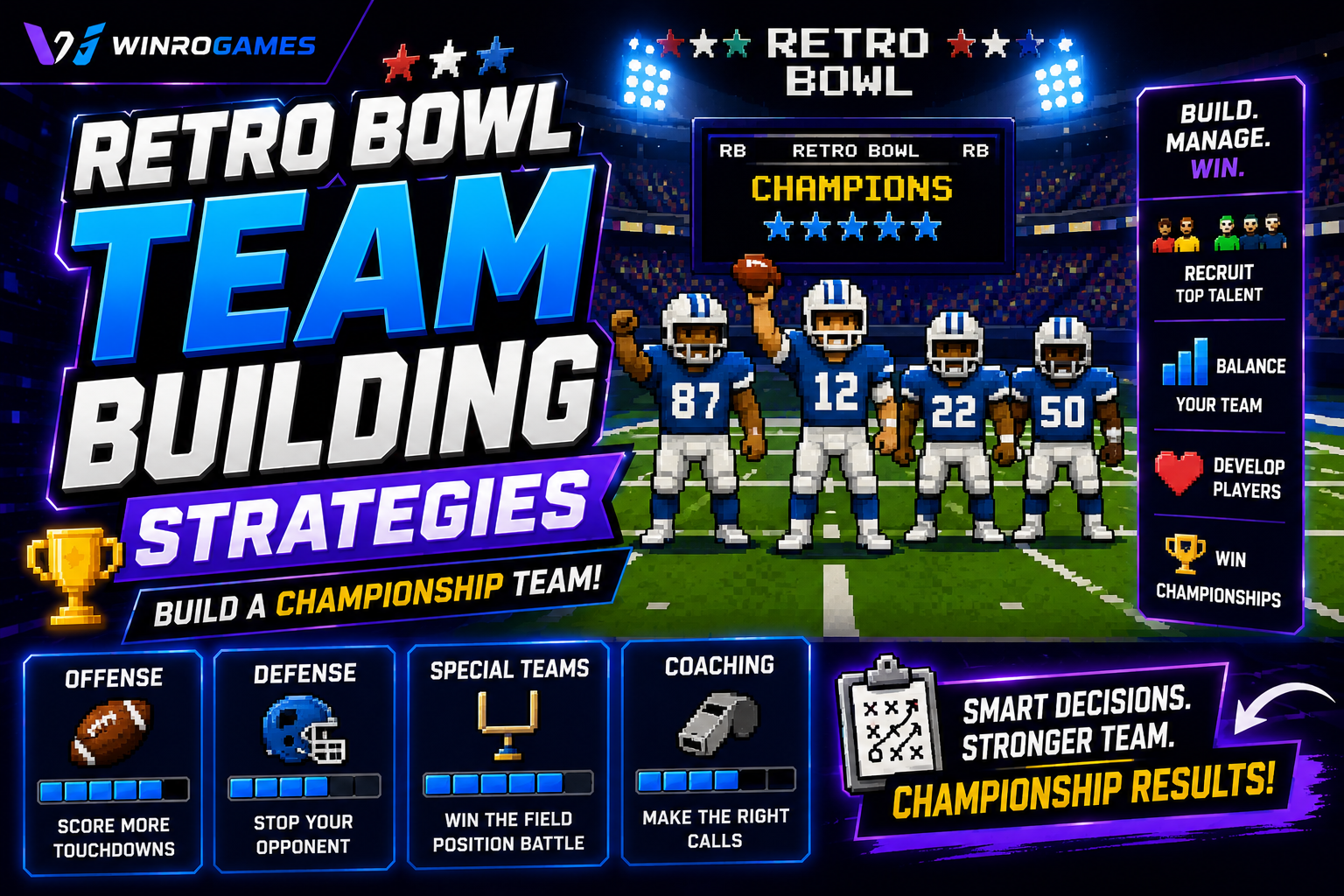
Let's be honest — your first few Retro Bowl seasons were probably a disaster. You drafted a flashy wide receiver in round one, ignored your offensive line entirely, blew your salary cap on a free agent quarterback with terrible morale, and watched your defense give up 40 points a game while you threw four interceptions trying to force deep balls to your one good player. It happens to everyone. Retro Bowl looks like a cute pixel-art football game, but under the hood, it's a surprisingly deep roster management sim that will absolutely punish bad team building.
I've burned through enough rebuilds to know what works and what doesn't. I've taken one-star teams to the Retro Bowl in three seasons. I've kept dynasties alive for 15+ years without cap hell. And I've made every mistake in the book so you don't have to. This guide covers everything — draft philosophy, positional value, salary cap chess, free agency timing, and the hidden mechanics the tutorial never mentions. Let's build you a winner.
Why Most Retro Bowl Teams Fail (Before You Even Play a Snap)
The biggest killer in Retro Bowl isn't a tough schedule or bad RNG — it's poor resource allocation. You have three currencies in this game: salary cap space, draft picks, and coaching credits. Every decision you make spends one of these. The players who struggle are the ones who don't understand the exchange rate.
Spending $30 million on an elite quarterback when your defense is a bunch of nameless two-star fill-ins? That's a bad trade. Burning coaching credits to boost a 30-year-old running back's speed instead of developing a rookie? Also bad. Winning consistently means understanding what actually moves the needle on the field and ruthlessly cutting everything that doesn't. Nostalgia for a player who won you a title three seasons ago is how dynasties die.
Before we get into specific strategies, internalize this rule: Retro Bowl rewards efficiency over flash. A well-coached three-star player in the right system will outperform a mismanaged five-star diva every time. Build the system first. The stars will follow.
The Positional Value Hierarchy: Who Actually Matters
Not every roster spot is created equal. In fact, some positions in Retro Bowl are nearly useless unless you're running a very specific scheme. Here's the definitive ranking based on impact per salary dollar.
Tier 1: Must-Have Positions (Spend Here)
- Quarterback. You control the QB on every offensive snap. A good one makes your entire offense better — throwing accuracy, range, and stamina directly impact your ability to move the ball. A bad QB limits your playbook and forces you into a run-heavy, low-ceiling offense. Invest here first. Always.
- Wide Receiver (at least one elite). Speed kills in Retro Bowl. A fast WR who can beat press coverage deep changes the geometry of the field. Defenses have to respect the deep ball, which opens up underneath routes and the running game. One true WR1 is non-negotiable.
- Defensive Lineman (one elite pass rusher). Sacks and pressures force incompletions and interceptions. The game simulates defense without your input, so defensive success comes down to player ratings. A five-star DL will generate consistent pressure that makes your entire secondary look better. This is the defensive position with the highest individual impact.
Tier 2: High Value (Fill When You Have Cap Room)
- Tight End. A security blanket who can block and catch. On short-yardage plays and in the red zone, a good TE is a mismatch nightmare. They're also cheaper than WRs with comparable catching ability. If you run a balanced offense, don't sleep on this position.
- Running Back. A luxury, not a necessity. The default RB is serviceable if your offensive line is decent. But a fast RB with good catching hands turns screen passes and outside runs into chunk plays. If you're a pass-heavy player, you can get away with a budget RB. If you love the ground game, invest here.
- Defensive Back (one ball-hawking safety or corner). Interceptions flip games. A DB with high speed and tackling can erase deep threats and create turnovers. One elite DB paired with a good pass rush is a formula for a top-5 defense.
Tier 3: Fillers (Don't Overpay)
- Offensive Linemen. Here's the controversial take: OL is overrated in Retro Bowl. Yes, they help with run blocking and give you more time in the pocket, but the impact is subtle compared to skill positions. One decent OL is fine. A full line of five-star blockers is a waste of cap space that could be spent on actual playmakers.
- Linebackers. The middle ground of your defense. LBs contribute to run stopping and short pass coverage, but they don't generate the game-changing plays that DLs and DBs do. Draft them if they fall, but don't chase them.
- Kicker. If you're scoring touchdowns consistently, you don't need a great kicker. A one-star kicker makes extra points and short field goals just fine. Save your cap space for positions that touch the ball more than four times a game.
Draft Day: How to Actually Win the Draft
The draft is where dynasties are built. Free agency is expensive — you're paying market rate for established talent. Rookies are cheap, controllable for years, and can develop into stars with coaching. Here's how to approach every draft with a plan.
Pre-Draft Scouting: Know Your Needs Before the Picks Start
Never walk into a draft blind. Before the draft screen even loads, look at your roster and identify your two biggest holes. Maybe you're losing your WR1 to free agency. Maybe your defense is aging. Write those needs down — mentally or literally — and stick to them. Drafting the "best available player" sounds smart until you end up with four running backs and no secondary.
Round One: Premium Positions Only
Your first-round pick should almost always be a quarterback, wide receiver, or defensive lineman. These are the positions where elite talent makes the biggest difference, and they're expensive to fill in free agency. Getting a five-star potential QB on a rookie contract is how you free up $20 million in cap space for three seasons. Don't waste a first-rounder on a kicker. Don't be that person.
Rounds Two and Three: Fill Holes, Chase Potential
By the middle rounds, the elite talent is gone. Now you're looking for players with high potential ratings even if their current overall is low. A two-star rookie with four-star potential is a better pick than a three-star rookie with no room to grow. Those developmental players need coaching credits and playing time to blossom, but a season or two of investment turns a late-round pick into a reliable starter on a bargain contract.
Late Rounds: Take Flyers on Traits
Speed is the most expensive attribute to improve with coaching credits. In the later rounds, prioritize players with high base speed regardless of their overall rating. A WR with max speed and terrible catching is still useful as a decoy who stretches the field. A DB with elite speed can contribute on special teams and develop into a starter. Draft traits, not overalls, when the talent pool thins out.
Salary Cap Management: The Game Behind the Game
The salary cap increases as your team improves and your fan base grows, but it never increases fast enough to keep everyone. You will lose players you love. That's not a failure — it's the design. The best Retro Bowl players embrace roster turnover instead of fighting it.
The 30-Year-Old Rule
Players begin declining around age 28-29, and the drop accelerates after 30. When a star player hits 30, you have a choice: trade them while their value is still high, or let them retire on your roster and eat the declining production. Emotionally, it hurts to trade the QB who won you three titles. Strategically, it's often the right move. Flip an aging star for a first-round pick, draft their replacement, and stay young and cheap. Sentimentality is a cap space killer.
Never Pay Market Rate for Depth
Your backups shouldn't cost real money. Fill your bench with late-round rookies on minimum deals and undrafted free agents with one good trait. If your starting WR goes down for two games, a budget backup can hold the line. Don't pay $8 million for a WR2 when a rookie on a minimum contract can catch three balls a game just fine behind your WR1.
Front-Load Contracts When You Have Cap Room
If you have excess cap space in a given season, use it. Extend young stars early with front-loaded deals that pay more now and less later. A quarterback who signs a five-year extension at age 25 with a decreasing cap hit over time is the most valuable asset in the game. By year four and five of that deal, you're paying elite QB money for pennies on the dollar, and that surplus cap room funds the rest of your roster.
Free Agency: Buy Wins, But Spend Smart
Free agency is a trap for the undisciplined. Shiny five-star players hit the open market, and your instincts scream "SIGN THEM ALL." Resist. Free agents are expensive, and their contracts are almost never bargains. You're paying retail price. The draft is wholesale. Build through the draft, supplement through free agency.
When Free Agency Makes Sense
- You're one piece away. If your roster is stacked except for one glaring hole and you're in a championship window, go get your guy. A one-year rental to push you over the top is worth the cap hit.
- A young star somehow hits the market. Occasionally, the AI lets a 24-year-old with five-star potential walk. That's worth chasing — you'll pay a premium, but you're getting prime years, not a decline phase.
- Your draft was a disaster. If you whiffed on your picks and a position group is unplayably bad, free agency is your emergency fix. Just don't make it a habit.
When to Walk Away
If a free agent is 29 or older and asking for a multi-year deal at top-of-market money, let someone else pay that bill. You're buying the decline, not the prime. Also, avoid bidding wars. If two teams are driving up the price, bow out. There's always another player, another draft, another season.
Coaching Credits: The Hidden Development Engine
Coaching credits are easy to ignore and devastating to waste. You earn them through wins, achievements, and fan approval. Spend them wisely, and your players level up faster. Blow them on unimportant upgrades, and your roster stagnates.
Priority Spending
- Speed on skill players. Speed is the best attribute in Retro Bowl. It impacts separation, breakaway runs, defensive range, and return ability. Boost speed on your QB, WR, RB, and DB before anything else.
- Stamina on your QB. A tired QB throws less accurately. Your QB touches the ball every offensive snap — keeping their stamina high means fourth-quarter comebacks are possible instead of interception fests.
- Catching on your TE and WR2. Drops kill drives. Once speed is handled, invest in hands. A receiver with 10 speed and 3 catching is fast enough to get open and unreliable enough to break your heart.
- Tackling on defensive players. Nothing worse than a DB who gets to the ball carrier and whiffs. Tackling upgrades prevent yards after catch and broken runs.
Scheme Fit: Build Around Your Play Style
Your roster should reflect how you actually call plays, not some abstract "best lineup" theory. Be honest with yourself about your tendencies and build accordingly.
The Pass-Heavy Offense
If you throw 40 times a game, your WR room matters more than your RB. Invest in two solid receivers and a pass-catching TE. Your offensive line needs to be good enough to give you a clean pocket, but you don't need elite run blockers. A receiving-back who can turn checkdowns into first downs is more valuable than a power runner who needs 20 carries to get going.
The Ground-and-Pound Offense
If you love running the ball, your offensive line value jumps significantly. Invest in at least two quality OL and a strong RB. Your QB can be a game manager — accuracy and stamina matter, but you don't need a cannon arm. Use your WRs as blockers and occasional deep threats to keep defenses honest.
The Balanced Attack
If you mix run and pass evenly, prioritize versatility. A TE who can block and catch is your best friend. A RB with decent receiving stats lets you audible into passes without subbing personnel. Your roster should avoid extreme specialists — a one-dimensional player limits your play-calling flexibility.
Morale and Condition: The Stats You're Ignoring
Player morale isn't just flavor text. Low morale tanks performance. A five-star WR with terrible morale will drop passes and run lazy routes. Keeping your locker room happy is a competitive advantage.
- Win games. Nothing boosts morale like winning. Players on losing streaks get frustrated regardless of their individual stats.
- Meet with players. When a player requests a meeting, take it. Spending a few coaching credits to boost morale is cheaper than watching their trade value plummet.
- Don't bench stars without cause. Benching a high-rated player for a rookie tanks their morale and can spread negativity through the locker room. If you're developing a young player behind a veteran, manage the transition carefully.
- Rest your starters when condition drops. Playing a tired player increases injury risk and reduces effectiveness. Use your bye week to rest key contributors, and rotate backups in during blowouts to keep your starters fresh for important games.
Complete Rebuild Strategy: From One-Star to Champion
Taking over a bad team is the most satisfying challenge in Retro Bowl. Here's the step-by-step blueprint I use for every rebuild.
- Year One: Tear It Down. Trade every player over 27 with trade value. Accumulate draft picks. Your record will be terrible — embrace it. A top-3 draft pick is more valuable than a 6-11 season that misses the playoffs anyway.
- Year One Draft: Draft a QB. If a potential franchise QB is available, take them. If not, draft the best defensive player and tank another year for the QB class. A bad team without a QB is just a bad team. A bad team with a young franchise QB is a future contender.
- Year Two: Draft Defense and Skill Positions. With your QB in place, spend the next draft building the defense and adding weapons. Target a WR1 and a DL in the first two rounds. Fill OL and secondary in the later rounds.
- Year Three: Compete. Your young core should be developing. Use free agency to patch any remaining holes with short-term deals. Aim for the playoffs. A first-round exit is fine — the experience boosts your young players' ratings.
- Year Four and Beyond: Contend and Reload. You're in the window. Keep drafting well, extend your core players before they hit free agency, and trade aging stars a year early rather than a year late. The goal isn't one Retro Bowl — it's five.
The Trade Market: Steal Value When the AI Slips Up
The CPU in Retro Bowl isn't great at evaluating draft picks. You can exploit this. A future first-round pick is often valued lower than a current mid-round pick by the AI, even though future firsts are significantly more valuable in reality. If you're in a win-now mode, trading your future picks for established players can push you over the top. Just don't trade away your entire future for one season — the bill comes due.
Also, shop your aging players before they decline. A 29-year-old WR coming off a 1,500-yard season still has trade value. A 31-year-old WR who just posted 600 yards? Nobody wants him, and his contract is an anchor. Be proactive, not reactive.
The One Mistake Even Good Players Make
Overvaluing overall rating. A player's overall number is a rough guide, not a definitive ranking. Look at the individual attributes. A 4.5-star WR with 10 speed and 6 catching plays better than a 5-star WR with 7 speed and 9 catching in many schemes. Speed is king. Acceleration determines how quickly they reach top speed. Stamina dictates fourth-quarter performance. Understand what each attribute does in the context of your system, and don't let the star rating make decisions for you.
Final Thoughts: Dynasty Building Is a Mindset
Retro Bowl isn't about one great season. It's about building a machine that wins year after year, cycling through players and eras without missing a beat. The best franchises in this game aren't the ones with the most five-star players — they're the ones with the smartest cap sheets, the deepest draft pipelines, and the discipline to move on from beloved players before the decline hits.
Start your next save with these principles. Draft a QB. Build through the trenches. Spend on speed. Trade aging stars for picks. Stay young, stay cheap, and stay hungry. The Retro Bowl trophy belongs to the team that manages the margins, not the one that throws the biggest contracts at the biggest names.
Now go clear your cap space, scout those rookies, and get to work. Somewhere out there, a three-star quarterback with five-star potential is waiting to lead your dynasty. Find him. Draft him. Win with him. And when he turns 30, trade him for a haul and do it all over again. That's Retro Bowl. That's the game within the game.
What's your go-to team building strategy? Running a pass-heavy offense or pounding the rock? Drop your setup in the comments — I'm always looking for new schemes to test.