December 31, 2020. The day the internet had been dreading for three years finally arrived. Adobe pulled the plug on Flash Player. Just like that, a technology that had powered browser gaming for over two decades — that had given us Line Rider, Bloons Tower Defense, Fancy Pants Adventure, Super Meat Boy (originally a Flash prototype), Alien Hominid, and thousands of other creative experiments — was gone. Browsers blocked it. Adobe stopped updating it. The coffin was sealed.
The obituaries were brutal. "Browser gaming is dead," declared tech blogs. "The end of an era," mourned nostalgia pieces. Archivists scrambled to preserve Flash games through projects like Flashpoint, saving what they could before the digital dark age swallowed two decades of creative history. For a moment, it genuinely felt like the end of something irreplaceable. Flash wasn't just a plugin. It was a culture — Newgrounds animations, Kongregate badges, Miniclip high scores, Armor Games strategy titles. An entire generation learned to game through a browser window running Adobe Flash.
But here's what the obituaries missed. While everyone was mourning, something remarkable was already happening. The replacement was already in place. It had been growing quietly for years, and when Flash finally died, it didn't leave a vacuum — it left a foundation. HTML5, WebGL, and WebAssembly had been maturing in the background, and they were ready to do things Flash never could. What followed wasn't a funeral. It was an evolution. And four years later, browser gaming isn't just alive — it's bigger, faster, safer, and more capable than the Flash era ever dreamed possible.
Let's trace the full journey from the panic of 2017 (when Adobe first announced Flash's death) to the thriving browser gaming ecosystem of 2026. This is the story of how losing the thing that defined web gaming for a generation turned out to be the best thing that ever happened to it.
Chapter 1: What Flash Actually Was (And Why It Had to Die)
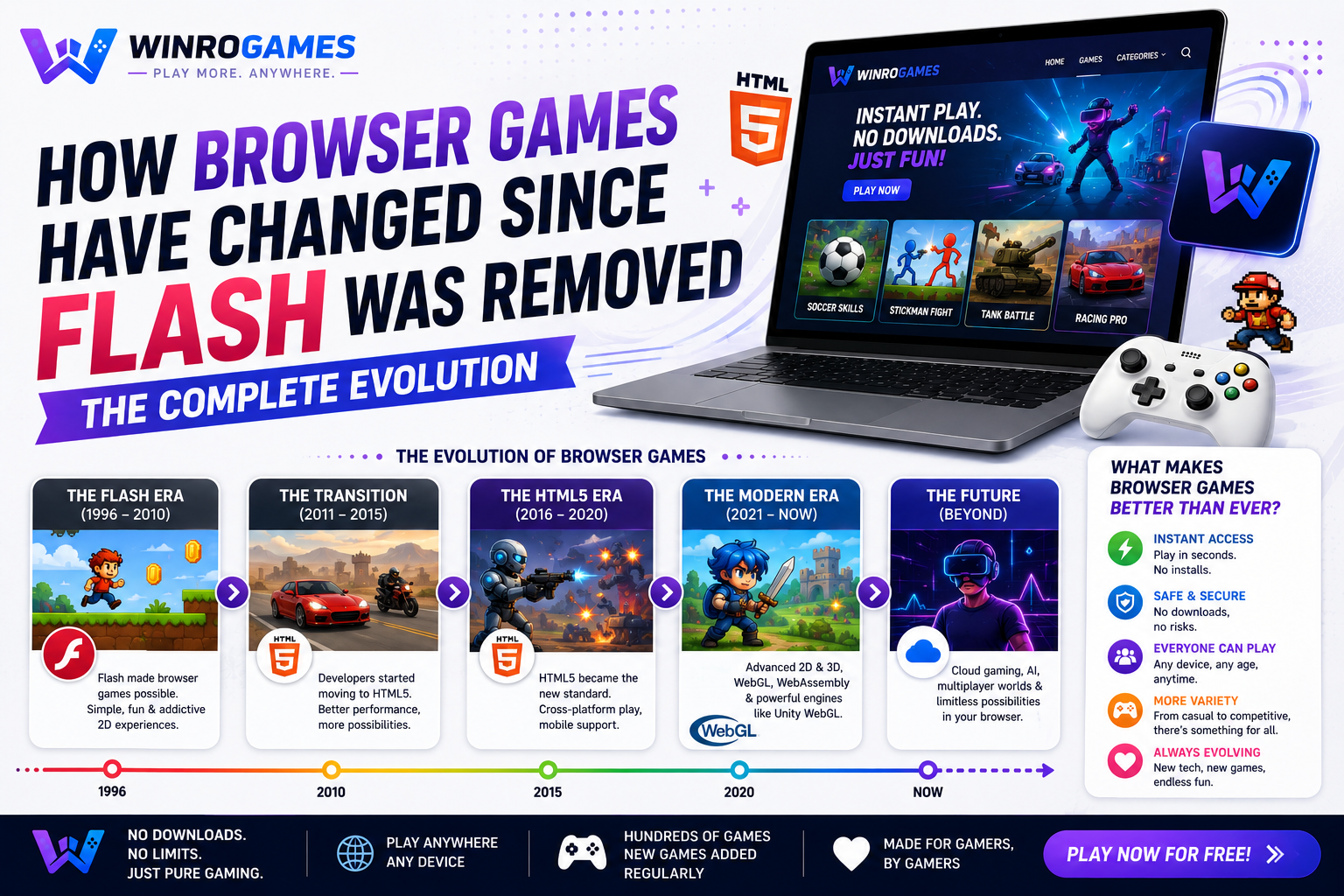
To understand why the transition mattered, you have to understand what Flash was — and wasn't. Adobe Flash (originally Macromedia Flash before Adobe's 2005 acquisition) was a multimedia platform for creating animations, rich internet applications, and — crucially for our story — browser games. It was a plugin. You installed it separately from your browser. It ran in its own little sandbox, disconnected from the webpage around it. Developers used a tool called Flash Professional to create .SWF files, which browsers would play through the Flash Player plugin.
At its peak in the late 2000s, Flash Player was installed on over 95% of internet-connected desktops. It was everywhere. And it was also, unfortunately, a security disaster. Flash vulnerabilities were one of the most common attack vectors for malware throughout the 2000s and 2010s. Adobe patched constantly. Hackers found new holes constantly. The cycle was endless. Steve Jobs's famous 2010 "Thoughts on Flash" open letter — the one that banned Flash from iPhones and iPads — cited security, performance, battery drain, and touch incompatibility as dealbreakers. He was right about all of it, even if his tone was characteristically dismissive.
Flash was also fundamentally a desktop technology. It never worked properly on mobile. It consumed battery life like nothing else. It crashed browsers regularly. It didn't support modern web standards like accessibility features, semantic HTML, or responsive design. As the web evolved toward mobile-first, secure, standards-based architecture, Flash became a relic. The announcement in July 2017 that Adobe would end support by 2020 wasn't a surprise to anyone paying attention. The surprise was that it took so long.
Chapter 2: The Panic Years (2017–2019)
When Adobe dropped the 2020 deadline, the reaction from the gaming community split into two camps. Camp One was denial. "They'll extend the deadline. Something will replace it. Flash can't actually die — there are too many games." Camp Two was grief. Developers who had built careers on Flash saw their life's work facing obsolescence. Players who had grown up on browser games watched their childhood libraries face digital extinction.
Some developers scrambled to port their Flash games to other platforms. Super Meat Boy had already made the jump to consoles years earlier. Binding of Isaac (which started as a Flash game) had been rebuilt in a proper engine. But for every success story, there were thousands of smaller games — experimental projects, hobbyist creations, one-person labors of love — that would never be ported. The Flash game ecosystem was like a vast library where most of the books existed in a single, fragile format that was about to become unreadable.
Enter the archivists. Projects like BlueMaxima's Flashpoint emerged to preserve Flash games before they vanished. Flashpoint is a preservation project that archives Flash games (and other web plugins) with a custom launcher that plays them locally. As of 2026, it has preserved over 160,000 games and animations. It's one of the most ambitious digital preservation efforts in history, and it exists because a community refused to let two decades of creative work disappear. If you want to play the Flash classics today, Flashpoint is how you do it. The games live on — just not in browsers.
Meanwhile, in the background, the replacement was already taking shape.
Chapter 3: HTML5 — The Foundation That Was Already There
HTML5 wasn't created to replace Flash. It was created to modernize the web. The fifth major revision of HTML introduced native support for audio and video embedding, the
The
The transition wasn't seamless. Developers who had spent years mastering ActionScript (Flash's programming language) had to learn JavaScript. Flash's visual timeline-based animation tools had no direct HTML5 equivalent. The tooling was less mature. But the direction was clear. Flash was a rented house. HTML5 was the land itself. The move was inevitable, even if the moving process was painful.
Chapter 4: WebGL — The 3D Revolution Flash Never Had
Here's where the story shifts from "replacement" to "upgrade." Flash could do 2D games beautifully. Flash could do simple 3D through software rendering, but it was slow, limited, and never a serious 3D gaming platform. WebGL changed everything. Released in 2011 but really hitting its stride around 2015–2017, WebGL brought hardware-accelerated 3D graphics to browsers. It gave JavaScript access to the device's GPU through the OpenGL ES API — the same graphics API used by mobile games and embedded systems.
Suddenly, browser games could do real 3D. Not software-rendered approximations. Hardware-accelerated, shader-powered, 60-FPS 3D graphics running natively in a browser tab. Games like Krunker.io emerged — a full first-person shooter with slide-hopping mechanics, sniper quickscoping, and custom maps, all running in a tab. That was impossible in Flash. The technology literally couldn't do it. WebGL made browser gaming capable of experiences that would have required a dedicated game engine and a download just a few years earlier.
WebGL 2.0 arrived in 2017, adding more advanced rendering features. And as of 2023–2024, WebGPU began rolling out — a next-generation graphics API for browsers that provides even lower-level access to GPU hardware, enabling compute shaders and advanced rendering techniques previously exclusive to native applications. Browser games in 2026 can tap into graphics capabilities that didn't exist on any platform when Flash was in its prime.
Chapter 5: WebAssembly — Near-Native Speed in a Browser
If WebGL gave browser games their graphics muscles, WebAssembly (WASM) gave them their processing power. Introduced in 2017 and supported across all major browsers by 2019, WebAssembly is a binary instruction format that runs at near-native speed in the browser. In plain English: it lets developers run code that's almost as fast as a native application, without leaving the browser.
Why does this matter for gaming? Because JavaScript — the traditional language of the web — is interpreted, not compiled. It's fast enough for most web applications, but for computationally intensive game logic, physics simulations, and complex AI, it can become a bottleneck. WebAssembly removes that bottleneck. Developers can write game code in C++, Rust, or other compiled languages, compile it to WASM, and run it in a browser at speeds approaching a native executable.
The practical impact is enormous. Game engines like Unity and Unreal Engine now export to HTML5 using WebAssembly. Games that would have required a standalone client in 2015 can run in a browser tab in 2026. Complex physics simulations. Large-scale multiplayer netcode. Procedural generation. AI pathfinding. All running in a browser at speeds that Flash developers could only dream about. Flash was an interpreter running inside a plugin. WASM is compiled code running at near-native performance. The difference is generational.
Chapter 6: What We Lost — The Flash Culture
Before we celebrate too much, let's be honest about what didn't survive the transition. Flash wasn't just a technology. It was a creative culture that the replacement ecosystem hasn't fully replicated. Flash games were often weird, personal, experimental, and rough around the edges in ways that modern browser games rarely are. Someone with a cracked copy of Flash Professional and a weird idea could create something overnight and share it with the world. The barrier to entry was almost nonexistent. The tools were visual and intuitive — you could animate characters on a timeline, draw directly in the authoring environment, and create interactive experiences without writing much code.
The result was an explosion of creativity. Games that didn't fit any genre. Games that were barely games — more like interactive toys or animated experiments. Strange humor. Dark themes wrapped in cartoon aesthetics. The kind of creative chaos that happens when the tools are accessible and the distribution platform (Newgrounds, Kongregate, Miniclip) has no gatekeepers.
HTML5 development is more powerful but also more technical. The tooling is less visual. JavaScript is more complex than ActionScript. The barriers to creating a browser game today are higher than they were during Flash's peak, even though the capabilities are vastly greater. Some of that wild, experimental energy has migrated to platforms like itch.io, where indie developers share weird, personal projects. But the specific culture of Flash gaming — the Newgrounds community, the voting systems, the sense that anyone could make a game and have it played by millions — hasn't been perfectly replicated.
What we gained in technology, we partially lost in accessibility. That's not a small trade-off.
Chapter 7: The .IO Explosion — A New Kind of Browser Game
While Flash was dying, something new was being born. The .io game phenomenon started around 2015 with Agar.io and exploded through the late 2010s with Slither.io, Diep.io, Wings.io, Starve.io, and dozens of others. These games shared a distinct DNA: simple graphics (often geometric shapes), massive multiplayer lobbies, short gameplay loops, and the addictive "one more round" quality that keeps players engaged for hours.
.IO games were built on HTML5 and WebSockets from the ground up. They were never Flash games. They represented a new philosophy of browser gaming — not single-player experiences or level-based adventures, but persistent multiplayer arenas where you drop in, compete, die, and restart in a continuous loop. The graphics were deliberately minimalist, which kept performance smooth on any hardware. The controls were simple enough to learn in seconds. The depth came from the competition, not the mechanics.
The .io era proved something important: browser games didn't need to replicate Flash's style to be successful. They could be something entirely different. The .io aesthetic — clean, geometric, multiplayer-focused — became the new face of browser gaming. For a generation of players who never experienced Flash, this was simply what browser games looked like. The transition wasn't a downgrade to them. It was the baseline.
Chapter 8: Mobile Changed Everything
Flash's fatal flaw was mobile. It never worked on iPhones. It barely worked on early Android devices. When the smartphone revolution happened, Flash was left behind. HTML5, by contrast, was mobile-native from day one. Every smartphone browser supports HTML5. Every tablet runs HTML5 games smoothly. The canvas element scales to any screen size. Touch events are standard browser APIs.
This transformed the audience for browser games. Flash games had an audience of desktop users — massive in the 2000s, but shrinking as mobile usage grew. HTML5 games have an audience of everyone with a device that has a browser. That's billions of people. A student on a Chromebook. An office worker on a locked-down PC. A commuter on a budget Android phone. A kid on a hand-me-down iPad. All playing the same games, on the same web, with no downloads required.
The mobile browser gaming ecosystem has become particularly important in regions where expensive data plans and limited device storage make app downloads impractical. In parts of Southeast Asia, Africa, and South America, browser gaming is often the primary form of digital gaming — not a supplement to console or PC gaming, but the main event. Flash could never serve that audience. HTML5 does it effortlessly.
Chapter 9: The Rise of Game Portals 2.0
The Flash era had its portals: Newgrounds, Kongregate, Miniclip, Armor Games, AddictingGames, NotDoppler. These sites curated and distributed Flash games, built communities around them, and provided developers with revenue sharing. When Flash died, many of these portals faced an existential crisis. Some failed to transition. Others reinvented themselves entirely.
A new generation of game portals emerged, built specifically for HTML5. CrazyGames became one of the largest, with a clean modern interface and a focus on WebGL-powered 3D games alongside 2D titles. Poki targeted mobile-friendly browser games with a curation approach. Coolmath Games — despite the name — became a massive platform for school-appropriate browser games, thriving in the education-adjacent space that Flash portals rarely targeted. Armor Games and Newgrounds successfully transitioned to HTML5, preserving their communities while modernizing their libraries.
These new portals learned from the Flash era's mistakes. They optimized for mobile. They built recommendation algorithms. They integrated with social platforms. They offered developers better monetization tools — rewarded video ads, optional in-game purchases, subscription models. The business of browser gaming matured alongside the technology.
Chapter 10: The Unblocked Games Phenomenon
Here's a development that almost no one predicted. When Flash died, school IT departments breathed a sigh of relief. Finally, the primary source of classroom distraction was gone. Or so they thought. What actually happened was the rise of "unblocked games" — HTML5 games hosted on domains specifically chosen to slip past school network filters.
HTML5 games are fundamentally harder to block than Flash games. A Flash game required the Flash plugin, which IT administrators could disable at the network level. An HTML5 game is indistinguishable from any other web traffic. It's JavaScript running in a browser — the same technology that powers Google Docs, Gmail, and every educational web application. Schools can't block JavaScript without breaking the internet. They can block specific gaming domains, but new ones appear constantly. It's an endless game of whack-a-mole that the schools are losing.
This created a massive, largely invisible user base. Millions of students playing HTML5 games during breaks, study halls, and slow afternoons. The unblocked games ecosystem operates largely outside mainstream gaming coverage — it doesn't show up in Steam charts or console sales figures. But in terms of daily active players, it's one of the largest gaming audiences on the planet. And it exists entirely because HTML5 games can run anywhere, on any device, without triggering network security filters.
Chapter 11: The Tools That Made the Transition Possible
The Flash authoring tool was a complete creative environment — animation, coding, asset management, and publishing all in one application. HTML5 development was initially more fragmented. Over time, a new ecosystem of tools filled the gap.
Phaser emerged as the leading HTML5 game framework — an open-source library that handles rendering, physics, input, audio, and asset loading. It's not a visual tool like Flash, but it provides everything a developer needs to build 2D browser games efficiently. Construct 3 brought visual, drag-and-drop game creation to HTML5 — the closest spiritual successor to Flash's accessible authoring experience. Godot Engine added HTML5 export, letting developers use a full-featured game engine and deploy to browsers with a single click. Unity and Unreal Engine both support WebGL/WebAssembly exports, though the resulting games are larger and less suited to instant-play scenarios.
The tooling is now mature. A developer in 2026 has more options for creating browser games than Flash ever provided — and the results run faster, on more devices, with better security. The learning curve is steeper for complete beginners, but the ceiling is dramatically higher.
Chapter 12: What Browser Games Look Like in 2026
Let's paint a picture of the current landscape. In 2026, browser gaming is a diverse ecosystem with multiple thriving subcultures:
- Competitive multiplayer games like Krunker.io, 1v1.LOL, and Venge.io deliver FPS and battle royale experiences that rival paid games from a decade ago. Active esports scenes. Ranked matchmaking. Regular content updates.
- Casual .io games continue to dominate with simple, addictive loops. Paper.io 2, Hole.io, and new entries in the genre attract millions of daily players.
- Puzzle and word games like Wordle Unlimited and 2048 provide quick mental breaks with near-zero load times.
- Sports simulations like Retro Bowl and Basketball Stars offer deep franchise modes and competitive matchmaking.
- Indie experimental games on platforms like itch.io push the boundaries of what browser games can be — narrative experiences, art games, procedural experiments.
- Educational games have become a massive category as schools embrace interactive learning through browser-based titles.
- Cloud gaming in browsers — while streaming native games rather than running HTML5 — has normalized the idea that a browser tab is a legitimate gaming platform. Xbox Cloud Gaming, GeForce Now, and Amazon Luna all run in browsers.
The browser game of 2026 can be a 3D shooter, a complex strategy game, a social deduction party, a meditative puzzle, or a deep sports sim. It loads in seconds. It costs nothing. It works on your phone, your laptop, your Chromebook, your smart TV's browser. The technology stack — HTML5, WebGL, WebAssembly, WebSockets, WebGPU — provides capabilities that Flash could never approach. The audience is larger and more diverse. The ecosystem is healthier, with multiple revenue models supporting developers.
Flash vs. HTML5: The Honest Comparison
| Aspect | Flash Era (2000–2020) | HTML5 Era (2015–Present) |
|---|---|---|
| Installation | Plugin required, separate install | Nothing — works in every browser |
| Security | Constant vulnerabilities, malware vector | Browser sandbox, no plugin attack surface |
| Mobile Support | Effectively none. Blocked on iOS. | Native. Every smartphone browser. |
| 3D Graphics | Software rendering, very limited | Hardware-accelerated WebGL/WebGPU |
| Performance | Plugin overhead, battery drain | Near-native with WebAssembly |
| Developer Tools | Flash Professional — visual, intuitive | More fragmented but more powerful |
| Accessibility | Poor — opaque to screen readers | Integrates with web accessibility APIs |
| Creative Culture | Wild, experimental, low barrier to entry | More polished, higher barrier, still evolving |
| Preservation | Fragile — .SWF files, Flashpoint rescues | Standards-based — will outlast us all |
| Game Types | 2D platformers, puzzles, point-and-click | 3D shooters, MMOs, complex sims, everything |
The Legacy Flash Left Behind
Flash deserves more than to be remembered as obsolete technology that had to die. It was a creative revolution. It democratized game development at a time when making games required expensive dev kits and specialized programming knowledge. It gave us the vocabulary of browser gaming — the understanding that you could open a webpage and immediately be playing something fun, creative, and free. That expectation, that muscle memory of "click link, play game," was built by Flash over two decades. HTML5 inherited that expectation. The entire modern browser gaming ecosystem stands on the cultural foundation Flash created.
The creators who cut their teeth on Flash went on to shape the broader gaming industry. Edmund McMillen (Super Meat Boy, Binding of Isaac). Tom Fulp (Newgrounds founder, Alien Hominid). The Bloons team at Ninja Kiwi. Countless indie developers who learned game design by making weird Flash experiments and sharing them with a community that embraced weirdness. Flash was a training ground, an incubator, a scene. Its influence extends far beyond the games that ran in it.
The preservation efforts matter. Flashpoint and similar projects aren't just saving old games — they're saving a chapter of internet history. Future generations should be able to experience Line Rider, QWOP, Fancy Pants Adventure, and the thousands of other creative works that defined a medium. Digital preservation is cultural preservation. The Flash era deserves to be remembered not as a security vulnerability that had to be patched, but as a creative explosion that changed how the world thought about games.
What Comes Next
The evolution isn't stopping. WebGPU is rolling out across browsers, bringing modern graphics API capabilities that will enable even more impressive browser games. AI-assisted development tools will lower the barrier to creating browser games — possibly recapturing some of the accessibility that Flash provided. Progressive Web Apps are blurring the line between browser games and installed applications, letting HTML5 games work offline and launch from home screens without app stores. 5G networks are eliminating latency concerns for browser-based multiplayer.
The trajectory is clear. Browser gaming will continue absorbing capabilities that were once exclusive to native applications. The gap will keep shrinking. The audience will keep growing. The creative possibilities will keep expanding. Flash was a chapter — a beautiful, chaotic, irreplaceable chapter — but the story of browser gaming is still being written. The technology that replaced Flash didn't just fill its shoes. It grew into something bigger.
The next time someone tells you browser games died with Flash, send them this article. Or better yet, send them a link to Krunker.io and tell them it's running in a tab. Browser gaming didn't die. It evolved. And it's only getting started.
What Flash game do you miss the most? And what modern browser game has filled that void for you? Drop both in the comments — I'm collecting recommendations for the next preservation project I support.