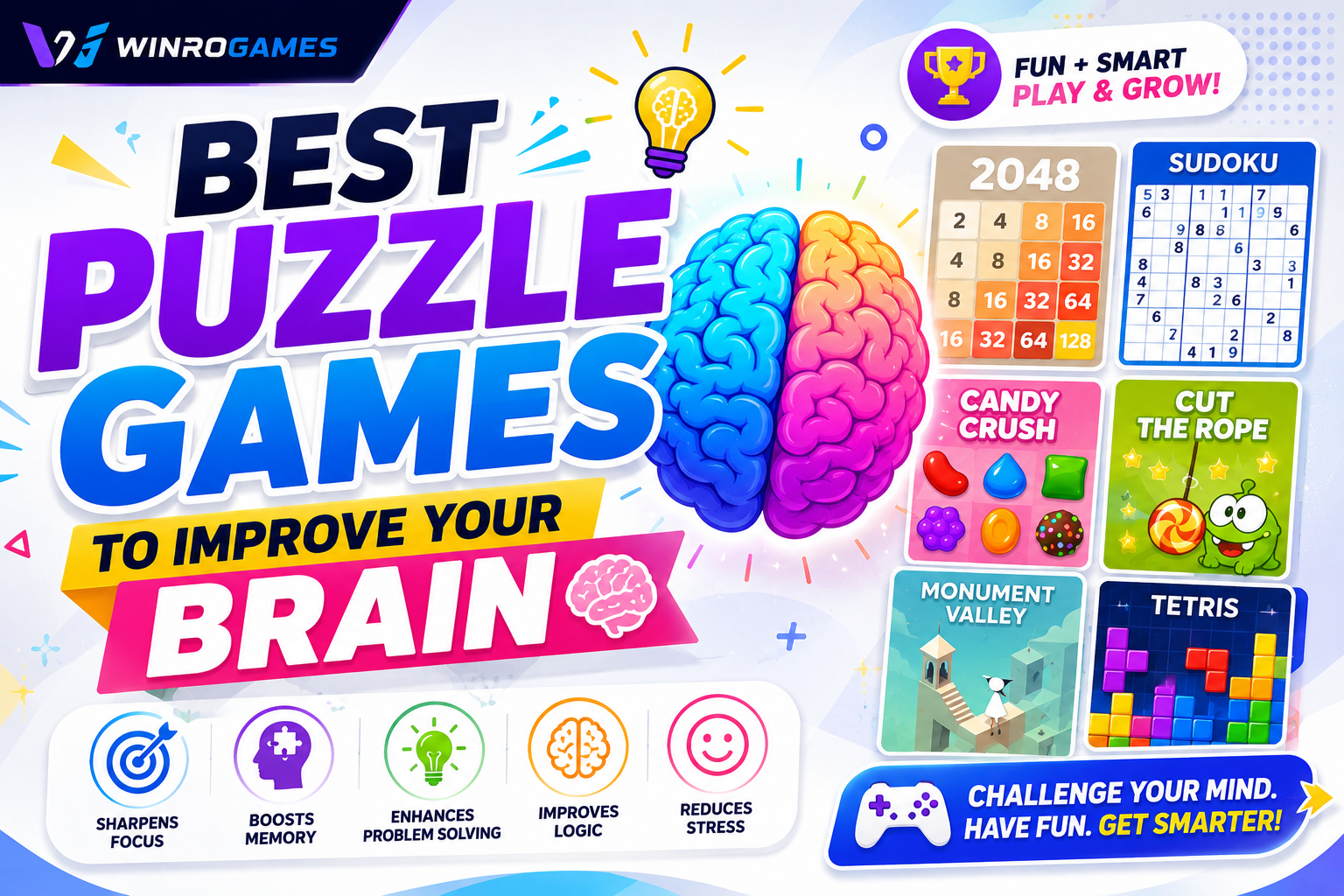
Let's address the elephant in the room. You've probably seen those "brain training" apps with flashy ads promising to raise your IQ by 20 points if you play for 10 minutes a day. Most of that is marketing nonsense. The science on brain training is nuanced — you won't suddenly become a genius by matching colored tiles, and no game will prevent cognitive decline on its own. But here's what the research does show: certain types of puzzle games consistently improve specific cognitive skills like working memory, spatial reasoning, problem-solving speed, and pattern recognition. The key is playing the right kinds of games consistently, not just any game with "brain" in the title.
I've spent way too many hours digging through cognitive science papers and testing puzzle games to separate the genuinely beneficial from the snake oil. This list covers games that neuroscientists and psychologists have actually studied, alongside modern titles that exercise the same mental muscles. They're organized by the cognitive skill they target most heavily, so you can build a balanced mental workout — or just jump to the section that matches what you want to improve.
The best part? These are legitimately fun. You won't have to force yourself to play them. That's the secret most brain-training apps miss: the cognitive benefits only compound when you actually want to keep playing. Let's find your next mental workout.
How Puzzle Games Actually Change Your Brain
Before we dive into the list, let's understand what's happening under the hood. When you solve puzzles, your brain isn't just passing time — it's physically strengthening neural pathways through a process called neuroplasticity. Think of it like building muscle. Each time you tackle a novel problem, your brain forms new connections between neurons. Repeated engagement makes those connections stronger and faster. Over time, skills like pattern recognition become more automatic, freeing up mental bandwidth for harder challenges.
A 2023 study published in Frontiers in Human Neuroscience found that adults who played logic puzzle games for 30 minutes daily over eight weeks showed measurable improvements in working memory and processing speed compared to control groups. Another long-term study from the University of Edinburgh tracked participants who regularly played puzzle games and found they had brain scans resembling people nearly a decade younger in terms of cognitive decline markers. The keyword is "regularly" — occasional puzzle-solving is nice, but consistent engagement drives lasting change.
Different puzzle types target different cognitive domains. Crossword puzzles strengthen verbal fluency and semantic memory. Spatial puzzles like Tetris improve mental rotation abilities. Logic puzzles sharpen deductive reasoning. A balanced diet of puzzle types yields the broadest cognitive benefits. That's exactly how I've structured this guide.
Logic & Deduction Puzzles: Train Your Inner Detective
Logic puzzles force you to hold multiple pieces of information in your head simultaneously and draw conclusions from incomplete data. They're the heavy compound lifts of the puzzle world — difficult, sometimes frustrating, and incredibly effective at building reasoning skills.
1. The Witness
Available on PC, consoles, and mobile, The Witness is a masterclass in teaching without words. You explore a beautiful open-world island filled with grid-based puzzles that start deceptively simple and evolve into mind-bending complexity. Each area introduces a new rule set — symbols that must be separated, colors that follow specific patterns, sounds that provide clues — and you have to figure out the rules through pure observation and experimentation. There are no tutorials, no text explanations, no hand-holding. Your brain must construct the logic framework from scratch, which is exactly what makes it such powerful cognitive training. Players report that after extended sessions, they start seeing grid patterns in real-world environments — a phenomenon called the Tetris Effect, which indicates deep neural encoding.
Cognitive benefit: Inductive reasoning, pattern recognition, non-verbal problem-solving.
2. Baba Is You
Imagine a puzzle game where the rules themselves are objects you can push around and rearrange. A block might say "Baba Is You." Another says "Wall Is Stop." You can push the words to create "Wall Is You" and suddenly you are the wall. Baba Is You breaks every assumption you have about how games work and forces you to think in pure logic chains. It's the closest thing to formal symbolic logic training wrapped in a charming pixel-art package. Some levels have stumped me for literal days — then the solution hits at 2 AM while I'm trying to sleep. That's your brain working offline, consolidating the problem in the background.
Cognitive benefit: Logical reasoning, creative problem-solving, cognitive flexibility.
3. Sudoku (The Classic That Still Works)
I know, I know. Sudoku feels like something your grandparents play. But there's a reason this number-placement puzzle has survived for decades: it works. No luck, no guesswork — pure deductive logic from start to finish. Each cell you fill eliminates possibilities elsewhere on the grid, creating cascading chains of logical conclusions. Modern apps like Good Sudoku by Zach Gage add quality-of-life features like auto-note mode and hint systems that actually teach you advanced techniques (X-wing, swordfish, Y-wing) instead of just giving you answers. Start with easy puzzles and work toward expert-level grids where you're tracking dozens of interdependent constraints simultaneously. That's working memory getting a serious workout.
Cognitive benefit: Working memory, deductive reasoning, sustained attention.
4. The Case of the Golden Idol
Set in a grotesque 18th-century world of aristocrats and occultists, this game presents frozen crime scenes where someone has died under mysterious circumstances. You click around the scene to collect words — names, objects, verbs — and then fill in the blanks of a Mad Libs-style deduction panel to reconstruct exactly what happened. Each scene is a logic puzzle where you must eliminate impossibilities and arrive at the only explanation that fits all the evidence. It scratches the same itch as solving a murder mystery but in bite-sized 30-minute chunks. The art style is unsettling in the best way, and the "aha" moment when the solution clicks is pure dopamine.
Cognitive benefit: Deductive reasoning, evidence synthesis, narrative comprehension.
Spatial Reasoning & Visual Puzzles: Think in 3D
Spatial reasoning — the ability to mentally manipulate objects and understand spatial relationships — is one of the most trainable cognitive skills. These games put that skill front and center.
5. Tetris / Tetris Effect
If there's one puzzle game with rock-solid scientific backing, it's Tetris. Research from Oxford University found that playing Tetris after a traumatic event reduced the frequency of intrusive flashbacks. Other studies show it increases gray matter density in brain regions associated with spatial reasoning and motor coordination. Tetris Effect elevates the classic formula with stunning visuals, reactive music, and a flow-state-inducing presentation that makes 45 minutes feel like 10. The core mechanic — fitting falling blocks into complete lines against increasing speed — trains rapid spatial rotation and decision-making under pressure. You're literally rewiring your visual cortex every time you play.
Cognitive benefit: Spatial reasoning, mental rotation, processing speed.
6. Monument Valley & Monument Valley 2
Inspired by M.C. Escher's impossible architecture, Monument Valley sends you through optical illusion landscapes where you rotate and manipulate structures to create paths. Staircases connect in geometrically impossible ways. Platforms shift perspective when you spin the camera. It's meditative and gorgeous, with a soundtrack that calms your nervous system while your brain works through spatial puzzles. The difficulty curve is gentle enough for anyone to enjoy, but the spatial reasoning required is genuine. You're constantly asking: "If I rotate this, what connects? If this character walks here, where will they end up?"
Cognitive benefit: Spatial visualization, perspective-taking, mental rotation.
7. Portal & Portal 2
Valve's masterpiece needs little introduction, but people forget it's fundamentally a spatial reasoning puzzle series disguised as a first-person shooter. The portal gun lets you create linked openings on surfaces — walk through one, emerge from the other, momentum preserved. The puzzles require you to think in trajectories, momentum vectors, and spatial relationships that defy everyday physics. "Thinking with portals" rewires how you perceive 3D space. I've caught myself mentally placing portals on office walls to reach distant hallways. That's the game literally changing how your brain processes spatial information. Plus, GLaDOS is one of the funniest video game characters ever written.
Cognitive benefit: Spatial reasoning, physics intuition, creative problem-solving.
8. Gorogoa
A hand-drawn puzzle game where you manipulate illustrated panels on a four-panel grid. Images can be zoomed, panned, stacked, and combined to create new scenes. A bowl in one panel becomes a window in another. A doorway connects to a completely different illustration. Gorogoa plays like a fever dream of spatial connections, and there's genuinely nothing else like it. It's also short — you can finish it in a couple of hours — which makes it a perfect concentrated dose of spatial reasoning training. The art is breathtaking, every frame worthy of hanging on a wall.
Cognitive benefit: Spatial association, creative visualization, non-linear thinking.
Word & Language Puzzles: Verbal Fluency Workouts
Verbal fluency — the ability to retrieve words from memory quickly — declines with age if not actively maintained. These word games keep your language centers firing on all cylinders.
9. Wordle & Its Endless Variants
Wordle conquered the world for a reason. Six guesses to find a five-letter word, with color-coded feedback on each attempt. The genius is in the constraint — you must balance exploring new letters against confirming what you already know, all within six tries. It's a daily five-minute workout for your verbal working memory and strategic elimination skills. Once the daily puzzle is done, Wordle Unlimited lets you keep playing, and variants like Quordle (four words simultaneously) and Waffle (rearrange scrambled letters) offer different verbal challenges. The social sharing aspect — comparing results with friends without spoiling the answer — makes it sticky in a way solo puzzles rarely achieve.
Cognitive benefit: Verbal working memory, strategic elimination, vocabulary recall.
10. NYT Crossword (Especially the Mini)
The New York Times Crossword is the gold standard of word puzzles. The full daily crossword ranges from approachable (Monday) to devastating (Saturday), with Sunday being a larger mid-week difficulty puzzle. If you're new to crosswords, start with The Mini — a 5×5 grid that takes 1–3 minutes and gives you a quick verbal victory. Crossword solving engages multiple cognitive systems simultaneously: semantic memory (retrieving facts and vocabulary), pattern completion (filling in partial words), and lateral thinking (parsing clever clue wordplay). Research published in the Journal of the International Neuropsychological Society found that regular crossword solvers showed cognitive function equivalent to people ten years younger on certain measures.
Cognitive benefit: Semantic memory, verbal fluency, lateral thinking.
11. SpellTower
Imagine word search crossed with Tetris. Letters stack up from the bottom of the screen, and you trace words through adjacent tiles to clear them. Longer words clear more tiles and earn higher scores. The tower grows relentlessly, and if it reaches the top, the game ends. SpellTower forces rapid word retrieval under time pressure, which is excellent for building verbal fluency. Unlike turn-based word games, this one makes your brain sprint. There's something uniquely satisfying about spotting "QUARTZ" buried in a mess of tiles and watching the tower collapse.
Cognitive benefit: Rapid word retrieval, anagram skills, vocabulary breadth.
12. Typeshift
Another Zach Gage creation (the man knows word puzzles), Typeshift presents columns of letters that slide vertically. Your job is to shift the columns to spell words in the center row, using each letter exactly once. It starts easy and gradually introduces longer columns, more letters, and the constraint of using every single letter on the board. It's Scrabble meets a Rubik's Cube. The spatial element — physically sliding letters into alignment — activates different brain regions than pure typing-based word games, giving you a more well-rounded verbal-spatial workout.
Cognitive benefit: Anagram solving, spatial-verbal integration, planning ahead.
Math & Number Puzzles: Quantitative Reasoning Unlocked
Math anxiety is real, and many people avoid number puzzles because school made them feel stupid. These games rebuild quantitative confidence through playful, low-stakes engagement with numbers.
13. Threes! (The Original, Not the Clone)
Before 2048 took over the world, there was Threes! — the game 2048 shamelessly cloned. You slide numbered tiles on a grid to combine 1s and 2s into 3s, then 3s into 6s, 6s into 12s, and so on. Each tile has a charming little personality and makes adorable sounds when combined. The strategy is deeper than 2048 because tiles don't combine identically — you need specific pairings, which makes planning several moves ahead essential. It's pure mental math wrapped in the most delightful presentation. I've had this on my phone for eight years and still play weekly. The game never gets old because the puzzle is always fresh.
Cognitive benefit: Mental arithmetic, sequential planning, spatial strategy.
14. Human Resource Machine
This is a puzzle game that teaches you to think like a programmer without writing a single line of actual code. You control an office worker who performs tasks by following visual commands — add two numbers, sort a list, compare values. Each level asks you to build a sequence of instructions that solves the puzzle, with bonus challenges for optimizing instruction count and runtime. It's algorithmic thinking in disguise. By the end, you've accidentally learned assembly language concepts like registers, loops, and conditional branching. The mental shift from "solving one problem" to "building a system that solves all instances of this problem" is genuine cognitive growth.
Cognitive benefit: Algorithmic thinking, step-by-step logic, optimization skills.
15. Calculator: The Game
You're given a starting number, a target number, and a limited set of calculator buttons (add 5, multiply by 3, reverse digits, insert a 0, etc.). Your goal: reach the target in the minimum number of operations. It sounds simple until Level 20, when you're juggling operations like "Sum of Digits," "Mirror," and "Raise to Power" to transform 42 into 107 in four moves. Calculator: The Game builds number sense — that intuitive understanding of how numbers relate to each other — better than any educational software I've encountered. It's genuinely fun, too, with a sense of humor and delightful "aha" moments.
Cognitive benefit: Number sense, operation sequencing, mental flexibility.
Strategy & Planning Puzzles: Think Five Moves Ahead
These games train executive function — planning, resource management, and the ability to hold multiple future scenarios in your head simultaneously.
16. Into the Breach
From the creators of FTL, Into the Breach is turn-based strategy distilled to its purest form. Giant monsters attack cities on an 8×8 grid. You control three mechs with unique abilities. Each turn, you see exactly what the monsters will do next — where they'll attack, how much damage they'll deal — and your job is to perfectly counter their moves. It's chess with mechs, and every turn is a puzzle with a perfect solution if you're clever enough to find it. The brilliance is in the perfect information: there's no RNG hiding behind the curtain. When you lose, it's because you missed something. When you win, it's because you outthought the game entirely.
Cognitive benefit: Predictive planning, resource allocation, consequences analysis.
17. Mini Metro
Design a subway system for a growing city. Stations appear randomly. You draw lines between them, assign trains, and try to keep passengers from overcrowding stations as the city expands. It's minimalist, elegant, and strangely hypnotic — the clean geometric maps pulse with little moving shapes representing passengers. Mini Metro forces constant re-evaluation of your network under growing demand. Do you add a new line or extend an existing one? Do you connect two busy stations directly or make passengers transfer? These are real urban planning problems boiled down to their strategic essence. The game's daily challenges add endless replayability.
Cognitive benefit: Systems thinking, adaptive planning, efficiency optimization.
18. Slay the Spire
A roguelike deckbuilder where each run presents a unique path of battles, events, and upgrades. You build your card deck as you climb the Spire, combining cards that interact in powerful ways. The puzzle is in the deck composition: do you take this card that's strong now but might dilute your combo later? Do you fight an elite enemy for a relic reward or play it safe? Slay the Spire trains probabilistic thinking — you're constantly estimating the odds of drawing the cards you need, weighing risk versus reward, and adapting your strategy as your deck evolves. It's the most addictive game on this list by a wide margin. Thousands of hours have been lost to the Spire. No regrets.
Cognitive benefit: Probabilistic reasoning, risk assessment, adaptive strategy.
Memory & Attention Puzzles: Sharpen Your Focus
In an era of constant distractions, these games rebuild your capacity for sustained attention and working memory retention.
19. Brain It On! Physics Puzzles
Each level presents a physics challenge — knock this ball into a cup, balance this shape, drop the right object — and you draw the solution directly on the screen. Draw a ramp, a lever, a weight, or a Rube Goldberg contraption. The game judges your solution against the physics simulation. Brain It On! exercises cause-and-effect reasoning in a tangible, visual way. You're predicting physical outcomes and refining your mental model each time your drawing fails. It's like being back in a sandbox building marble runs, but with hundreds of increasingly tricky puzzles that force you to think about gravity, momentum, and leverage.
Cognitive benefit: Cause-and-effect reasoning, physics intuition, iterative problem-solving.
20. Two Dots
A deceptively simple connect-the-dots game with over 5,000 levels. Connect same-colored dots to make them disappear, complete objectives within a limited number of moves, and navigate obstacles like anchors, fire, and monsters. What makes Two Dots cognitively valuable is the forward planning required — you're constantly scanning the board, anticipating cascading matches, and planning three or four moves ahead to set up squares (which clear an entire color). It's gentle enough to play while listening to a podcast but engaging enough to strengthen visual scanning and sequential planning. The minimalist art style and soothing sound design make it a calming daily ritual.
Cognitive benefit: Visual scanning, sequential planning, pattern recognition.
How to Build a Brain Training Routine That Actually Sticks
Having great puzzle games is half the equation. The other half is playing them consistently enough to see cognitive benefits. Here's how to build a sustainable habit without it feeling like homework.
The 15-Minute Daily Mix
Instead of marathon puzzle sessions on weekends, aim for 15–30 minutes daily. Rotate through different puzzle types across the week — logic on Monday, spatial on Tuesday, word games on Wednesday, and so on. This cross-training approach prevents boredom and exercises different cognitive domains. Keep a puzzle app on your phone's home screen. Those random 5-minute gaps — waiting for coffee, sitting in a parked car before an appointment — are perfect micro-sessions that add up.
Track Your Progress (But Don't Obsess)
Many of these games track completion times and scores. Watching your average Sudoku time drop from 15 minutes to 7 over several months is tangible evidence of cognitive improvement. But don't let numbers become the point. The goal is the mental process, not the leaderboard position. If you're stressed about beating yesterday's score, you're undermining the cognitive benefits.
Pair Puzzles With Other Healthy Habits
Puzzle games work best as part of a broader brain-healthy lifestyle. Physical exercise increases BDNF (brain-derived neurotrophic factor), which supports neuroplasticity. Quality sleep consolidates the learning from your puzzle sessions. Social interaction — discussing puzzles with friends, comparing Wordle results — adds an emotional engagement layer that strengthens memory encoding. Don't let puzzle games replace exercise, sleep, or social time. Let them complement those pillars.
Embrace the Struggle
The cognitive benefits of puzzles come from the struggle, not the solution. When you're stuck on a Baba Is You level for 45 minutes, your brain is working harder than when you breeze through an easy puzzle in three minutes. Frustration is a signal of growth. If you never feel challenged, increase the difficulty. If you're consistently frustrated to the point of quitting, dial it back. The sweet spot is right at the edge of your abilities — what psychologists call the "zone of proximal development."
What About "Brain Training" Apps Like Lumosity?
Let's address this directly. Commercial brain training apps have a mixed scientific record. In 2016, the Federal Trade Commission fined Lumosity $2 million for deceptive advertising about cognitive benefits. A large-scale study published in Nature found that while these apps make you better at the specific games they contain, the improvements don't reliably transfer to real-world cognitive tasks.
The games in this guide are different because they exercise cognitive skills in richer, more varied contexts. Solving a Witness puzzle involves spatial reasoning, pattern recognition, and inductive logic simultaneously — more like real-world problem-solving than matching colored shapes. The complexity and variety matter. Play widely across different puzzle types rather than grinding one "brain training" app.
The Puzzle Games I Keep Coming Back To
If I had to pick a personal Mount Rushmore from this list — the games that have stayed on my devices for years and genuinely feel like mental hygiene — it would be: Tetris Effect for pure spatial flow, Baba Is You for when I want to feel my brain stretching uncomfortably, Wordle for the daily five-minute ritual, and Slay the Spire for when I have an hour to lose and want to think deeply about probability trees. That rotation covers spatial, logical, verbal, and strategic thinking. Your perfect rotation might look different based on which cognitive areas you want to strengthen.
Start With One Game Today
Choice paralysis is real when you're looking at a list of 20 excellent games. So here's the simplest possible advice: pick one game from this list that's available on a device you already own. Download it right now. Play it for ten minutes. That's it. Don't overthink the "optimal brain training protocol." The best puzzle game for your brain is the one you'll actually play tomorrow, and the day after that, and the day after that.
Cognitive decline isn't a switch that flips at a certain age. It's a gradual process that we can influence through daily habits. Puzzle games are one of those rare activities that are genuinely enjoyable and genuinely good for you. Not many things in life fall into that intersection. Enjoy it.
Now, if you'll excuse me, I have a Baba Is You level that's been mocking me for three days. I think I've finally figured out the solution. Or maybe I haven't. Either way, my brain will be slightly stronger for trying.
Which puzzle game has had the biggest impact on your thinking? Or which one from this list are you going to try first? Drop a comment — I'm always looking for new recommendations from fellow puzzle addicts.