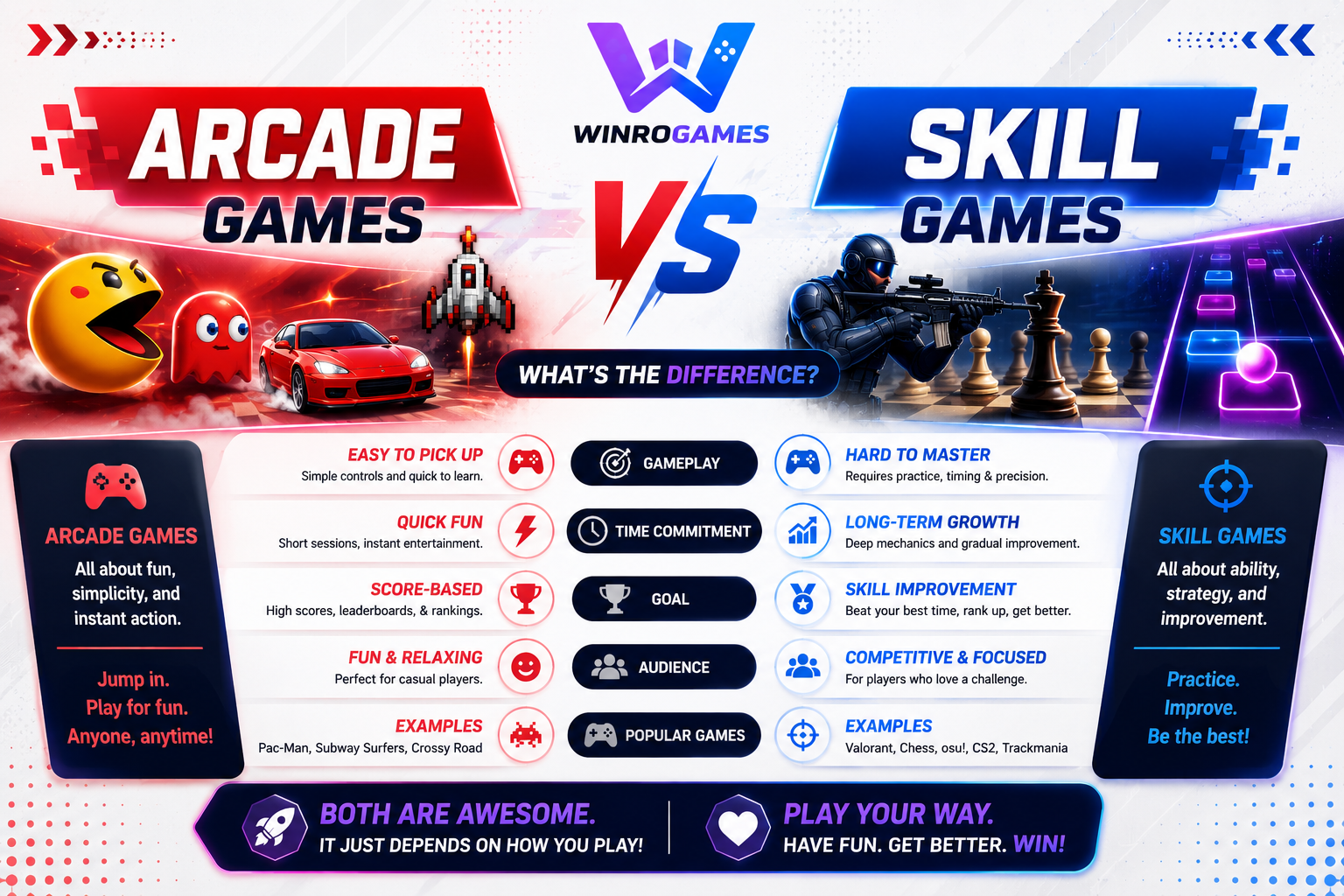
Let me describe two gaming experiences, and you tell me which one sounds more familiar. Experience one: you grab a joystick, the music is loud, the colors are bright, and within five seconds you're dodging asteroids, collecting coins, and chasing a high score that resets the moment you die. No tutorial. No story. Just pure, unfiltered gameplay. Experience two: you spend hours learning movement mechanics, studying frame data, practicing combos in training mode, and slowly climbing a ranked ladder where every victory feels earned through deliberate improvement.
If the first sounds like classic arcade gaming and the second sounds like modern skill-based competition, you're already intuiting the divide. But here's the thing — the line between arcade games and skill games isn't just about difficulty or era. It's a fundamental design philosophy that shapes how games engage your brain, what they reward, and why certain titles keep you playing for decades while others lose their shine after a week.
Gamers throw around these terms constantly, often using them interchangeably when they shouldn't be. "That game's too arcadey" or "I only play skill games" are phrases that reveal assumptions worth examining. Because the truth is more nuanced — and understanding the difference will completely change how you choose your next game. Let's break it down properly.
First, Let's Define Both Terms Clearly
Before we can compare, we need definitions that actually hold up. These aren't dictionary entries — they're practical frameworks based on decades of game design evolution.
What Is an Arcade Game?
Arcade games trace their DNA back to the coin-operated cabinets of the 1970s and 1980s — Pac-Man, Space Invaders, Donkey Kong, Galaga. The business model shaped the design: games needed to be immediately understandable (so anyone could walk up and play), difficult enough to end quickly (so the next person could insert a quarter), and addictive enough to keep players coming back for "one more try."
Modern arcade games have evolved far beyond cabinets, but they retain those core design principles. Arcade games prioritize instant accessibility, simple control schemes, escalating difficulty, score-based progression, and short gameplay loops measured in minutes rather than hours. They're designed to be fun in the first five seconds, not the fifth hour. The enjoyment comes from the raw moment-to-moment experience — the satisfying sound of collecting a coin, the rush of clearing a wave, the frustration and immediate determination when you die at 9,850 points when your high score is 9,900.
Key characteristics of arcade games include: minimal tutorials (the game teaches through play), limited move sets (often 1-3 core actions), infinite or very long skill ceilings without defined endpoints, score attack mentalities, and rapid restart loops where death to retry takes under two seconds.
What Is a Skill Game?
Skill games are a broader and somewhat newer category — though their roots go just as deep. A skill game is any game where player improvement, rather than character progression or luck, is the primary determinant of success. Your victory depends on how well you execute, not on what level your character is or what gear you've equipped. The game provides a consistent mechanical framework, and your mastery of that framework determines outcomes.
This definition spans multiple genres. Fighting games are skill games (your ability to execute combos and read opponents). Rhythm games are skill games (your timing and pattern recognition). Competitive shooters are skill games (your aim, movement, and game sense). Even some puzzle games qualify when they emphasize optimization and speed over relaxed problem-solving.
Key characteristics of skill games include: deep mechanical systems that reward practice, clear feedback on performance (accuracy percentages, rank systems, frame data), deliberate practice as the primary progression path, competitive ecosystems (ranked modes, tournaments, leaderboards), and high skill ceilings that take hundreds or thousands of hours to approach.
The Core Differences: 7 Ways These Genres Diverge
Now that we have working definitions, let's map the specific differences that matter when you're choosing what to play.
1. Time to Fun vs. Time to Mastery
Arcade games front-load the fun. You pick up the controller, and within seconds — not minutes — you're experiencing the core gameplay loop. Space Invaders doesn't need a tutorial. You move, you shoot, you understand. The joy is immediate. Mastery, however, is gradual and often never fully achieved. The game gets harder, the patterns get faster, and you keep chasing that high score that always feels just barely out of reach.
Skill games invert this relationship. The first hour of a fighting game, a competitive shooter, or a rhythm game at high difficulty can be genuinely unfun. You're bad. You know you're bad. The game reminds you constantly that you're bad. But as you invest time — learning combos, building muscle memory, studying matchups — the satisfaction curve climbs. At 100 hours, you're having experiences that were literally impossible at hour one. Skill games ask for patience and repay it with depth.
This is why arcade games are better for short sessions and casual play, while skill games reward long-term commitment. Neither approach is superior — they serve different needs.
2. The Role of Randomness
Arcade games embrace controlled randomness. Enemy patterns in Galaga have random elements. Power-up spawns in Pac-Man follow patterns but fruit bonuses appear semi-randomly. This randomness keeps each run feeling fresh and prevents perfect memorization from trivializing the game. It also means that sometimes you lose to bad luck — and arcade players accept this as part of the experience.
Skill games tend to minimize or eliminate randomness. A fighting game match between two players has zero RNG (random number generation) in most modern titles — every hit, every block, every combo is deterministic. Competitive shooters minimize random bullet spread in favor of learnable recoil patterns. Even skill-based roguelikes like Slay the Spire give you enough information to make informed decisions despite procedural generation. In skill games, randomness is a spice, not the main course. Players want to know that their loss was their fault, because that means improvement is possible.
3. Progression Systems
Arcade games use external progression sparingly, if at all. Your progression is your high score. Maybe there's a leaderboard. Maybe there's a "New Record!" flash when you surpass your previous best. But the game doesn't give you experience points, unlockable abilities, or permanent upgrades that make subsequent runs easier. Each session starts from the same baseline. Your only advantage is that you, the player, have improved.
Skill games exist on a spectrum here. Pure skill games (like Chess or Street Fighter) offer no mechanical progression whatsoever — identical pieces, identical characters, every match. Hybrid skill games (like competitive shooters with unlockable weapons or MOBAs with character rosters) add progression systems that expand options without directly increasing power. The key distinction: in a true skill game, a veteran player on a fresh account will still dominate newcomers because the skill is in the player, not the profile.
4. Session Length and Commitment
Arcade games are designed for short, intense sessions. A game of Tetris can last anywhere from 30 seconds to 15 minutes depending on skill. Downwell runs rarely exceed 20 minutes. Super Hexagon sessions can be measured in seconds. You can play an arcade game during a coffee break and feel satisfied. The game respects your time by being dense — packing maximum engagement into minimum minutes.
Skill games often demand longer sessions to enter the performance zone. A fighting game player needs warm-up time — 15-30 minutes of practice before their execution is competition-ready. A competitive shooter player needs several matches to dial in their aim for the day. A MOBA match is a 30-45 minute commitment you can't pause or walk away from. Skill games ask for scheduling. Arcade games ask for a spare moment.
5. The Death and Restart Loop
Arcade games have perfected the restart. When you die in Celeste, you're back at the beginning of the screen in under a second. Geometry Dash restarts the level instantly. Super Meat Boy (arcade-inspired platformer) respawns you before the death animation finishes. This frictionless restart loop is essential to arcade design — it transforms death from a punishment into a learning tool. Dying doesn't feel bad because you're already trying again before the frustration can settle.
Skill games can't always offer this. A death in a battle royale means 5-10 minutes of queueing and dropping before you're back in combat. A loss in a fighting game means watching the victory animation, returning to character select, loading the next match. The friction between attempts is higher, which makes each death more consequential — and can make learning more frustrating. This is why skill games develop dedicated training modes, to provide arcade-style rapid repetition within a skill-game framework.
6. Spectacle vs. Systems
Arcade games love spectacle. Bright colors, screen shake, particle effects, dramatic sound design, score multipliers that flash across the screen. The sensory experience is part of the reward. Pac-Man Championship Edition turns eating ghosts into a neon light show. Bayonetta (arcade-inspired action) rewards combo execution with increasingly absurd visual payoff. Arcade games want you to feel awesome even when you're just pressing buttons.
Skill games tend toward visual clarity over spectacle. Competitive shooters strip away visual noise so players can identify threats instantly. Fighting games use clean, readable animations so you can react to startup frames. The information density matters more than the visual drama. A skill game player turns down graphics settings not for performance but for competitive advantage — fewer particles, less screen shake, clearer sightlines. The reward is the win, not the fireworks.
7. The Social Dimension
Arcade games are often social in a "shoulder-to-shoulder" way. You gather around a cabinet, pass the controller, compare high scores, and trash-talk in person. The social experience is physical and immediate. Even online, arcade games foster community through shared leaderboard competition — everyone chasing the same score, watching replays of the top run, swapping strategies in forums.
Skill games are social in a "face-to-face" competitive way. The primary social unit is the match — two or more players testing their abilities directly. Communities form around competition: ranked ladders, tournaments, coaching, matchup discussions. The social bonds are forged through shared struggle against each other rather than shared struggle against the game. Both are valid. Both create lasting communities. They just create different kinds.
The Overlap Zone: Games That Are Both
Here's where this discussion gets interesting. The best games often refuse to stay in one category. They borrow from both traditions to create experiences that are immediately fun AND deeply rewarding to master. This hybrid zone is where some of the most beloved games of the last decade live.
Celeste — Arcade Accessibility, Skill-Game Depth
Celeste looks like an arcade platformer. Simple controls (jump, dash, climb), instant respawns, screen-based challenges that take seconds to complete. You can pick it up and have fun in the first 30 seconds. But the skill ceiling is astronomical. The B-side and C-side levels demand frame-perfect execution of advanced techniques like wavedashing, wall bouncing, and momentum conservation. The speedrunning community has pushed the game to limits the developers didn't anticipate. It's arcade and skill simultaneously — accessible to everyone, masterable by the dedicated few.
Rocket League — Arcade Premise, Competitive Execution
Rocket-powered cars playing soccer. That's the arcade pitch — silly, immediate, anyone can understand it in five seconds. But the mechanical depth is staggering. Aerial control, flip resets, ceiling shots, dribbling, rotation strategy — the skill ceiling keeps rising years after release. A new player and a Grand Champion are effectively playing different games. Rocket League welcomes casual players with arcade charm while sustaining a professional esports scene built entirely on skill.
Hades — Arcade Loop, Skill Progression
Supergiant's masterpiece builds on arcade roguelike foundations. Each run is a self-contained 20-40 minute experience with randomized rooms and escalating difficulty. You can pick it up, play a run, and walk away satisfied. But the weapon aspects, heat system, and skill-based combat reward hundreds of hours of deliberate practice. Speedrunners clear the game in under six minutes using techniques that require pixel-perfect positioning and frame-perfect dash timing. It's an arcade game you can sink 500 hours into without the arcade game ever feeling repetitive.
Beat Saber — Pure Hybrid
Walk up, grab the sabers, slash blocks to music. Immediate arcade joy. But Expert+ maps require reaction times under 100 milliseconds, full-body coordination, and pattern recognition that only develops after dozens of hours. The ranking system, modding community, and competitive scene are pure skill-game infrastructure. Beat Saber might be the perfect hybrid — arcade enough for parties, skill-based enough for daily practice sessions.
How to Tell Which Type You Prefer
Still not sure where you land? Answer these five questions honestly, and your preference will reveal itself.
- When you have 15 minutes free, do you want something fun immediately, or are you willing to spend that time warming up for a longer session later? If the former, you lean arcade. If the latter, you lean skill.
- Does losing because of bad RNG frustrate you more than losing because of your own mistakes? If RNG frustrates you more, you probably prefer skill games where outcomes are deterministic. If you can shrug off bad luck, arcade games with randomness won't bother you.
- Do you enjoy the process of deliberate practice — labbing combos, drilling aim trainers, studying frame data? If that sounds like fun, skill games are your home. If it sounds like homework, arcade games will respect your time better.
- Do you need progression systems to stay engaged, or is a high score enough? If you need unlocks and level-ups, look for hybrid games that blend arcade gameplay with skill progression. If the number going up is all the reward you need, pure arcade games deliver.
- Are you playing to relax or playing to improve? Arcade games excel at the former. Skill games excel at the latter. Most people need both at different times — hence the value of a diverse gaming diet.
Why the Distinction Matters for Game Discovery
Understanding this spectrum transforms how you find new games. When a game is described as "arcadey," that's not necessarily a criticism — it's a signal about design priorities. When a reviewer says a game has a "high skill ceiling," they're telling you about the commitment required to access the deepest experiences.
I've watched friends bounce off games they should have loved because they didn't understand what they were signing up for. A player who loves arcade experiences picks up a competitive fighting game, loses 20 matches in a row during their first online session, and concludes they're "bad at games." They're not. They just played a skill game expecting an arcade experience. The game wasn't designed to be fun in the first five minutes — it was designed to be rewarding after 50 hours. That's not a flaw. It's a different promise.
Conversely, a skill-game enthusiast might dismiss an arcade masterpiece as "shallow" because they're looking for mechanical depth in the wrong place. The depth in Tetris isn't in a combo list — it's in spatial reasoning, stacking efficiency, and the ability to maintain composure as speed increases. Different kinds of depth for different kinds of players.
The Historical Context: How We Got Here
This distinction didn't always exist. In the 1980s, almost all video games were arcade games by necessity — the hardware couldn't support deep simulation, and the business model demanded quarter-feeding loops. Home consoles began shifting the paradigm. Without the pressure of coin drops, games could be longer, more complex, and less immediately punishing. RPGs introduced character progression as an alternative to player progression. Simulation games prioritized realism over accessibility.
The skill game category as we know it today really crystallized with the rise of competitive gaming in the late 1990s and 2000s. StarCraft, Counter-Strike, and Street Fighter III: 3rd Strike built communities around mastery. Streaming and esports accelerated the trend — suddenly, watching someone who had practiced for 10,000 hours was a spectator sport. The skill game became aspirational. You weren't just playing; you were training.
But arcade games never went away. They evolved. Mobile gaming brought arcade design principles to billions of new players. Indie developers resurrected arcade sensibilities with modern polish. The resurgence of roguelikes merged arcade permadeath with skill-based progression systems. Today, we live in a golden age where both traditions are thriving, often within the same game.
Table: Arcade vs Skill Games at a Glance
| Aspect | Arcade Games | Skill Games |
|---|---|---|
| Time to fun | Seconds | Minutes to hours |
| Session length | 1–20 minutes | 20 minutes to several hours |
| Restart speed | Instant | Varies, often slower |
| Progression type | High score, personal best | Rank, MMR, tournament results |
| Role of RNG | Present, adds variety | Minimized, competitive integrity |
| Learning curve | Gentle start, steep later | Often steep from the beginning |
| Visual design | Spectacle and feedback | Clarity and information |
| Social experience | Shared space, leaderboards | Direct competition, teams |
| Examples | Tetris, Pac-Man, Downwell | CS2, Street Fighter, Osu! |
| Hybrid examples | Celeste, Hades, Rocket League | Beat Saber, Slay the Spire, Dead Cells |
The Bottom Line: You Need Both
Here's the conclusion I've reached after decades of gaming across this spectrum: a healthy gaming diet includes both arcade and skill games. They satisfy different needs at different times.
Arcade games are for Tuesday evening when you're exhausted from work and want to feel something immediately. They're for lunch breaks and bus rides and the 20 minutes before you need to leave for an appointment. They're for the days when you don't want to think about optimization — you just want to play. Arcade games remind you that gaming is supposed to be fun, not a second job.
Skill games are for Saturday morning when you're fresh, caffeinated, and ready to focus. They're for the satisfaction of seeing your rank tick upward after weeks of deliberate practice. They're for the electric feeling of a close match against an evenly-matched opponent where every decision matters. Skill games remind you that you're capable of growth, that persistence pays off, and that mastery is a journey worth taking.
The gamers who burn out are often the ones who play only one type. The skill-game grinder who treats every gaming session like training eventually forgets why they started playing in the first place. The arcade-only player who never commits to anything deeper misses the profound satisfaction of genuine mastery. The sweet spot is in the middle — respecting both traditions for what they offer.
So the next time you're choosing a game, ask yourself: am I in an arcade mood or a skill mood? What do I need from this session — immediate joy or long-term growth? The answer will guide you to the right game every time. And if you're lucky enough to find a hybrid that delivers both? Hold onto it. Those games are rare. Those games are special. Those games are why we keep playing.
Where do you fall on the arcade-to-skill spectrum? Are you chasing high scores or grinding ranked ladders? Drop your preference in the comments — and tell me which game perfectly hits both notes for you. I'm always looking for hybrids that nail the balance.